Towing a caravan isn’t really that difficult but it does require a great deal more care. Remember, that by the simple act of coupling up your caravan, your vehicle has become much heavier, wider, longer and taller. It will be harder to move and very much harder to stop, so don’t forget to allow extra time and space for all manoeuvres, including overtaking.
A caravan follows the path of the car’s wheels closely. But, as the track of the caravan is usually wider than that of the car, special care should be exercised in turning corners or pulling alongside kerbs, posts, etc, as they may be missed by the car but struck by the caravan. Always keep in mind the width of the caravan and don’t cut corners; also be aware of the caravan’s increased height when passing under trees or other overhangs.
Don’t wander or weave or you will set up a sway motion at speed.
Starting off
The extra weight of your caravan will be immediately noticeable on starting, accelerating or slowing down. Automatic transmissions will, for many vehicles and drivers, be the best option as they take much of the stress out of driving and can reduce wear and tear on the vehicle to some degree. However some people still prefer manual transmissions, even though they involve a bit more work.
For vehicles fitted with an automatic transmission, starting off simply involves selecting Drive and accelerating gently.
For vehicles fitted with a manual transmission, start the vehicle moving with as little clutch slip as possible, increasing speed gradually until the caravan’s momentum reduces the labouring of the engine. The change to a higher gear should be made when the engine shows no sign of strain.
If practical, organise all stops on level or down grades to facilitate easier starting off.
Should you be forced to stop and re-start on a steep hill, if it is safe to do so, ease the strain on the tow vehicle by allowing the outfit to run back a short distance with the steering over on one lock so that the car and caravan are at an angle to each other. This will relieve the tow vehicle of the full load when starting off. The first part of the forward motion of the tow vehicle will pull the caravan straight and, by the time its full weight is applied, the vehicle will be moving.
Which gear?
There is no hard and fast rule on which gear is appropriate to tow in, be it a manual or automatic transmission. You should consult your vehicle owner’s handbook for the manufacturer’s recommendation or discuss this with an authorised dealer. What gear is suitable for towing will be dependent on a number of factors including the vehicle’s engine capacity, its power and torque outputs, transmission design and gear ratios (both manual and auto), road conditions, and the trailer weight. For example, in the case of occasionally towing a small box trailer taking a load of rubbish to the tip, selecting drive or using fifth or possibly even sixth gear (if so equipped) in a manual as judged appropriate by a reasonable and sensible driver for road/speed/load conditions i.e. the engine isn’t labouring, is likely to be okay. The issue of correct gear selection becomes more critical though when towing a heavy load such as a large caravan, heavy trailer, large boat, horse floats etc, especially if this sort of towing is sustained or regular duty.
Towing speeds and Speed limits
The speed limit when towing is generally the posted speed limit, however in Western Australia the maximum speed for trailers over 750kg ATM is 100km/h. However some vehicle manufacturers impose reduced speed limits when towing. This may be across the board or it may be when the weight of the trailer exceeds a certain limit. Where such limits apply, this typically means that the vehicle is restricted to a maximum of approximately 80km/h.
Vehicle cruising speed will ultimately be governed by legal speed limits, road conditions, the power of the towing vehicle, the driver’s experience and any speed limits recommended by the vehicle manufacturer.
Lower speeds put less stress on the vehicle and save fuel. Be conscious, however, that slow moving vehicles can cause major traffic hold-ups and considerable frustration to other drivers. Check your mirrors frequently and, where possible pull over and allow traffic to pass.
It is also a good idea to keep in the left lane where possible so that faster traffic is not impeded.
Long vehicles
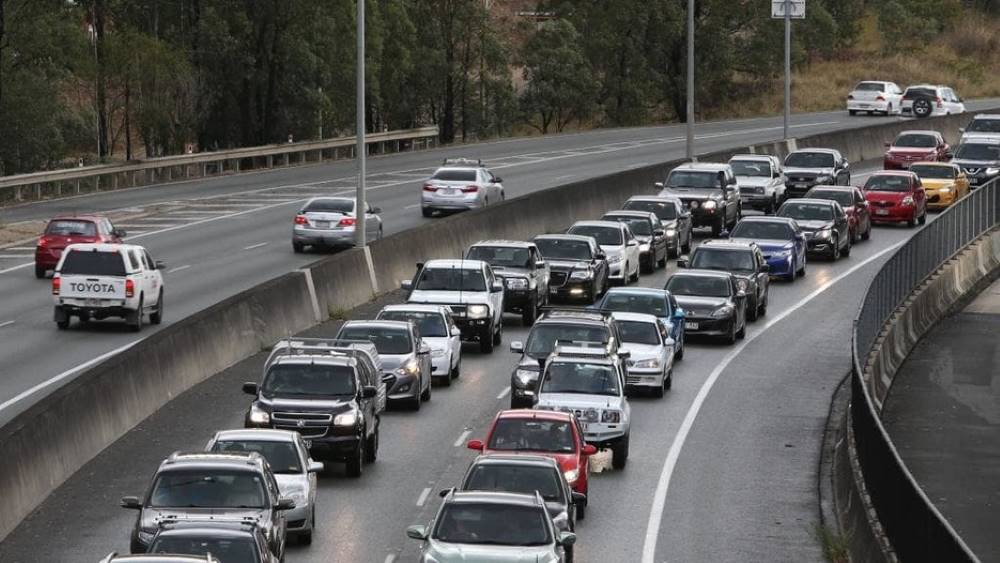
Queensland Traffic Regulations state that a “long vehicle”, outside a built-up area is required to maintain a minimum distance of 60 metres behind another “long vehicle” (a long vehicle is one that, together with its load and projections is 7.5 metres long or longer, and includes caravans and their tow vehicle). In a designated “road train area”, the minimum distance becomes 200 metres. Exceptions are where marked lanes provide for two lanes of traffic to move in the same direction, during overtaking and when travelling in a built up area.
Climbing and descending hills
When climbing hills great care should be taken to ensure that the engine does not overheat. While it is normal for the engine temperature to rise due to increased engine and automatic transmission load, it is possible that the engine may overheat to the point where damage can occur. It is therefore very important that a close watch is kept on the temperature gauge at all times and that any sudden or excessive rises in temperature be investigated.
Many vehicle manufacturers specify the fitment of an additional transmission cooler to reduce the heat loads imposed on the vehicle’s cooling system.
When descending a hill make use of the braking power of the engine rather than relying only on the brakes. A safe rule is to descend the hill in the gear needed to climb it. In the case of automatic transmissions manually select a lower gear to maximise engine braking.
Points to remember
- After travelling a few kilometres, pull up and walk around the caravan to see that all is in order. Look in the van to check that no doors or cupboards have swung open.
- Remember the height and width of the van.
- Give good signals.
- Take care when overtaking – remember your length is at least double and your acceleration much reduced.
- Avoid high speeds. Your cruising speed should reflect the conditions, your skill level, posted speed limits and any limitations stated by the towing vehicle’s manufacturer.
- Keep well to the left to enable faster vehicles to overtake. When travelling on narrow roads and when a road train or heavy vehicle approaches, pull well to the left and / or stop until it has passed.
- When being overtaken by large buses, trucks and semi-trailers, your van will tend to be pushed away and then pulled back towards these vehicles. Stay alert and keep control to avoid sway. Light acceleration will help pull the van straight.
- Keep engine revs up on hills. Steep hills are best climbed in the cool of the day.
- Rough or corrugated roads should be driven at low speed.
- If a “slide” is encountered on gravel, drive out of it gradually by judicious use of the accelerator and steering. Avoid heavy brake applications.
- Do not cross flooded causeways during or immediately after heavy rain storms as the current could cause the caravan to overturn.
- Punts and ferries should, if possible, be avoided at low tide because of the steeper approach and departure angles.
- Be especially conscious of wind conditions and drive accordingly.
- Watch for higher than normal engine temperatures and fuel use when driving into head winds. Travel at a slower pace than usual to help minimise the effects.
- The condition and adjustment of caravan wheel bearings should be checked before and regularly during trips.
- Make sure tyres are inflated to the manufacturer’s recommendations for the weight being carried. Check pressures regularly.
- Adjust the vertical height of the headlights if the front of the tow vehicle rises noticeably when the caravan is connected.
The information provided in this fact sheet is intended as a general guide only. You should carry out further research and investigations into the topics outlined above prior to implementing any actions or recommendations.