

Best things to do on Norfolk Island: Hidden beaches, convict history and local secrets
Wearing T-shirts and bucket hats, my fellow passengers on QF179 don’t look anything like bounty hunters.
But we are. And we’re armed.
Cameras and smart phones are charged, and everyone understands the brief – to seek and enjoy the treasures of this South Pacific isle.
After a two-hour flight – they come in from either Sydney or Brisbane – the final approach into Norfolk Island is flagged by thousands of its famous pines, their monstrous green fronds framing the runway and swaying like the loving arms of football fans.
Trying to steal the show are towering granite cliffs coddling tiny white beaches, coral reefs screeching blue and green, and the sandstone ruins of Kingston.
Once the South Pacific’s most cruel penal settlement, the old town now sits pretty in manicured lawns that could have been trimmed with nail scissors.
We are gifted our first treasure in the arrival’s hall where “watawieh” (pronounced wot-a-way) welcomes all.
It means “how are you?” in Norf’k – a curious mix of 18th-century English and Tahitian.
It was the language of Fletcher Christian’s Bounty mutineers and their Tahitian wahine who settled on Pitcairn Island – their descendants later relocated to Norfolk.
Answer by saying “kushu”, which means great, and you’ve just spoken one of the rarest languages in the world.
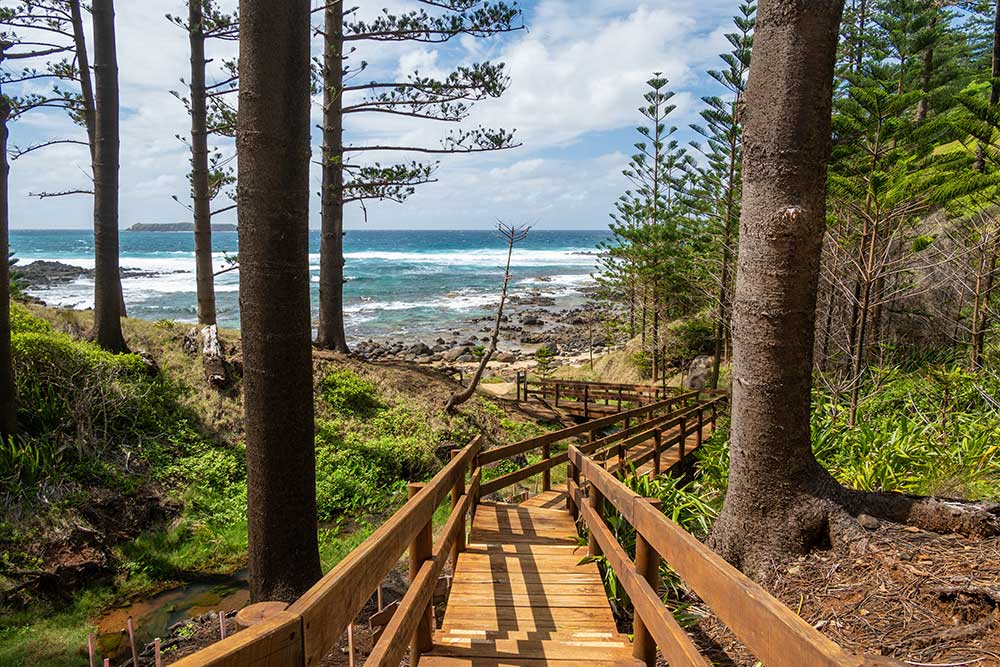
The boardwalk down to Bumboras Beach.
Norfolk Island's natural treasures: Beaches, wildlife and marine life
Norfolk’s beaches are sirens.
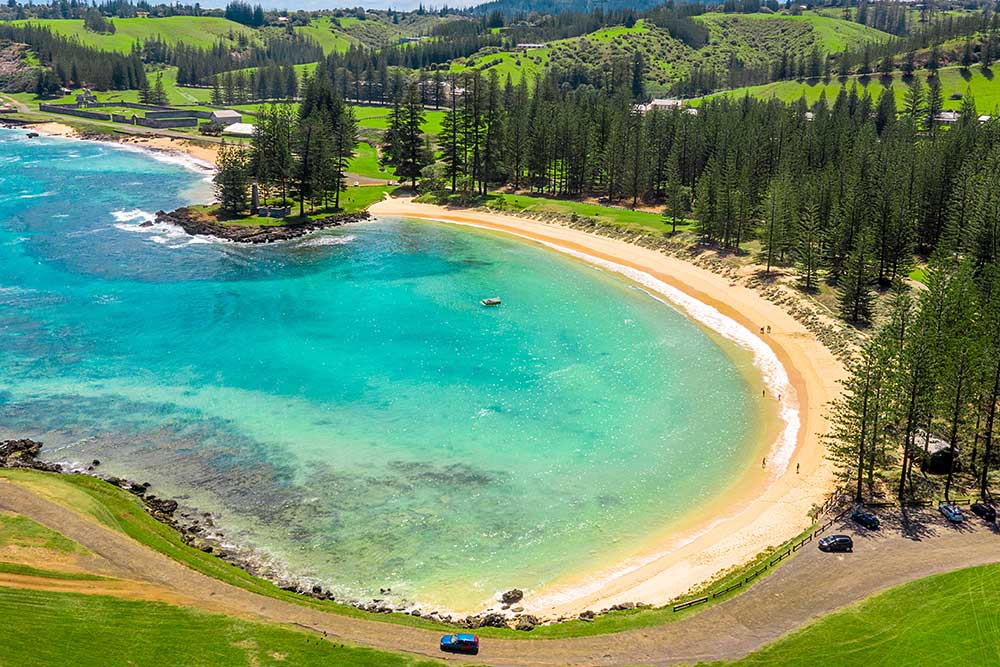
Emily Bay is the Instagram-ready model, perfectly poised with Lone Pine its slender side kick.
A steep switchback descent reveals Anson Bay, one of the most remote stretches of sand in the world, Bumboras Beach lures with a cool forest boardwalk, then there’s Slaughter Bay, which is the antithesis of its horrendous name.
Slaughter is the old English word for slow-moving water, which wasn’t the case on 19 March 1790 when HMS Sirius, the flagship of the First Fleet, lost a violent, watery bout here.
Artefacts from the wreck – the ship’s one-tonne anchor, carronades and cannonballs – now RIP in Norfolk Island Museum, just metres from the wreck site.
To explore this First Fleet treasure to the real-life soundtrack of crashing waves is a unique experience.
Beneath the waves are living treasures – including fish found nowhere else in the world, like the Norfolk Island blenny, freckled dwarfgoby and the gilded tuskfish.
Snorkelling Emily Bay I am hoping to spot them.
However, I am distracted by Norfolk’s cheeky and highly territorial aatuti.
They dash out from coral bommies attempting to kiss me to death with their teeny-weeny mouths.
I pick a bunch of "sea grapes" to feed them and enjoy a few myself – the gas-filled beads pop in my mouth like bursts of salty caviar.
There are riches overhead, too.
Each year tens of thousands of seabirds – petrels, red-tailed tropic birds, shearwaters, masked boobies, gannets and sooty terns – fly in to breed.
But it’s in Norfolk’s ancient rainforest that I find a special feathered treasure – the Norfolk green parrot.
Its call – ‘kek-kek-kek’ – helps me home in on its location.
What a treat to see this species that once faced extinction.
But it’s a quick show.
A pair of the rare birds flash their red crowns and are off.
Harder to spot (I don’t see one during my time of the island), is the Norfolk Island morepork, a species of owl whose numbers dwindled to one single female in 1986, before two males were introduced from New Zealand to save the lineage.
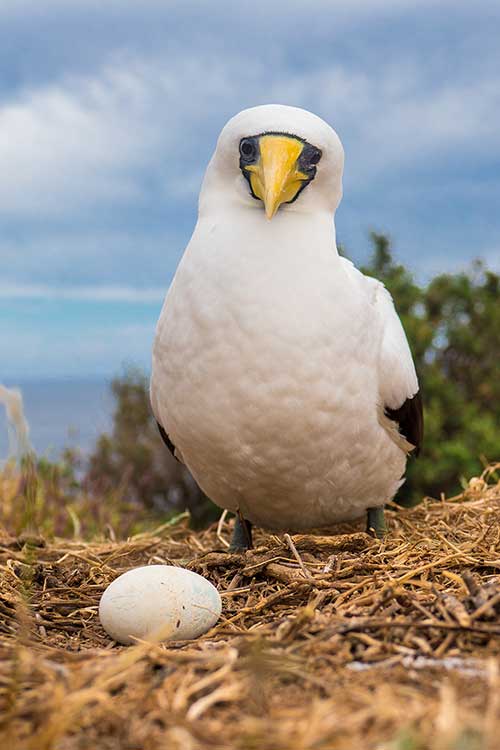
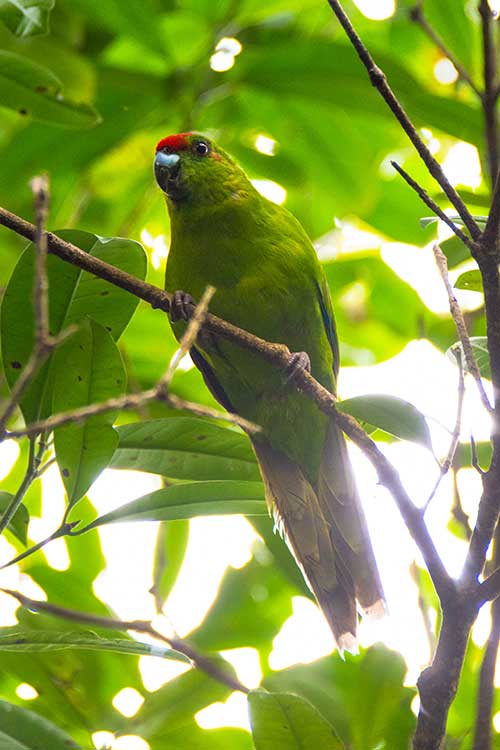
The masked booby and green parrot.
Norfolk Island's creative spirit: Art, conservation and culture
Saving the stories of Norfolk’s rare and endangered flora and fauna is local artist Sorrel Wilby.I find her at In the Wild, a new venture that has mini golf, a rainforest walk, cafe, bar and Wilby’s art gallery Nature’s Bounty.
Her beautiful pastel drawings illustrate the who’s who and the who was, of Norfolk’s flora and fauna – the vulnerable, critically endangered and extinct.
It’s the tip of a massive project.
After winning a Churchill Fellowship, Wilby travelled overseas to examine preserved specimens of species long ago lost to the island.
Now she documents and draws them, ensuring the burgled bounty is being brought home in a growing collection she is gifting to the island.
To "meet" the grey-headed guava bird, the local subspecies of the long-tailed triller, and the Norfolk kākā is a grounding moment, one Wilby tells me, has brought many to tears.
Exploring Norfolk Island's convict history and haunted heritage
I expect many tears were shed during Norfolk’s penal colony days.
There were two convict settlements here. The first, as a mainly agricultural outpost to support Sydney, lasted from 1788 to 1814; the second, from 1825 to 1855 saw the worst of the worst sent here.
It was a brutal place for prisoners, described by Australian author Marcus Clarke as “hell in paradise” in his novel For the Term of His Natural Life.
In 1834, visiting vicar Father William Ullathorne noted prisoners sentenced to hang saw death as mercy.
“Every man who was reprieved broke down in tears while those condemned to death dropped to their knees, dry-eyed, and thanked God they were to be delivered from the place,” he wrote.
Today, Kingston and Arthur’s Vale Historic Area is a UNESCO heritage-listed site.
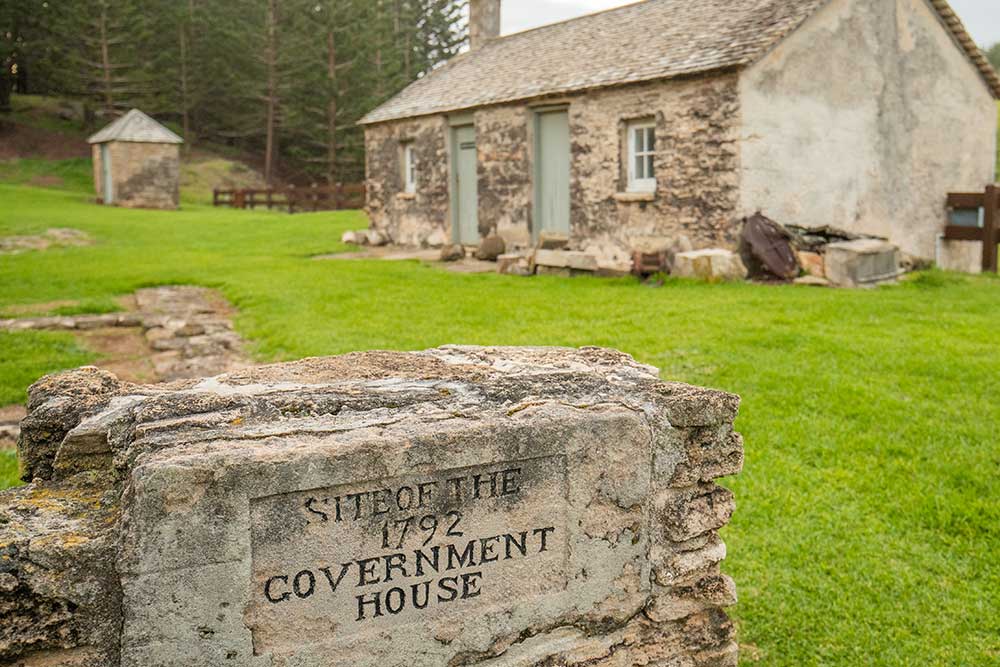
The site of the former Government House.
I’m exploring it on bicycle with Kingston Cruisers, a business that sets up guests with a step-through bike, phone and headset for a GPS audio tour.
Each bite of information is triggered to play as I pedal around the site, and I love that I can set my own pace, which is a slow one.
The gory stories you’ll hear by day, are more terrifying at night.
I join a lantern-lit walking ghost tour through the convict cemetery to a duplex on Quality Row that is said to be one of Australia’s most haunted houses.
The hairs prickling on the back of my neck seem to confirm it.
The ghost stories are oral treasures, passed down through generations, preserving the folklore and ensuring the tales of nameless convicts, mistreated servants and local figures are not lost to time.
While it’s dark, look up.
Norfolk is a gold-level dark sky zone and the cosmos here sparkles.
There are tours on offer, but with no need for a telescope it’s easy to lay down a rug at Captain Cook lookout or Anson Bay to see some of the brightest stars in the South Pacific.
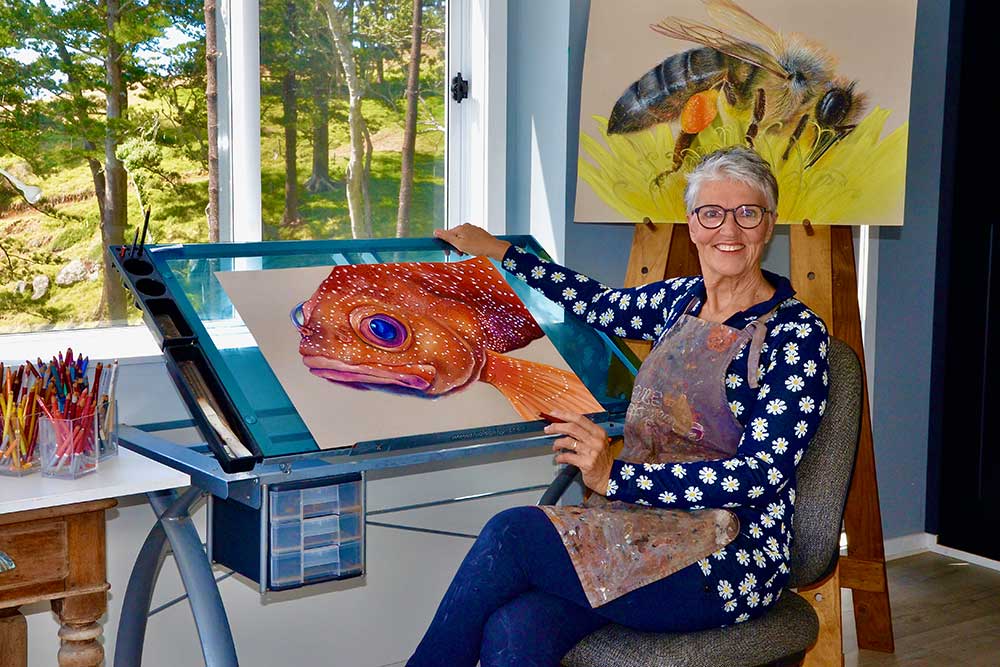
Sorrel Wilby in her Norfolk Island studio.
Meet the locals: Food, markets and Norfolk Island experiences
Howie Martin guides me on rainforest hikes, Phoenix Kenny teaches me how to paint pine trees, PJ Wilson rolls me through Hundred Acre Reserve on a horse-drawn carriage, Haydn “Teddy” Evans sells me his homegrown veggies at the market, and at Cascade Pier, Scotty gives me the catch of the day.
The local favourite is trumpeter and the whole fish costs just $20.
Without doubt, though, the Norfolk folk are the most valuable booty you’ll find.
Don’t leave without a spending a night with the island’s top chef, Kurt Menghetti.
At the Homestead Restaurant, I watch as he spoons coconut-turmeric broth over flametail snapper, caught just hours earlier.
Meanwhile, sizzling away beside Kurt are locally sourced meats and vegetables.
They’re charring over a hand-built Argentinian parrilla (grill), fired by charcoal Kurt makes himself from olive tree wood on his property. That’s gold. So too is his naturally fermented sourdough and a crème caramel that sells out nightly.
Of all the crosses on this treasure of an island, I think I’ve found my favourite.
The writer was a guest of Norfolk Island Tourism.
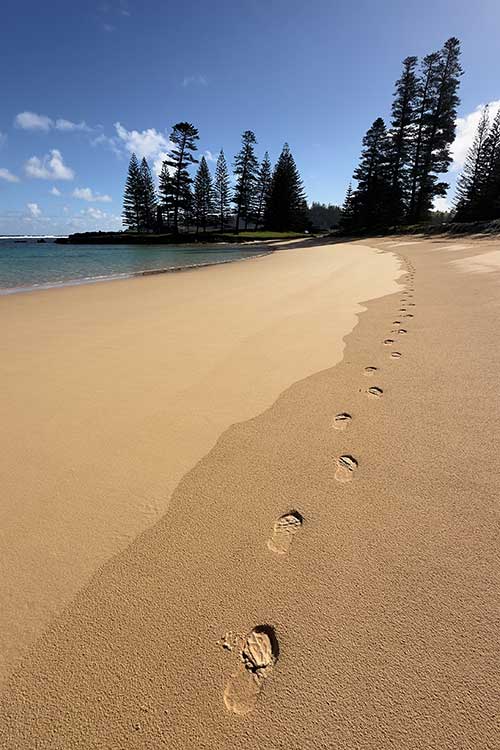
The golden sands of Emily Bay.
Frequently asked questions about Norfolk Island
Why do flights to Norfolk Island leave from the international terminal?
Flights to Norfolk Island leave from the international terminals in Sydney and Brisbane because passengers are subject to Australian Border Force and biosecurity processing.
Do I need a passport to travel to Norfolk Island?
Australian citizens do not need a passport. You do need government-issued photo ID, such as an Australian driver's licence, proof-of-age card, or other accepted photo identification. A passport is still the preferred form of ID because it can speed up processing and helps if your flight is diverted to another country (New Zealand, for example).
Do they speak English on Norfolk Island?
Yes, English is widely spoken on Norfolk Island. But the island also has its own unique language called Norf'k, a language that developed from 18th-century English and Tahitian. All you need to learn is “watawieh” (wot-a-way) which means hello!
I’ve heard there are special road rules. What are they?
Cows and chickens roam freely and have right of way on all roads. And, while not a law, it’s a local courtesy to wave at passing cars.
Is there a hospital on Norfolk Island?
There’s a small hospital on the island for basic care but serious medical issues may require evacuation to mainland Australia. Another reason to ensure you have comprehensive travel insurance.
Is it safe on Norfolk Island?
Very safe. Crime levels are very low, traffic accidents are rare and there are no dangerous land animals. There are occasional stinging jellyfish, though they are not a concern as they are in tropical northern Australia.
Do I need a car?
Norfolk Island has 80km of hilly, winding roads and there is no public transport. Unless you are on a group tour with organised transport you will need a car to visit the sights and get to restaurants. Plus, it’s part of the experience.
When is the best time to visit?
Autumn and spring are best for pleasant weather, smaller crowds and great value on flights and accommodation. Bounty Day on 8 June is popular as the island’s biggest annual celebration, while the peak seabird season is from November to February.
Practical tips for visitors
- Book a hire car early.
- Book tours before you leave home
- Make special dinner reservations
- Don’t miss sunset over Anson Bay
- BYO snorkel gear if you prefer your own
- Qantas flies directly to Norfolk Island from Brisbane and Sydney.
- Visits Norfok Island Tourism for more information.

Related topics
Things to note
The information in this article has been prepared for general information purposes only and is not intended as legal advice or specific advice to any particular person. Any advice contained in the document is general advice, not intended as legal advice or professional advice and does not take into account any person’s particular circumstances. Before acting on anything based on this advice you should consider its appropriateness to you, having regard to your objectives and needs.
Insurance Products (excluding Travel Insurance) are issued by RACQ Insurance Limited ABN 50 009 704 152 (RACQI) and arranged by RACQ Distribution Services Pty Ltd (RDS) ABN 35 116 361 650, AFSL 567130 and RDS' authorised representatives (including RACQ Operations Pty Ltd ABN 80 009 663 414, AR No. 234978 (RACQO)). Conditions, limits and exclusions apply.
Any advice provided by RDS and RACQO is general advice only and does not take into account your personal objectives, financial situation or needs and you will need to consider whether the advice is appropriate for you. Read the Product Disclosure Statement (PDS) before making a purchase decision on the product. You can also access our Target Market Determinations on this website.
RDS receives a commission from RACQI for the policies it arranges. RACQO receives fees paid for services it provides to RDS. Further details about remuneration are available on request prior to purchasing.
RACQ Operations Pty Ltd (ABN 80 009 663 414, AR No. 234978) and Members Travel Group Pty Ltd (ABN 45 144 538 803, AR No.432492) (RACQ) are authorised representatives of the RACQ Travel Insurance insurer Tokio Marine & Nichido Fire Insurance Co., Ltd. (ABN 80 000 438 291 AFSL 246 548) (Tokio Marine). Tokio Marine Management (Australasia) Pty Ltd (ABN 69 001 488 455, AR No. 1313066) is an authorised representative of Tokio Marine, and administers RACQ Travel Insurance as the managing agent on behalf of Tokio Marine. Terms, conditions (including eligibility criteria), exclusions, limits and sub-limits apply. Any advice is general advice only, and does not take into account your specific objectives, financial situation or needs. Before you purchase, please consider the Combined Product Disclosure Statement (PDS) / Financial Services Guide (FSG) and Target Market Determinations (TMDs) available at racq.com or on request from RACQ.