

Off-road caravanning: 7 expert tips for safer adventures
I’ve spent more than 25 years working across the caravanning industry, including sales, service and repair, insurance, and now industry development with Caravanning Queensland. But my connection to caravanning started well before my career.
I was born into the industry.
My father spent more than 40 years working in caravanning, and family holidays almost always involved a caravan or camper. My first trip to K’gari (Fraser Island) was when I was just four weeks old, and some of my earliest memories are camping on North Stradbroke Island.
So you could say getting off the beaten track is in my blood.
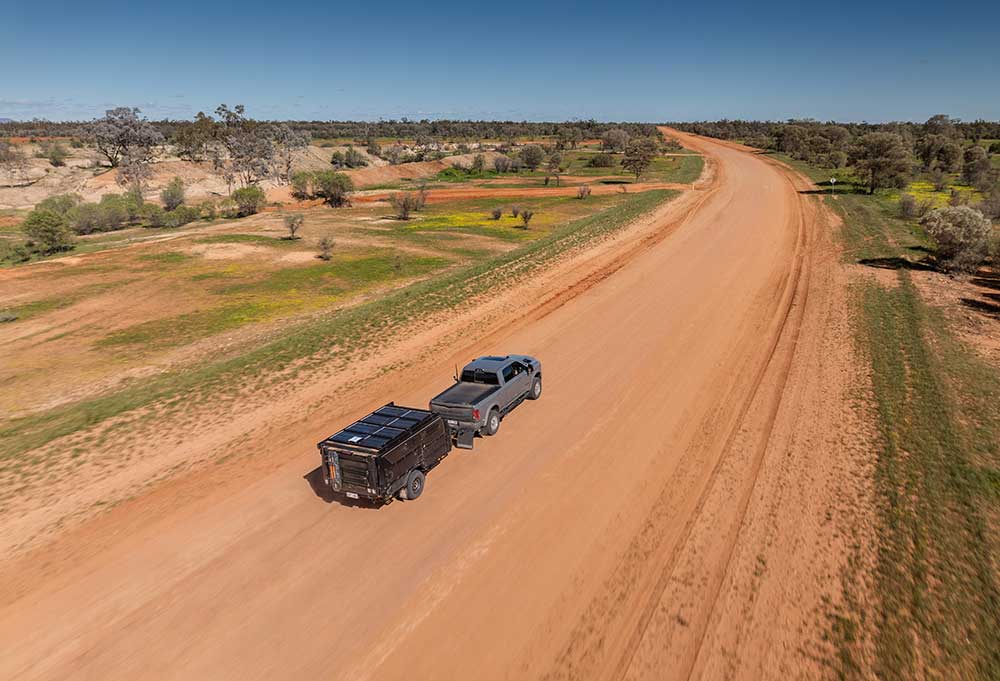
After plenty of kilometres on dirt, sand and corrugations, these are some of my top tips for anyone planning to take their RV beyond the bitumen.
1. Make sure your RV is built for the trip
'Off-road' can mean very different things.
Don’t assume that because a caravan or camper has high ground clearance, large tyres or a particular suspension system that it is automatically designed for every off-road environment.
Before planning your trip, understand exactly what your manufacturer considers acceptable use and read the warranty conditions.
Know the limitations of your RV and match your destination and driving conditions to what the product was designed to handle.
2. Get it inspected before you leave
A thorough inspection before a major off-road trip is one of the best investments you can make.
Have your RV serviced and tell the service business where you are going and the type of conditions you expect to encounter.
This gives the technician an opportunity to pay particular attention to components that will be subjected to additional loads and vibration.
Prevention at home is generally much easier than repairs on the side of a remote track.
3. Drive to the conditions, not the speed limit
One of the most important pieces of advice I can give is simple: drive to the conditions.
Just because a road has a particular speed limit doesn’t mean that speed is appropriate when towing a caravan or camper.
Corrugations, sand, washouts, potholes, loose gravel, changing road surfaces and visibility all need to influence your speed.
Slow down, give yourself additional braking distance and remember that your tow vehicle and RV are working considerably harder in these conditions.
Reducing speed also reduces the punishment being transferred through your tow vehicle, caravan and everything inside it.
4. Stop regularly and inspect your setup
When travelling off-road or over significant corrugations, make more frequent stops part of your routine.
Walk around the entire combination. Visually inspect your tyres, wheels, suspension, hitch, safety chains, electrical connections and the exterior of the RV for anything that has moved, loosened or been damaged.
Where appropriate and in accordance with the manufacturer’s specifications, check critical fasteners such as wheel nuts and relevant suspension components using the correct equipment and torque settings.
Then look inside.
Open the RV carefully and inspect cupboards, drawers, appliances and stored items for signs of movement. Finding something starting to work loose at a scheduled stop is much better than discovering it after another few hundred kilometres of corrugations.
These stops are also a good opportunity for the driver to get out, stretch and reset before continuing.
5. Carry the right tools and know your torque settings
Corrugations are relentless. Constant vibration can test fasteners, fittings and components throughout your RV.
I recommend carrying a quality torque wrench and keeping a list of the manufacturer’s specified torque settings for items you are permitted to inspect, particularly wheel nuts and relevant suspension fasteners.
A suitable basic tool kit, tyre equipment and recovery equipment should also be part of your setup.
Make sure your jack is appropriate for your RV, its weight and the terrain you are travelling on. A standard jack that works perfectly well on a concrete driveway may be unsuitable on sand, dirt or uneven ground.
6. Take dust seriously
If you’re regularly travelling on dirt roads, dust management is worth considering.
Fine dust has an incredible ability to find its way into an RV through vents, seals and other openings. Depending on your RV and the conditions you intend to travel in, a suitable dust-reduction or positive-pressure system can be a worthwhile investment.
Also check door, window and storage-compartment seals before leaving and understand which vents must remain unobstructed for safety.
7. If it can move, assume it will
Off-road travel will shake, rattle and test almost everything you’ve packed.
Secure loose items properly and think beyond simply shutting cupboard doors.
Pay particular attention to glass containers, liquids, food and anything capable of leaking.
One lesson I’ve learnt over the years is that corrugations can even work a tightly closed jar lid loose.
I normally put jars, bottles and other liquids into sealed bags or containers so that if something does leak, the mess is contained.
There aren’t many worse ways to finish a long day on the tracks than opening the caravan door to discover a cupboard full of sauce – or a fridge full of spilt milk.
Preparation makes the difference
Off-road caravanning is one of the best ways to experience Australia, but getting there – and getting home – requires preparation.
Know the capabilities of your vehicle and RV, drive to the conditions, stop regularly to inspect your setup, carry the right equipment and take the time to prepare both your RV and its contents.
The more remote the destination, the less you want to discover what you should have checked before you left.
BY BEN MENZIES, BUSINESS DEVELOPMENT MANAGER CARAVANNING QUEENSLAND


Related topics
Things to note
The information in this article has been prepared for general information purposes only and is not intended as legal advice or specific advice to any particular person. Any advice contained in the document is general advice, not intended as legal advice or professional advice and does not take into account any person’s particular circumstances. Before acting on anything based on this advice you should consider its appropriateness to you, having regard to your objectives and needs.
Insurance Products (excluding Travel Insurance) are issued by RACQ Insurance Limited ABN 50 009 704 152 (RACQI) and arranged by RACQ Distribution Services Pty Ltd (RDS) ABN 35 116 361 650, AFSL 567130 and RDS' authorised representatives (including RACQ Operations Pty Ltd ABN 80 009 663 414, AR No. 234978 (RACQO)). Conditions, limits and exclusions apply.
Any advice provided by RDS and RACQO is general advice only and does not take into account your personal objectives, financial situation or needs and you will need to consider whether the advice is appropriate for you. Read the Product Disclosure Statement (PDS) before making a purchase decision on the product. You can also access our Target Market Determinations on this website.
RDS receives a commission from RACQI for the policies it arranges. RACQO receives fees paid for services it provides to RDS. Further details about remuneration are available on request prior to purchasing.
RACQ Operations Pty Ltd (ABN 80 009 663 414, AR No. 234978) and Members Travel Group Pty Ltd (ABN 45 144 538 803, AR No.432492) (RACQ) are authorised representatives of the RACQ Travel Insurance insurer Tokio Marine & Nichido Fire Insurance Co., Ltd. (ABN 80 000 438 291 AFSL 246 548) (Tokio Marine). Tokio Marine Management (Australasia) Pty Ltd (ABN 69 001 488 455, AR No. 1313066) is an authorised representative of Tokio Marine, and administers RACQ Travel Insurance as the managing agent on behalf of Tokio Marine. Terms, conditions (including eligibility criteria), exclusions, limits and sub-limits apply. Any advice is general advice only, and does not take into account your specific objectives, financial situation or needs. Before you purchase, please consider the Combined Product Disclosure Statement (PDS) / Financial Services Guide (FSG) and Target Market Determinations (TMDs) available at racq.com or on request from RACQ.