

Lessons learned towing a caravan to Cape York
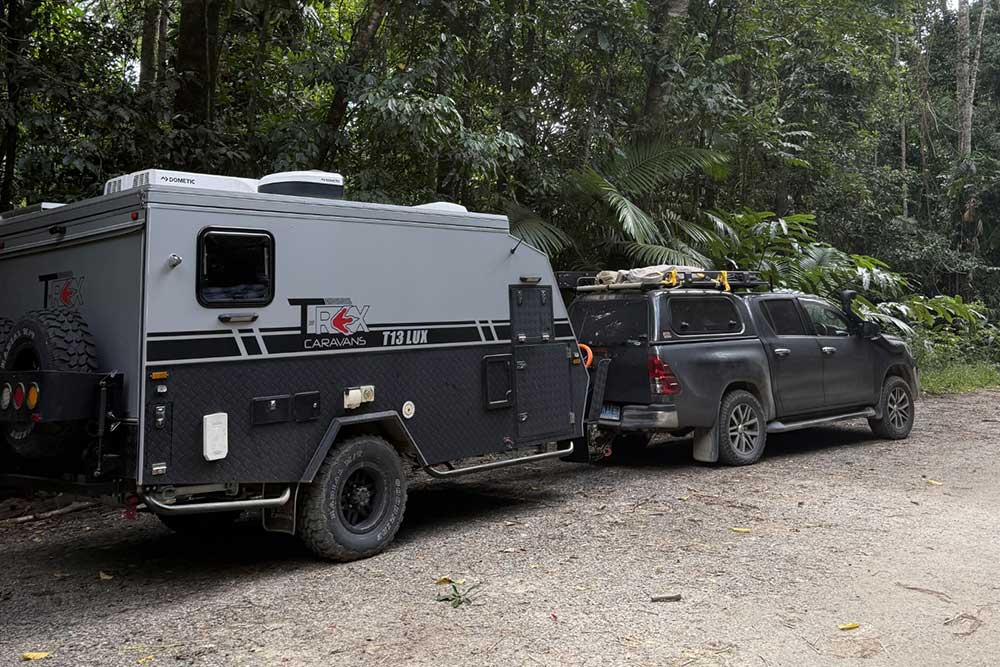
Driving a caravan to Cape York had long been on my husband's bucket list, but for me, the idea was equal parts exciting and intimidating.
After selling everything to travel Australia full-time, we decided to tow our off-road caravan all the way to the northernmost point of mainland Australia.
Along the way we learned plenty about preparation, tyre pressures, road conditions and avoiding costly mistakes, including one that saw our caravan come off the hitch just days before reaching the Tip.
By this point though, turning around wasn’t an option. We were going to make it; all of us, our van included.
Why we decided to take our caravan to Cape York
On 20 March 2026 my husband Warren and I hit the road to travel Australia full-time.
Our dream became reality after two years of planning, saving and selling everything we owned. A date that will now be etched in our minds forever.
We had set the date long before the practical planning started and before we even knew if we could achieve it.
Cape York was one of those bucket-list destinations, a must-do for my husband, but for me it was firmly in the maybe basket.
To be honest, I was scared of it. Of what the road conditions might do to our car and van, and about the remoteness.
When we bought our caravan, we were still debating whether we would even go t the Cape.
After the decision was made, our initial plan was to leave the van at Laura, or one of the stations along the way, and camp for the rest of the journey north.
Eventually we concluded that camping wasn’t for us. We had the off-road van, so why not put it through its paces?
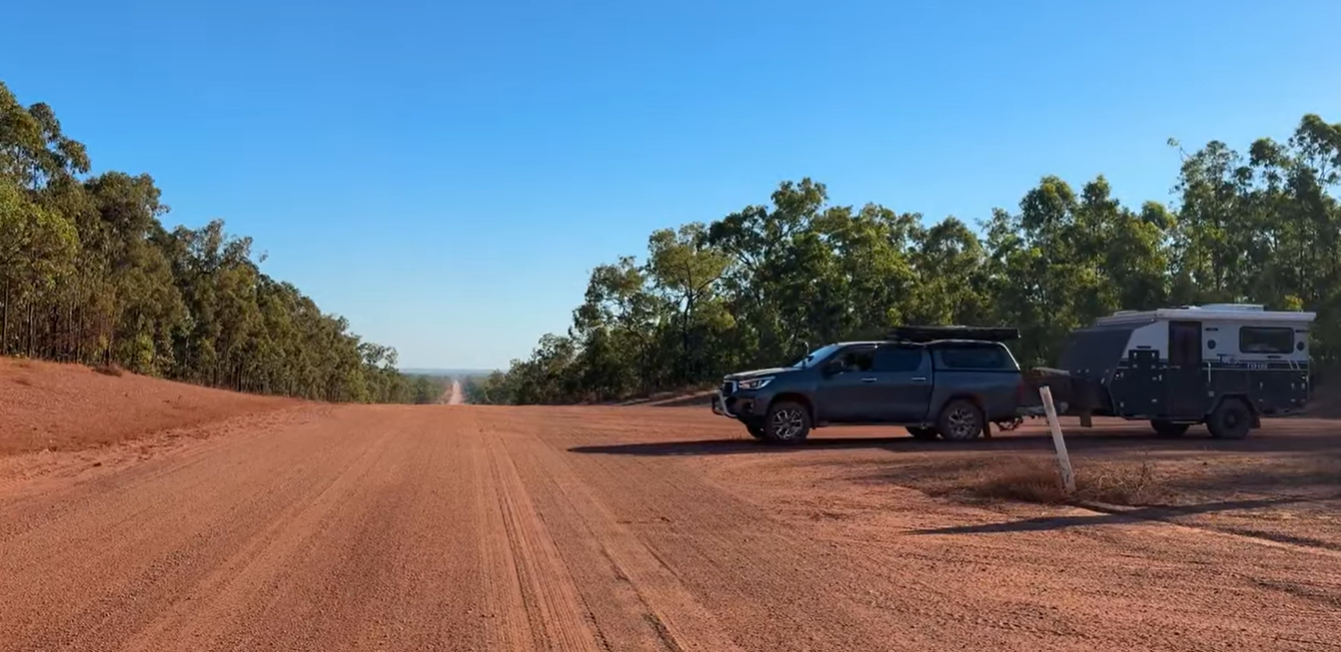
Is an off-road caravan necessary for Cape York?
When choosing our caravan we had a rough idea of what we wanted. As newbie towers, we wanted something small, but there were a few things we weren’t willing to compromise on: air-conditioning, a toilet and a shower.
Taking the van all the way meant we had everything we needed – a comfortable bed, water, a toilet and shower – making the journey far more comfortable than it might otherwise have been.
The off-road caravan gave us the confidence to tackle roads we might otherwise have avoided. The only thing holding us back is ourselves and our experience level.
Driving conditions on the road to Cape York
As it turned out, the road conditions were really good. We went early in the season, so the roads had just been graded.
On the way up, there wasn’t too much in the way of corrugations, but there were some dips that, if you’re not driving to the conditions, could see an early end to your trip. Take note of the dip signs and slow right down.
After we left Hann River Roadhouse we aired down our tyres, only to find a few kilometres later it went back to bitumen.
The dirt is in sections and it’s worth looking at WikiCamps for the point of interest "where the dirt starts".
We aired down and back up many times in the beginning. Again, this was due to inexperience.
We kept our speed to a maximum of 80km/h once we hit the dirt. There are so many differing opinions on this, so I would say to first timers: drive to the conditions and your comfort level.
For us, the biggest challenge of off-road caravanning wasn’t necessarily the road itself, it was our inexperience.
There is so much advice out there about tyre pressures, speeds and what you should or shouldn’t do, but ultimately, we had to learn our own setup and become comfortable making decisions based on the conditions in front of us.
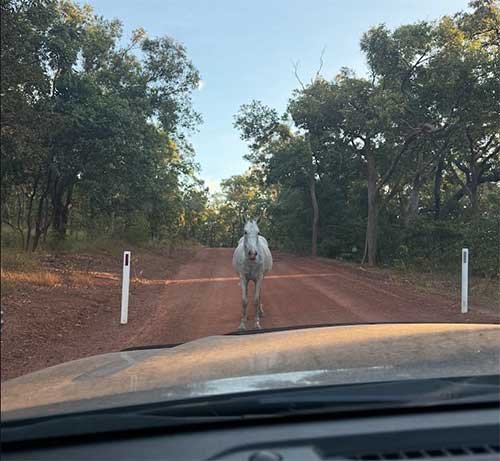
A horse blocking the road.
The biggest mistakes we made
One day we arrived at camp to find our cupboard door hinges had rattled off. The doors had literally come off and all our things were piled on the floor of the van.
But one problem we thankfully didn’t have was dust.
My number one piece of equipment I would recommend is a dust reduction system.
Our van stayed dust-free – on the inside, at least – for the entire trip and it was worth every cent. Ours operates automatically, so we didn’t have to remember to turn it on and off.
We met other travellers who told us horror stories of forgetting to turn on their dust reduction systems and then spending hours cleaning their vans.
Preparing for a Cape York caravan trip
We carried two jerry cans of fuel, giving us an additional 40 litres, as well as two jerry cans carrying 40 litres of fresh water on top of the 80-litre water tank in our caravan.
Bamaga is the last place to get groceries, water and fuel before heading to Punsand Bay, so it’s worth stocking up while you’re there.
Punsand Bay doesn’t have potable water, so you need to make sure you have enough with you for your stay.
It was while looking for the supermarket in Bamaga that we went over a speed bump and the caravan came off the hitch.
We had forgotten to press the hitch lock. Due to our inexperience, our safety chains were also a little too long, which meant they didn’t catch the van.
It was a rookie mistake and one we certainly won’t make again.
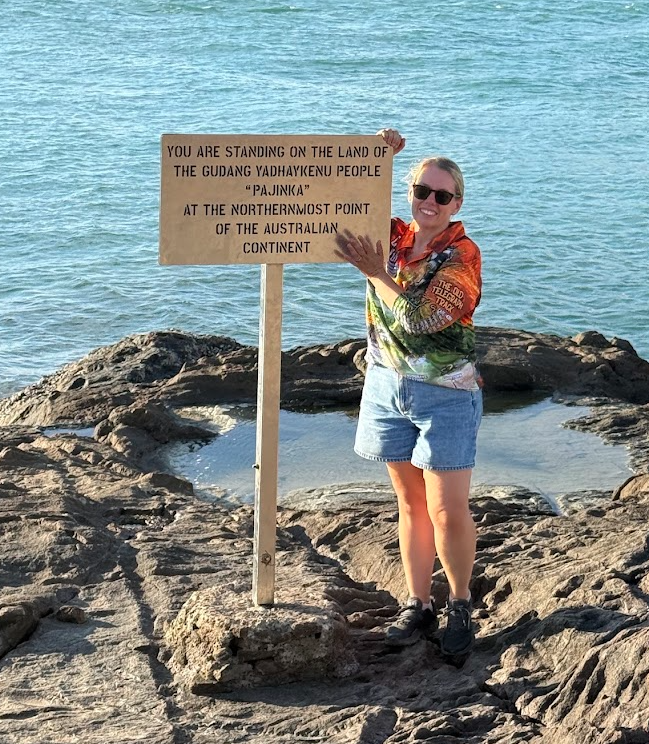
Lani at the Tip.
Was driving to Cape York worth it?
For all the practical lessons Cape York taught us, one thing I wasn’t prepared for was just how beautiful the journey would be. Red dirt, blue skies and dense green vegetation make the drive itself part of the experience.
Punsand Bay was the perfect place to stay. We could hear the waves from our campsite and watch the most incredible sunsets.
We spent our days exploring and our afternoons debriefing with other travellers. The pool and Corrugation Bar are the social hub.
There was a real sense of community among the travellers heading north.
We would cross paths with the same people at different points along the journey, each of us having our own adventure but ultimately heading towards the same place.
As for whether or not an off-road van is needed, or if a semi off-road could make the trip, this is a personal choice.
When we pulled into Punsand there was a mix of off-road and semi off-road vans. We all made it, some in worse shape than others. For us, having an off-road van gave us peace of mind.
The Tip itself was extraordinary.
It’s not a long walk but the feeling that washes over you when you see the sign, after all the mishaps, dust and kilometres, is indescribable.
The closest feeling I can attribute it to is relief that we made it and pride that we did it.
There isn’t anything I’d do differently, except maybe remembering the hitch lock!
Would I do it again? Absolutely yes.
This was the trip I never thought I’d make but I sure am glad we did.
Follow Lani's journey with The Van Wife Diaries on Instagram and Facebook.
Cape York road trip frequently asked questions
Can you drive to the tip of Cape York?
Yes. Travellers can drive all the way to Pajinka, commonly known as The Tip, the northernmost point of mainland Australia. The final section involves a short walk from the car park to the famous sign and lookout.
Is driving to Cape York worth it?
For many Australians, a trip to Cape York is the ultimate road trip. The journey combines remote landscapes, Indigenous culture, historic sites, waterfalls, fishing, wildlife and the achievement of reaching the northernmost point of mainland Australia.
Do you need a 4WD to drive to Cape York?
A four-wheel drive vehicle is strongly recommended. While some sections of the route may be accessible to high-clearance two-wheel-drive vehicles during the dry season, the Old Telegraph Track, river crossings and unsealed roads are best suited to a capable 4WD vehicle and driver.
When is the best time to drive to Cape York?
The dry season, from May to October, is generally the best time to visit Cape York. Roads are more accessible, river levels are lower and camping conditions are more comfortable. Many roads and attractions become inaccessible during the wet season.
How long does it take to drive to the tip of Cape York?
Most travellers allow seven to 14 days for a return trip from Cairns, depending on how many stops they make. Those wanting to explore destinations such as Fruit Bat Falls, Eliot Falls, Weipa and the Old Telegraph Track may spend two weeks or more.
How far is Cape York from Cairns?
The drive from Cairns to the tip of Cape York is about 1,000km one way. However, road conditions and sightseeing stops mean the journey often takes several days.
Is the Old Telegraph Track worth driving?
The Old Telegraph Track is regarded as one of Australia's great four-wheel-driving adventures. It features creek crossings, remote campsites and challenging terrain, but is suitable only for experienced drivers with properly equipped vehicles.
What are the best stops on the way to Cape York?
Popular stops include Bramwell Junction, Fruit Bat Falls, Eliot Falls, Twin Falls, Chilli Beach, Somerset, Loyalty Beach, Seisia and Weipa. Many travellers also visit Thursday Island as part of their Cape York adventure.
Can you camp at Cape York?
Yes. Cape York offers numerous camping options, ranging from bush camps beside waterfalls to commercial campgrounds at locations such as Seisia, Loyalty Beach and Bramwell Station.
Are there fuel stops on the way to Cape York?
Fuel is available at several locations including Lakeland, Laura, Coen, Archer River, Bramwell Junction and Bamaga. However, distances between fuel stops can be significant, so travellers should plan carefully and carry extra fuel if required.
Do I need permits to visit Cape York?
Some areas require permits or camping bookings, particularly Indigenous-owned lands and national park campgrounds. Visitors should check requirements before travelling.
Are there crocodiles at Cape York?
Yes. Estuarine crocodiles inhabit many rivers, creeks and coastal areas throughout Cape York. Visitors should obey warning signs, avoid swimming outside designated safe areas and always exercise caution near waterways.
Can you swim at Cape York?
Swimming is only recommended in designated locations that are considered safe from crocodiles and marine stingers. Popular freshwater swimming spots include Fruit Bat Falls and Eliot Falls.
Is there mobile phone coverage in Cape York?
Mobile reception is available in larger towns such as Weipa and Bamaga, but coverage is limited or non-existent across much of the peninsula. Many travellers carry satellite communication devices or emergency beacons.
What recovery gear should you take to Cape York?
A well-prepared 4WD should carry recovery boards, a snatch strap, rated recovery points, tyre repair equipment, an air compressor, spare tyres, basic tools and sufficient water and food supplies.
What is the northernmost point of mainland Australia?
Pajinka, commonly known as The Tip, is the northernmost point of mainland Australia. From the lookout, visitors can often see islands in the Torres Strait on clear days.
Can you tow a caravan to Cape York?
Many travellers tow off-road camper trailers and caravans to Cape York. However, some routes, particularly the Old Telegraph Track, are unsuitable for larger caravans and may require alternative bypass roads.
Is Cape York suitable for first-time 4WD travellers?
Yes, provided travellers prepare properly, understand remote-area driving requirements and choose routes that suit their experience level. The Peninsula Developmental Road allows many first-time adventurers to experience Cape York without tackling the most challenging tracks.
What is the biggest mistake people make when driving to Cape York?
Underestimating road conditions is one of the most common mistakes. Corrugations, creek crossings, isolation, wildlife and long distances can place significant stress on both vehicles and drivers. Proper preparation is essential.


Related topics
Things to note
The information in this article has been prepared for general information purposes only and is not intended as legal advice or specific advice to any particular person. Any advice contained in the document is general advice, not intended as legal advice or professional advice and does not take into account any person’s particular circumstances. Before acting on anything based on this advice you should consider its appropriateness to you, having regard to your objectives and needs.
Insurance Products (excluding Travel Insurance) are issued by RACQ Insurance Limited ABN 50 009 704 152 (RACQI) and arranged by RACQ Distribution Services Pty Ltd (RDS) ABN 35 116 361 650, AFSL 567130 and RDS' authorised representatives (including RACQ Operations Pty Ltd ABN 80 009 663 414, AR No. 234978 (RACQO)). Conditions, limits and exclusions apply.
Any advice provided by RDS and RACQO is general advice only and does not take into account your personal objectives, financial situation or needs and you will need to consider whether the advice is appropriate for you. Read the Product Disclosure Statement (PDS) before making a purchase decision on the product. You can also access our Target Market Determinations on this website.
RDS receives a commission from RACQI for the policies it arranges. RACQO receives fees paid for services it provides to RDS. Further details about remuneration are available on request prior to purchasing.
RACQ Operations Pty Ltd (ABN 80 009 663 414, AR No. 234978) and Members Travel Group Pty Ltd (ABN 45 144 538 803, AR No.432492) (RACQ) are authorised representatives of the RACQ Travel Insurance insurer Tokio Marine & Nichido Fire Insurance Co., Ltd. (ABN 80 000 438 291 AFSL 246 548) (Tokio Marine). Tokio Marine Management (Australasia) Pty Ltd (ABN 69 001 488 455, AR No. 1313066) is an authorised representative of Tokio Marine, and administers RACQ Travel Insurance as the managing agent on behalf of Tokio Marine. Terms, conditions (including eligibility criteria), exclusions, limits and sub-limits apply. Any advice is general advice only, and does not take into account your specific objectives, financial situation or needs. Before you purchase, please consider the Combined Product Disclosure Statement (PDS) / Financial Services Guide (FSG) and Target Market Determinations (TMDs) available at racq.com or on request from RACQ.