

Glass House Mountains: Queensland's ancient volcanic peaks explained
Rising unexpectedly from the coastal plain north of Brisbane, the Glass House Mountains are more than a striking landmark.
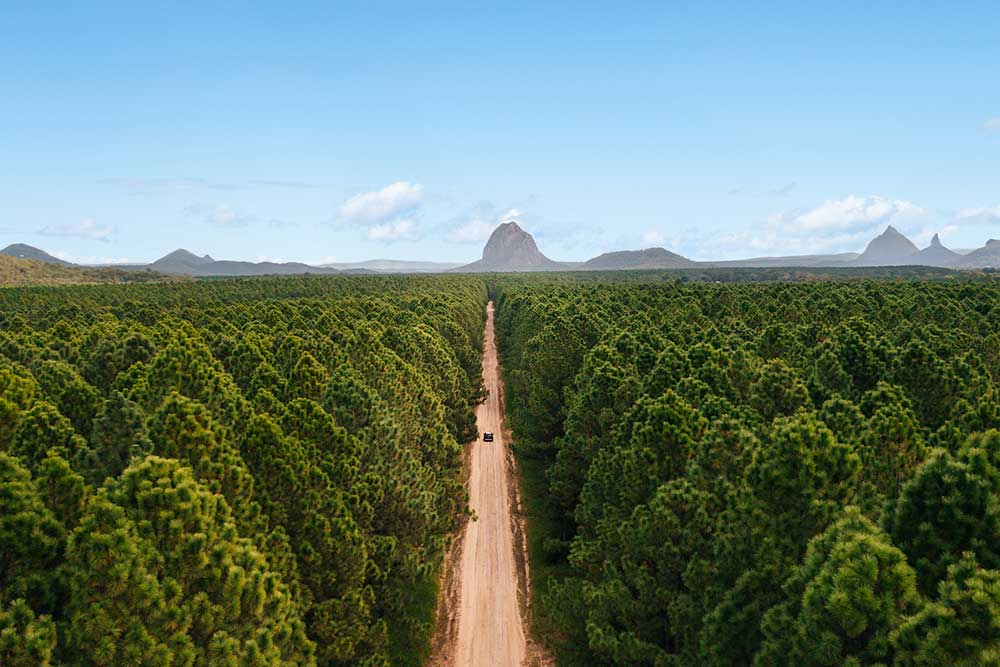
The Glass House Mountains are one of South East Queensland's most recognisable natural landmarks, rising dramatically from the coastal plain about 70km north of Brisbane.
Formed by ancient volcanic activity more than 25 million years ago, the mountains are renowned for their distinctive peaks, Aboriginal cultural significance and popular walking trails.
The mountains that make you look twice
There’s a moment on the drive north from Brisbane when the landscape suddenly changes.
Out beyond the roadside pines and paddocks, great rocky shapes begin rising from the coastal plain, some rounded, others sharp, one with a distinctly crooked neck.
That first glimpse of the Glass House Mountains never gets old. They’re part compass, part welcome-home sign and, the more you learn about them, part history book.
The temptation is to see the mountains, pull over for a photograph and keep driving towards the coast. Don’t. These ancient peaks deserve a closer look.
Volcanoes, but not as you might imagine
The first surprise is that the Glass House Mountains aren’t simply a collection of old volcanic cones.
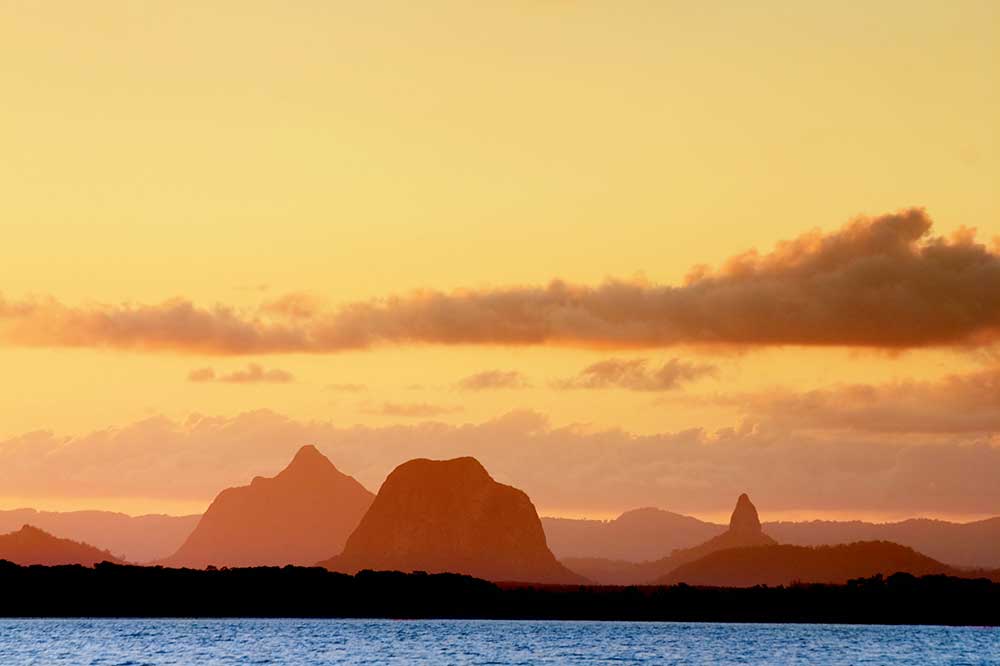
Around 25 to 27 million years ago, molten rock pushed into vents and beneath the Earth’s surface, cooling into extraordinarily hard trachyte and rhyolite. Over millions of years, the softer rock around it eroded away.
What remains are the volcanic cores standing above the plain today.
Once you know that, the landscape makes more sense.
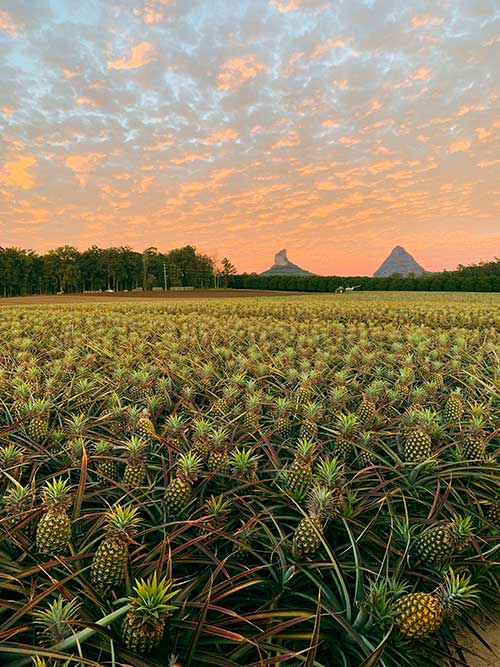
These aren’t mountains squeezed together into a range. They stand apart, domes, spires and crags separated by forest, farms and pineapple fields.
The tallest is Mount Beerwah at 556m. Nearby Coonowrin rises in a distinctive crooked profile, while Tibrogargan seems to hunker solidly over the surrounding country.
The entire landscape was added to the National Heritage List in 2006 for its natural, Indigenous and historic significance.
A landscape with a much older story
Long before Europeans sailed past these peaks, the Glass House Mountains were, and remain, deeply significant to the Kabi Kabi and Jinibara peoples.
This was a landscape of pathways, gathering places, ceremony and trade.
Evidence of long Aboriginal occupation includes rock art, axe-grinding grooves, quarries, burial places and former campsites, while individual peaks hold continuing spiritual significance.
There are also ancient stories connecting the mountains as a family.
In Jinibara tradition, Tibrogargan is the ancestral father and Beerwah the mother.
A widely told story identifies the crooked Coonowrin as their eldest son.
Learning this changes the way you look at the mountains. They stop being a collection of summits to tick off and become a cultural landscape to spend time with.
Why are they called the Glass House Mountains?
That part of the story came much later.
Sailing north aboard the Endeavour on 17 May 1770, Lieutenant James Cook spotted the unusual peaks from offshore.
Their shapes reminded him of the glass-making furnaces he knew from Yorkshire, England, so he recorded them as the 'Glass Houses'.
Almost three decades later, Matthew Flinders came exploring. In July 1799, travelling with Indigenous leader Bungaree and members of the Norfolk crew, he climbed Mount Beerburrum, the first recorded European ascent of one of the mountains. It’s extraordinary to stand there today and realise how long these peaks have acted as landmarks.
The best way to meet the mountains
If it’s your first visit, start slowly.
The Glass House Mountains Lookout is an easy introduction, with signs helping you put names to the peaks and views stretching across the volcanic landscape towards the coast. The lookout day-use area is in Beerburrum West State Forest, reached from Glass House-Woodford Road.
For a walk, the 4.1km Tibrogargan Circuit takes about 90 minutes and winds through casuarina, eucalypt and melaleuca forest around the mountain’s base.
The 2.8km Mount Ngungun walk is steeper and takes around two hours return, revealing broad views towards Tibrogargan, Coonowrin and Beerwah.
The Glass House Mountains are only about 70km north of Brisbane, but on each visit you realise they seem to operate on a different timescale altogether.
Stay long enough to notice the crooked profiles, the changing light on the rock and the improbable way these ancient volcanic remnants rise from the plain.
Once you know the stories behind them, you won’t simply drive past the Glass House Mountains again.


Related topics
Things to note
The information in this article has been prepared for general information purposes only and is not intended as legal advice or specific advice to any particular person. Any advice contained in the document is general advice, not intended as legal advice or professional advice and does not take into account any person’s particular circumstances. Before acting on anything based on this advice you should consider its appropriateness to you, having regard to your objectives and needs.
Insurance Products (excluding Travel Insurance) are issued by RACQ Insurance Limited ABN 50 009 704 152 (RACQI) and arranged by RACQ Distribution Services Pty Ltd (RDS) ABN 35 116 361 650, AFSL 567130 and RDS' authorised representatives (including RACQ Operations Pty Ltd ABN 80 009 663 414, AR No. 234978 (RACQO)). Conditions, limits and exclusions apply.
Any advice provided by RDS and RACQO is general advice only and does not take into account your personal objectives, financial situation or needs and you will need to consider whether the advice is appropriate for you. Read the Product Disclosure Statement (PDS) before making a purchase decision on the product. You can also access our Target Market Determinations on this website.
RDS receives a commission from RACQI for the policies it arranges. RACQO receives fees paid for services it provides to RDS. Further details about remuneration are available on request prior to purchasing.
RACQ Operations Pty Ltd (ABN 80 009 663 414, AR No. 234978) and Members Travel Group Pty Ltd (ABN 45 144 538 803, AR No.432492) (RACQ) are authorised representatives of the RACQ Travel Insurance insurer Tokio Marine & Nichido Fire Insurance Co., Ltd. (ABN 80 000 438 291 AFSL 246 548) (Tokio Marine). Tokio Marine Management (Australasia) Pty Ltd (ABN 69 001 488 455, AR No. 1313066) is an authorised representative of Tokio Marine, and administers RACQ Travel Insurance as the managing agent on behalf of Tokio Marine. Terms, conditions (including eligibility criteria), exclusions, limits and sub-limits apply. Any advice is general advice only, and does not take into account your specific objectives, financial situation or needs. Before you purchase, please consider the Combined Product Disclosure Statement (PDS) / Financial Services Guide (FSG) and Target Market Determinations (TMDs) available at racq.com or on request from RACQ.