
Car safety body ANCAP introduces new ratings
ANCAP set to introduce new-generation safety ratings for 2026.
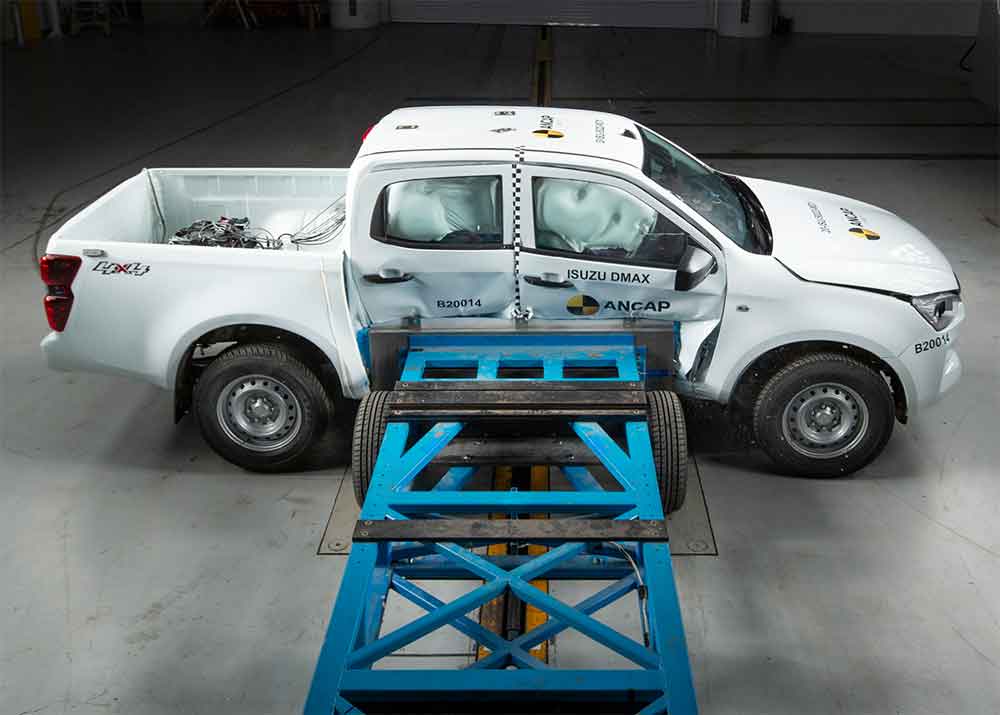
Australia’s leading independent automotive safety organisation ANCAP is poised to introduce strict new safety testing protocols in 2026 with the aim of helping consumers choose safer cars.
The changes are part of the Australasian New Car Assessment Program’s (ANCAP’s) tri-annual re-examining of its star rating criteria, with the organisation saying its new 2026-2028 protocols further strengthen the rigour and relevance of its tests.
Effective from January 2026, the new approach re-organises ANCAP’s safety assessment process and protocols based on the Haddon Injury Prevention Matrix which examines what happens before, during and after a crash.
ANCAP’s updated criteria aims to strengthen how the organisation evaluates the safety of new cars across four key areas: Safe Driving, Crash Avoidance, Crash Protection and Post-Crash.
Developed in collaboration with Euro NCAP, ANCAP said the new approach would ensure Australians and New Zealanders continued to benefit from the world’s most advanced crash testing and assessments.
ANCAP Chief Executive Carla Hoorweg said the organisation’s new ‘Stages of Safety’ approach provided a structure that could adapt to future technological developments, including automated driving.
Among the changes, some of which have been made specifically in response to consumer feedback, active driver assistance systems will be rewarded for smooth, intuitive operation as well as technical performance.
Electrically-operated door handles, which are an Increasingly common feature on modern vehicles and which often sit flush with bodywork when not in use, will also be assessed to ensure they remain operable after any crash.
Additionally, electric cars will be scored on their ability to isolate the high-voltage battery after a serious crash, ensuring the vehicle is safe to touch for occupants and first responders.
Vehicles will also be scored on their ability to notify first responders in the event of a crash. More than 40 percent of all new vehicles sold in Australia in 2024 featured technology capable of automatically connecting with emergency services following a crash, known as eCall.
Noting that post-crash response time plays a critical part in crash survival, ANCAP’s new protocols will place greater emphasis on the availability and performance of these eCall systems.
More on-road testing will also be conducted to better track the real-world capability of safety technology as part of aligning ANCAP testing with consumers’ experience. This on-road evaluation will examine how well the vehicle’s technology reads and responds to road conditions.
“Our role is to continually push for improvements in all areas of vehicle safety, and our 2026 protocols reflect that, Ms Hoorweg said.
“The outcome will be better protection of vehicle occupants and those around them, through the active prevention of crashes, superior protection in the event of a crash, and improved post-crash management.”
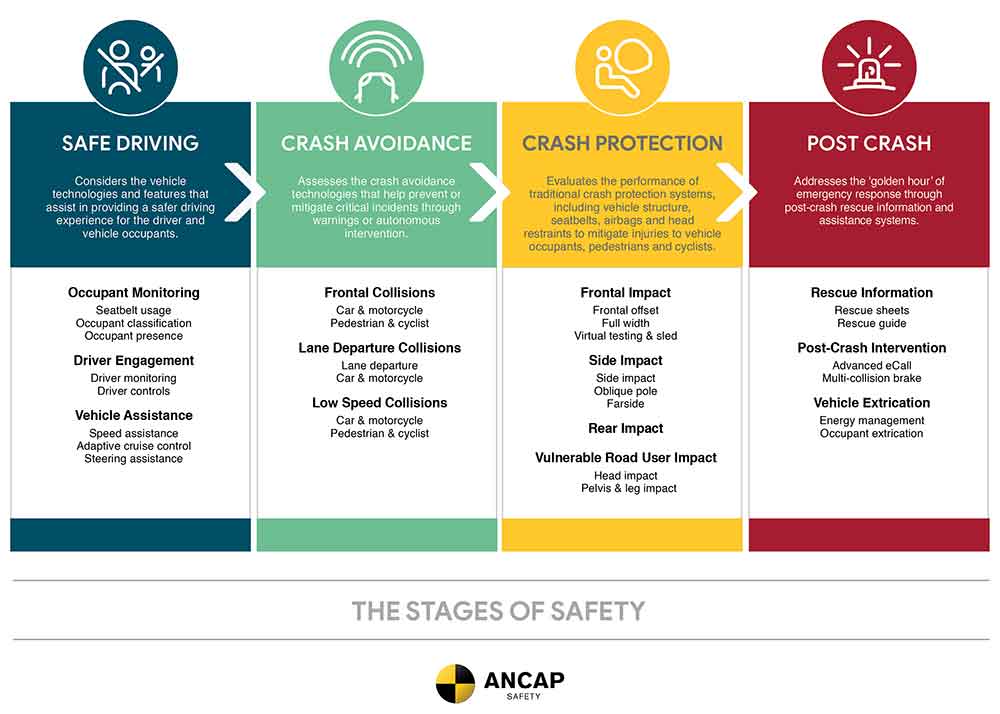
The four assessment areas evaluated from 2026, known as the Stages of Safety, will each be scored out of 100 points and will be expressed as a percentage for consumers seeking information beyond the simple star rating system.
Minimum thresholds will continue to apply for each stage – determining the overall star rating.
Learn more about ANCAP’s new car safety testing protocols



More articles
Related topics
Things to note
The information in this article has been prepared for general information purposes only and is not intended as legal advice or specific advice to any particular person. Any advice contained in the document is general advice, not intended as legal advice or professional advice and does not take into account any person’s particular circumstances. Before acting on anything based on this advice you should consider its appropriateness to you, having regard to your objectives and needs.
Insurance Products (excluding Travel Insurance) are issued by RACQ Insurance Limited ABN 50 009 704 152 (RACQI) and arranged by RACQ Distribution Services Pty Ltd (RDS) ABN 35 116 361 650, AFSL 567130 and RDS' authorised representatives (including RACQ Operations Pty Ltd ABN 80 009 663 414, AR No. 234978 (RACQO)). Conditions, limits and exclusions apply.
Any advice provided by RDS and RACQO is general advice only and does not take into account your personal objectives, financial situation or needs and you will need to consider whether the advice is appropriate for you. Read the Product Disclosure Statement (PDS) before making a purchase decision on the product. You can also access our Target Market Determinations on this website.
RDS receives a commission from RACQI for the policies it arranges. RACQO receives fees paid for services it provides to RDS. Further details about remuneration are available on request prior to purchasing.
Banking and loan products issued by Members Banking Group Limited ABN 83 087 651 054 AFSL/Australian credit licence 241195 trading as RACQ Bank. Terms, conditions, fees, charges and lending policies apply. This is general advice only and may not be right for you. This information does not take your personal objectives, circumstances or needs into account. Read the disclosure documents for your selected product or service, including the Financial Services Guide and the Terms and Conditions, and consider if appropriate for you before deciding.
Except for RACQ Bank, any RACQ entity referred to on this page is not an authorised deposit-taking institution for the purposes of the Banking Act 1959 (Cth). That entity’s obligations do not represent deposits or other liabilities of RACQ Bank. RACQ Bank does not guarantee or otherwise provide assurance in respect of the obligations of that entity, unless noted otherwise.
RACQ Bank subscribes to the Customer Owned Banking Code of Practice which establishes higher standards than the law requires. The Code reflects modern consumer expectations and developments in approaches to issues such as consumer vulnerability, guarantors, and supporting customers through financial hardship. Please read our Customer Owned Banking Code of Practice page for more information.
RACQ Operations Pty Ltd (ABN 80 009 663 414, AR No. 234978) and Members Travel Group Pty Ltd (ABN 45 144 538 803, AR No.432492) (RACQ) are authorised representatives of the RACQ Travel Insurance insurer Tokio Marine & Nichido Fire Insurance Co., Ltd. (ABN 80 000 438 291 AFSL 246 548) (Tokio Marine). Tokio Marine Management (Australasia) Pty Ltd (ABN 69 001 488 455, AR No. 1313066) is an authorised representative of Tokio Marine, and administers RACQ Travel Insurance as the managing agent on behalf of Tokio Marine. Terms, conditions (including eligibility criteria), exclusions, limits and sub-limits apply. Any advice is general advice only, and does not take into account your specific objectives, financial situation or needs. Before you purchase, please consider the Combined Product Disclosure Statement (PDS) / Financial Services Guide (FSG) and Target Market Determinations (TMDs) available at racq.com or on request from RACQ.