
How to tell if you need new tyres
Tread depth
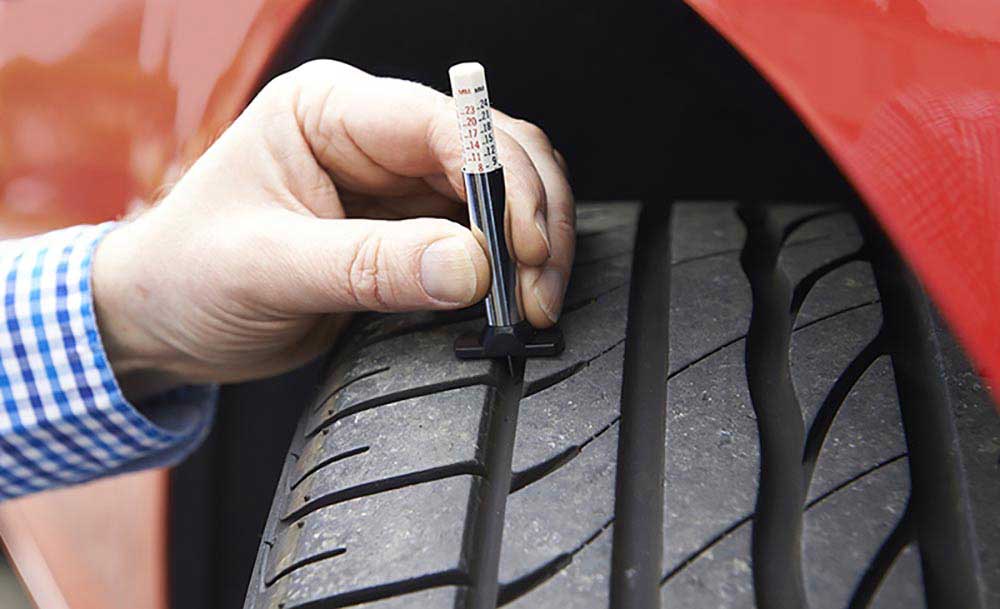
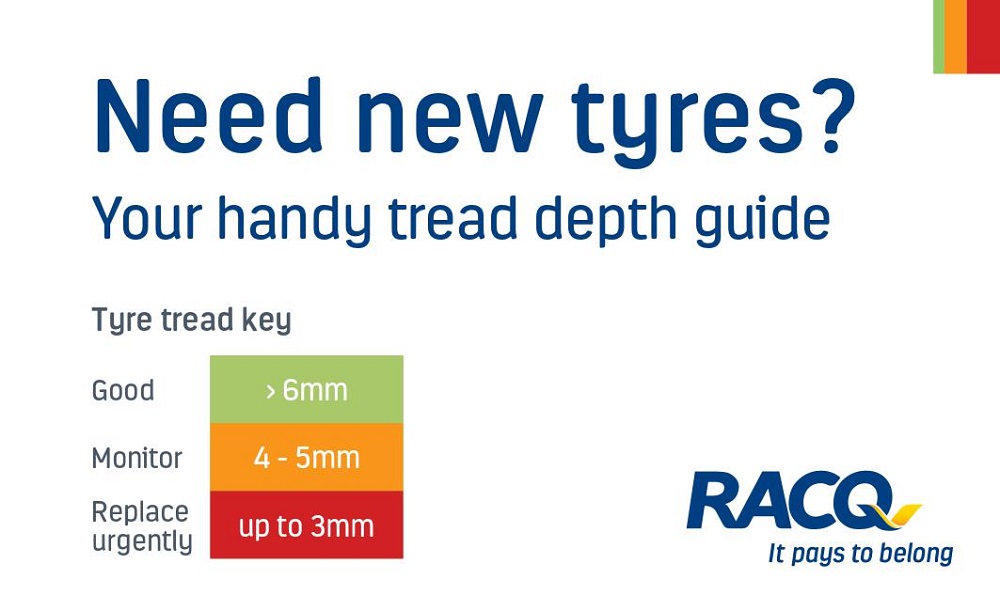
The tread depth on your tyres should never fall below 1.6 millimetres. If you regularly drive on slick or wet surfaces you will be better off with twice that much depth. You can easily buy a gauge to measure your tread depth the same way the professionals do.
These days tyres have convenient tread wear indicator bars built into them. These bars are barely visible when the tyre is new but as they gradually wear down these bars begin to appear. The bars are flat and run perpendicular to the direction of the trend itself. If more than one or two are visible this means the tread is getting low and the tyre needs replacing. The tread bars will be particularly obvious when driving on wet tracks as they will leave obvious prints. However, it is better to change your tyres before you reach this point as it is dangerous to drive in the wet without proper tyre tread.
Print off this handy tread guide
Leaks and weak spots
The other place in which problems with tyres can appear is in the side wall. Visual checks of this area are relatively simple. Look for tracks or cuts in the sidewall. These should be quite obvious to the naked eye. A particularly noticeable mark in the sidewall could be a sign your tyre is developing leaks or even worse, is ready to blow and will need replacing immediately. Take note of cracked and weathered sidewalls as these signs of wear can also lead to future problems.
If you can see a bulge or a blister on your tyre that seems to extend outward from the rest of the surface, it could mean the outer surface of the tyre has begun to weaken. This weak spot can cause a sudden blowout, which is extremely dangerous when your vehicle is moving. Get into the habit of checking for weak spots on your tyres regularly.
Vibrations
Vibration is inevitable when driving especially on poorly paved or unpaved roads. If you have been driving for a while you will probably be able to tell the difference between normal vibrations and when something is not right.
Lots of vibration could mean that your tyres are misaligned or unbalanced. It could also mean that your shock absorbers are starting to go or there is an internal problem with one of your tyres. Even if your tyres are not the direct cause of the vibration, they could eventually damage the tyre.
If you notice a large amount of vibration, particularly when driving on well-paved roads, you should get your car checked out right away.

More articles
Related topics
Things to note
The information in this article has been prepared for general information purposes only and is not intended as legal advice or specific advice to any particular person. Any advice contained in the document is general advice, not intended as legal advice or professional advice and does not take into account any person’s particular circumstances. Before acting on anything based on this advice you should consider its appropriateness to you, having regard to your objectives and needs.
Insurance Products (excluding Travel Insurance) are issued by RACQ Insurance Limited ABN 50 009 704 152 (RACQI) and arranged by RACQ Distribution Services Pty Ltd (RDS) ABN 35 116 361 650, AFSL 567130 and RDS' authorised representatives (including RACQ Operations Pty Ltd ABN 80 009 663 414, AR No. 234978 (RACQO)). Conditions, limits and exclusions apply.
Any advice provided by RDS and RACQO is general advice only and does not take into account your personal objectives, financial situation or needs and you will need to consider whether the advice is appropriate for you. Read the Product Disclosure Statement (PDS) before making a purchase decision on the product. You can also access our Target Market Determinations on this website.
RDS receives a commission from RACQI for the policies it arranges. RACQO receives fees paid for services it provides to RDS. Further details about remuneration are available on request prior to purchasing.
Banking and loan products issued by Members Banking Group Limited ABN 83 087 651 054 AFSL/Australian credit licence 241195 trading as RACQ Bank. Terms, conditions, fees, charges and lending policies apply. This is general advice only and may not be right for you. This information does not take your personal objectives, circumstances or needs into account. Read the disclosure documents for your selected product or service, including the Financial Services Guide and the Terms and Conditions, and consider if appropriate for you before deciding.
Except for RACQ Bank, any RACQ entity referred to on this page is not an authorised deposit-taking institution for the purposes of the Banking Act 1959 (Cth). That entity’s obligations do not represent deposits or other liabilities of RACQ Bank. RACQ Bank does not guarantee or otherwise provide assurance in respect of the obligations of that entity, unless noted otherwise.
RACQ Bank subscribes to the Customer Owned Banking Code of Practice which establishes higher standards than the law requires. The Code reflects modern consumer expectations and developments in approaches to issues such as consumer vulnerability, guarantors, and supporting customers through financial hardship. Please read our Customer Owned Banking Code of Practice page for more information.
RACQ Operations Pty Ltd (ABN 80 009 663 414, AR No. 234978) and Members Travel Group Pty Ltd (ABN 45 144 538 803, AR No.432492) (RACQ) are authorised representatives of the RACQ Travel Insurance insurer Tokio Marine & Nichido Fire Insurance Co., Ltd. (ABN 80 000 438 291 AFSL 246 548) (Tokio Marine). Tokio Marine Management (Australasia) Pty Ltd (ABN 69 001 488 455, AR No. 1313066) is an authorised representative of Tokio Marine, and administers RACQ Travel Insurance as the managing agent on behalf of Tokio Marine. Terms, conditions (including eligibility criteria), exclusions, limits and sub-limits apply. Any advice is general advice only, and does not take into account your specific objectives, financial situation or needs. Before you purchase, please consider the Combined Product Disclosure Statement (PDS) / Financial Services Guide (FSG) and Target Market Determinations (TMDs) available at racq.com or on request from RACQ.