
Big utes face crash avoidance testing
ANCAP safety recently examined the crash avoidance capability of full-size pickups like RAM and F-150, with some surprising results.
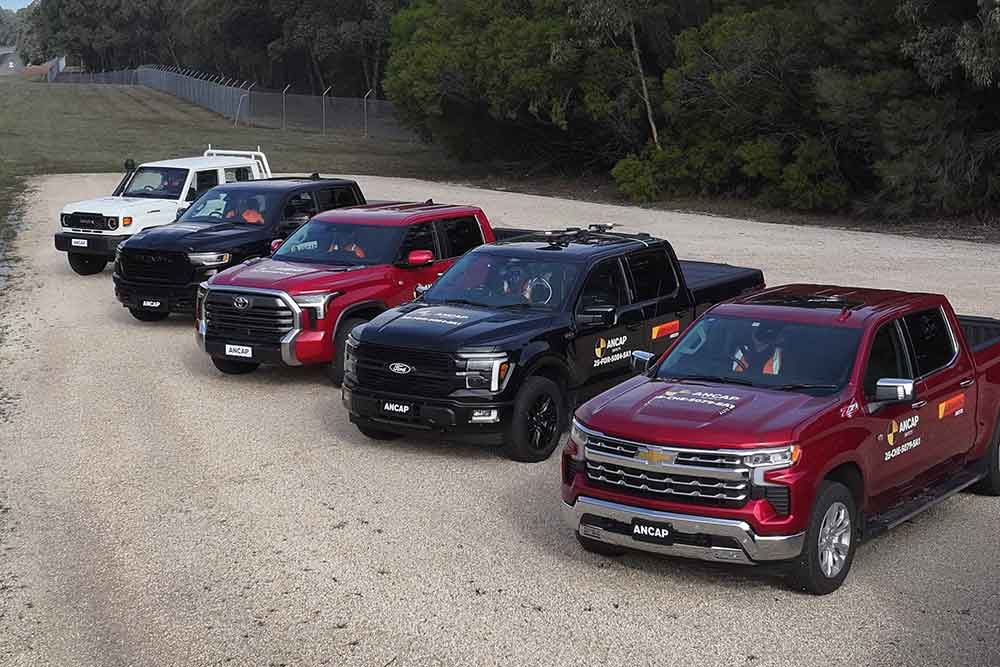
Utes or ‘pickups’ as the Americans prefer to call them are one of Australia’s most popular vehicle styles, with the Ford Ranger recently notching up its third successive year as Australia’s best-selling vehicle.
This is due in part to the Ranger and medium-duty ute rivals like the Toyota HiLux having dramatically improved their safety performance over the years, with most competitors in this segment now boasting a five-star ANCAP rating.
But the same cannot be said for full-size US pickups like the RAM and Chevrolet Silverado.
Locally reengineered versions of these full-size pickups have found a receptive market here in recent years as Australians consumers look for something big enough to haul their ever-larger caravans, boats and other recreational accessories.
Sales of large US-sourced pickups, also known as the over $100,000 Pickup segment, have been on a tear here for several years, setting a high-water mark of 10,611 sales in 2024, before stumbling last year to a still significant 8,763 sales, a decline of 17.4%.
Despite their growing presence on our roads, crash safety data on full-size pickups is relatively thin on the ground, promoting ANCAP safety to examine how well these large pickups protect road users by testing their crash avoidance technology in its inaugural Large Utilities ADAS Safety Comparison.
The new safety comparison – which examines NB and NA category utes with a Gross Combination Mass (GCM) of 7.0 tonnes or above –
stops short of being a full crash safety analysis, focusing instead on the ADAS performance and crash-avoidance capabilities of these vehicles.
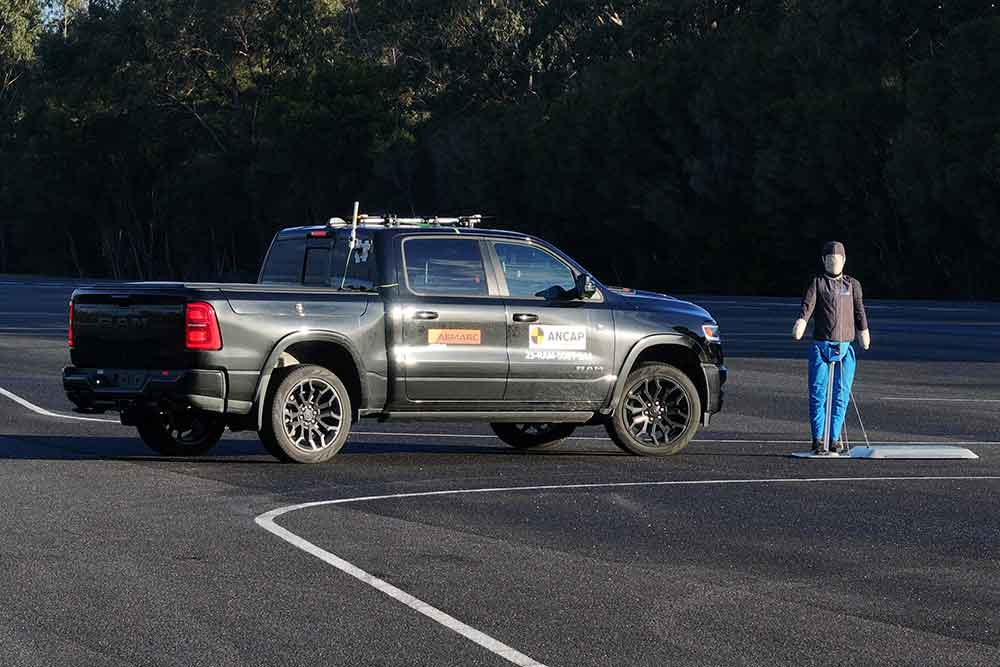
The Dodge Ram scored a Gold safety grading from ANCAP for its active safety features.
“There is community concern over the size of pickups when they are driving in suburban streets, around schools, and in built-up areas,” ANCAP Chief Executive Officer Carla Hoorweg said.
“Larger vehicles pose a bigger threat to other road users than passenger cars. The best way to reduce the potential risk of fatalities and serious injuries from large vehicles is to make sure they do the best possible job at avoiding a crash.
“We have applied international best practice in safety testing to this segment to make sure there is an incentive for manufacturers to improve crash avoidance technology.”
ANCAP’s test included the Big Four American-sourced players – Ford F-150, RAM, Chevrolet Silverado and Toyota Tundra – as well as that perennial favourite of Aussie farmers and graziers, the LandCruiser 70 Series.
ANCAP found the updated Ford F-150 to have the most comprehensive ranges of active safety features of the large utilities assessed, with the big Ford achieving the highest score (81%) and a Platinum safety grading. Note that the grading applies to MY24 Ford F-150 vehicles available for customer deliveries from Q1 2026, so earlier models may not have the same rating and performance.
Next highest was the RAM 1500 (MY25), which also came fitted with a broad range of well-performing features, scoring 70% and a Gold safety grading.
Two Toyota models tested
The two Toyota models tested included the LandCruiser 79 Series (from September 2022 build) and Tundra (from October 2023 build), each providing a reasonable level of performance achieving Silver.
Surprisingly, Toyota’s workhorse LC79 outshone its Tundra stablemate with scores of 55% and 50% respectively.
Bringing up the rear was the Chevrolet Silverado 1500 LTZ and ZR2 variants (from February 2025 build), which offer a narrower range of crash avoidance performance, resulting in a safety grading of Bronze (27%).
ANCAP’s summary was that the vehicles tested exhibited a high degree of advanced safety technologies, with a strong base to build from and a clear opportunity to achieve the performance levels seen in passenger vehicles.
The organisation said its initial comparisons will be used to inform the development of a framework and roadmap for future testing and assessment, with additional safety information expected to be available for a broader range of large pickup models/variants from 2026.
While it gave no specific commitment to crash-testing these vehicles, ANCAP did say that future phases could potentially extend into physical crash protection, ensuring the full picture of both crash avoidance and crash protection.


More articles
Related topics
Things to note
The information in this article has been prepared for general information purposes only and is not intended as legal advice or specific advice to any particular person. Any advice contained in the document is general advice, not intended as legal advice or professional advice and does not take into account any person’s particular circumstances. Before acting on anything based on this advice you should consider its appropriateness to you, having regard to your objectives and needs.
Insurance Products (excluding Travel Insurance) are issued by RACQ Insurance Limited ABN 50 009 704 152 (RACQI) and arranged by RACQ Distribution Services Pty Ltd (RDS) ABN 35 116 361 650, AFSL 567130 and RDS' authorised representatives (including RACQ Operations Pty Ltd ABN 80 009 663 414, AR No. 234978 (RACQO)). Conditions, limits and exclusions apply.
Any advice provided by RDS and RACQO is general advice only and does not take into account your personal objectives, financial situation or needs and you will need to consider whether the advice is appropriate for you. Read the Product Disclosure Statement (PDS) before making a purchase decision on the product. You can also access our Target Market Determinations on this website.
RDS receives a commission from RACQI for the policies it arranges. RACQO receives fees paid for services it provides to RDS. Further details about remuneration are available on request prior to purchasing.
Banking and loan products issued by Members Banking Group Limited ABN 83 087 651 054 AFSL/Australian credit licence 241195 trading as RACQ Bank. Terms, conditions, fees, charges and lending policies apply. This is general advice only and may not be right for you. This information does not take your personal objectives, circumstances or needs into account. Read the disclosure documents for your selected product or service, including the Financial Services Guide and the Terms and Conditions, and consider if appropriate for you before deciding.
Except for RACQ Bank, any RACQ entity referred to on this page is not an authorised deposit-taking institution for the purposes of the Banking Act 1959 (Cth). That entity’s obligations do not represent deposits or other liabilities of RACQ Bank. RACQ Bank does not guarantee or otherwise provide assurance in respect of the obligations of that entity, unless noted otherwise.
RACQ Bank subscribes to the Customer Owned Banking Code of Practice which establishes higher standards than the law requires. The Code reflects modern consumer expectations and developments in approaches to issues such as consumer vulnerability, guarantors, and supporting customers through financial hardship. Please read our Customer Owned Banking Code of Practice page for more information.
RACQ Operations Pty Ltd (ABN 80 009 663 414, AR No. 234978) and Members Travel Group Pty Ltd (ABN 45 144 538 803, AR No.432492) (RACQ) are authorised representatives of the RACQ Travel Insurance insurer Tokio Marine & Nichido Fire Insurance Co., Ltd. (ABN 80 000 438 291 AFSL 246 548) (Tokio Marine). Tokio Marine Management (Australasia) Pty Ltd (ABN 69 001 488 455, AR No. 1313066) is an authorised representative of Tokio Marine, and administers RACQ Travel Insurance as the managing agent on behalf of Tokio Marine. Terms, conditions (including eligibility criteria), exclusions, limits and sub-limits apply. Any advice is general advice only, and does not take into account your specific objectives, financial situation or needs. Before you purchase, please consider the Combined Product Disclosure Statement (PDS) / Financial Services Guide (FSG) and Target Market Determinations (TMDs) available at racq.com or on request from RACQ.