

Road rules: How to wear a seatbelt correctly in Queensland

Car Safety
Wearing a properly adjusted and fastened seatbelt is compulsory in Queensland for all motor vehicle occupants.
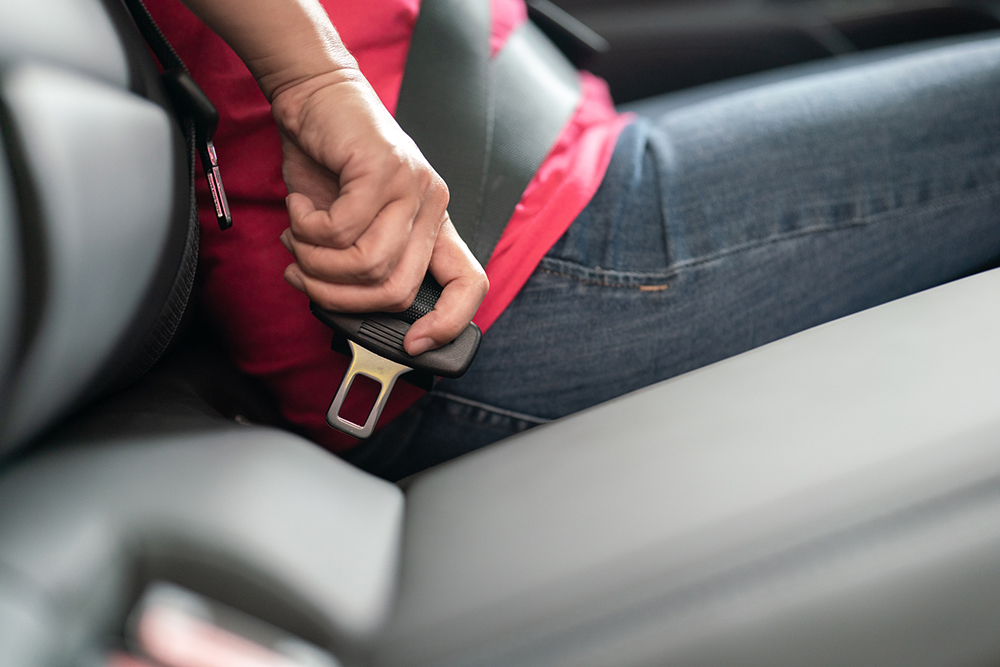
Person clicking in their seatbelt.

How to wear a seatbelt correctly

Seatbelts must always be worn correctly to provide maximum protection in the event of a crash.

  • The shoulder belt must run firmly across your shoulder and chest.
  • The lap belt must sit securely across your pelvic area, buckled low on your hips.

If you recline your seat

If your seat is reclined, you must ensure the seatbelt remains positioned correctly across your shoulder and chest. Improper positioning reduces the effectiveness of the restraint system.

Driver responsibilities

Drivers in Queensland are responsible for ensuring all occupants are correctly restrained at all times.

  • The driver and every passenger must wear a properly fitted seatbelt.
  • Children must use Australian Standard approved child restraints where required.
  • Each seating position in a vehicle may only be occupied by one person.

Correct and incorect examples of how to wear a seatbelt.

The correct, left, and incorrect ways to wear a seatbelt.

Seatbelt exemptions in Queensland

Seatbelt exemptions apply only in limited circumstances and must meet strict requirements.

  • You have a valid seatbelt exemption certificate issued by a qualified medical practitioner due to a medical condition or disability.
  • The vehicle was manufactured without seatbelts and the passenger is aged seven years or older.

Children under seven years of age are not permitted to travel in vehicles without correctly fitted seatbelts or child restraints.

Certain drivers — including bus drivers and taxi or rideshare drivers in specific situations — may be exempt from ensuring passengers are wearing seatbelts.

Why seatbelt safety matters

Wearing a correctly fitted seatbelt significantly reduces the risk of injury or death in a crash.

  • Proper seatbelt use can reduce the risk of fatal or serious injury by up to 50%.
  • Unrestrained occupants are several times more likely to be killed in a crash.

Did you know?

Seatbelt use became mandatory in Queensland on 1 January 1972, following Victoria’s world-first seatbelt law introduced in December 1970*.

By 1972, seatbelt laws were implemented nationwide, requiring drivers and passengers to wear a seatbelt where one was fitted.

Early adoption of these laws led to rapid road safety improvements. Victoria recorded approximately a 13% reduction in road fatalities in the first year, encouraging other states to introduce similar legislation.

*Source: MAIC–QUT Road Safety Research Collaboration

Learn more about Queensland road rules

RACQ provides road rules and safety advice to help protect all road users.

For more information about Queensland road rules, visit Transport and Main Roads Queensland or call 13 23 80.

 

Related topics

Things to note

The information in this article has been prepared for general information purposes only and is not intended as legal advice or specific advice to any particular person. Any advice contained in the document is general advice, not intended as legal advice or professional advice and does not take into account any person’s particular circumstances. Before acting on anything based on this advice you should consider its appropriateness to you, having regard to your objectives and needs.

Insurance Products (excluding Travel Insurance) are issued by RACQ Insurance Limited ABN 50 009 704 152 (RACQI) and arranged by RACQ Distribution Services Pty Ltd (RDS) ABN 35 116 361 650, AFSL 567130 and RDS' authorised representatives (including RACQ Operations Pty Ltd ABN 80 009 663 414, AR No. 234978 (RACQO)). Conditions, limits and exclusions apply.

Any advice provided by RDS and RACQO is general advice only and does not take into account your personal objectives, financial situation or needs and you will need to consider whether the advice is appropriate for you. Read the Product Disclosure Statement (PDS) before making a purchase decision on the product. You can also access our Target Market Determinations on this website.

RDS receives a commission from RACQI for the policies it arranges. RACQO receives fees paid for services it provides to RDS. Further details about remuneration are available on request prior to purchasing.

Banking and loan products issued by Members Banking Group Limited ABN 83 087 651 054 AFSL/Australian credit licence 241195 trading as RACQ Bank. Terms, conditions, fees, charges and lending policies apply. This is general advice only and may not be right for you. This information does not take your personal objectives, circumstances or needs into account. Read the disclosure documents for your selected product or service, including the Financial Services Guide and the Terms and Conditions, and consider if appropriate for you before deciding.

Except for RACQ Bank, any RACQ entity referred to on this page is not an authorised deposit-taking institution for the purposes of the Banking Act 1959 (Cth). That entity’s obligations do not represent deposits or other liabilities of RACQ Bank. RACQ Bank does not guarantee or otherwise provide assurance in respect of the obligations of that entity, unless noted otherwise.

RACQ Bank subscribes to the Customer Owned Banking Code of Practice which establishes higher standards than the law requires. The Code reflects modern consumer expectations and developments in approaches to issues such as consumer vulnerability, guarantors, and supporting customers through financial hardship. Please read our Customer Owned Banking Code of Practice page for more information.

RACQ Operations Pty Ltd (ABN 80 009 663 414 AR 000234978) and Members Travel Group Pty Ltd (ABN 45 144 538 803 AR 000432492) are acting as an Authorised Representative of the issuer of the insurance, Tokio Marine & Nichido Fire Insurance Co., Ltd. (ABN 80 000 438 291 AFSL 246 548). Any advice set out above is general in nature only, and does not take into account your objectives, financial situation or needs. Before purchasing any travel products, please consider the RACQ Travel Insurance Product Disclosure Statement (PDS) and the Target Market Determinations (TMDs) that apply to these products. Whilst the PDS outlines the Terms and Conditions of these products, the TMDs outline the intended class of customers that comprise the target market for these travel products. This will allow you to consider which products best suit your objectives, financial situation and needs and consider the products appropriateness to your personal circumstances. TMDs also outline matters involving the distribution and the review of these products. The PDS, Supplementary PDS and TMDs for each travel product can be found here.