
Electric HiLux due in May
Toyota has skipped the PHEV stage and gone straight to a full battery electric HiLux.
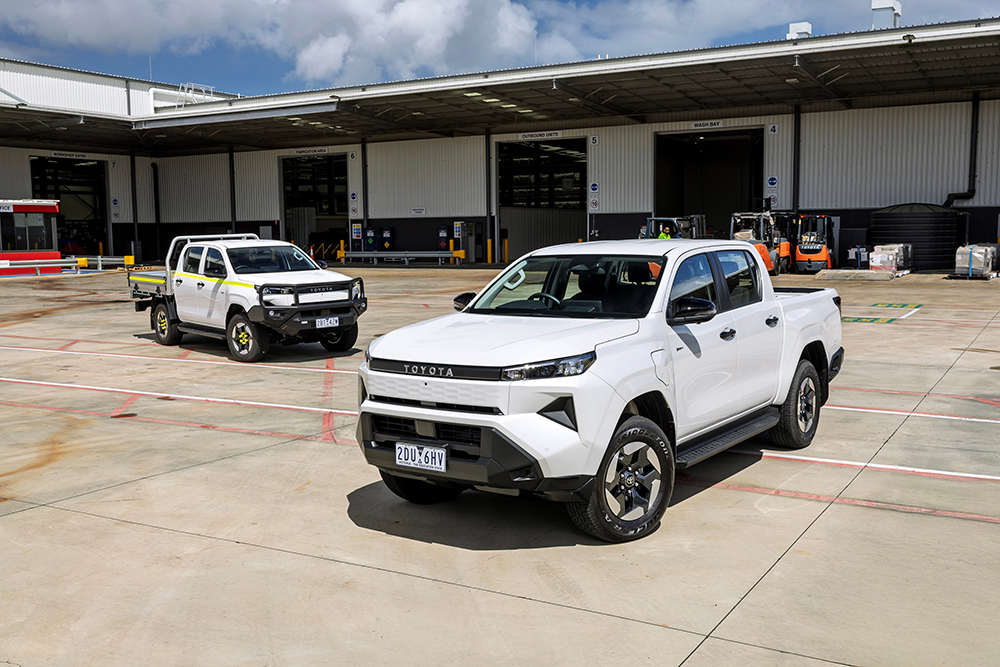
The light-commercial HiLux BEV has been designed with government fleets, mining and construction sectors in mind, with Toyota aiming it squarely at fleet customers looking to reduce tailpipe emissions.
The HiLux BEV has undergone an extensive local testing program with leading mining organisations prior to its launch to ensure it can match the performance, durability, and capability of its well-regarded diesel-powered stablemates.
The electric HiLux is available exclusively as an all-wheel drive, with double-cab body style and in mid-spec SR and high-grade SR5 guise.
Pricing and model lineup
Manufacturer recommended retail pricing starts with the SR double cab-chassis at $74,990, rising to $76,490 for the SR Double Cab pickup, and topping out with the flagship SR5 Pickup at $82,990.This compares with manufacturer recommended retail pricing for the equivalent diesel-powered auto transmission variants of $57,990 for the SR Double Cab Chassis, $59,490 for the SR Double Cab Pickup, and $65,990 for the SR5 Double Cab Pickup.
Design and interior updates
The battery-electric HiLux features similar ‘Cyber Sumo’ styling as that which debuted on the new eighth-generation HiLux last December, with key design changes including a closed-off upper front grille and aerodynamically enhanced 17-inch alloy wheels.
Vehicle features and interior trim are largely as per the equivalent diesel variants, with the HiLux BEV adopting the same all-new interior, upgraded chassis, safety, and multimedia upgrades as its stablemates.
Electric powertrain and battery technology
But there are some big changes under the skin where the HiLux BEV features a dual motor electric powertrain in lieu of the regular model’s 2.8-litre four-cylinder turbodiesel engine.
The electric drivetrain comprises a front motor producing 82kW and 206Nm, and a more powerful rear unit capable of 129kW and 269Nm of output. Combined system outputs are 144kW/468Nm.
Other changes to the HiLux BEV over its combustion stablemates include frame reinforcements, beefed-up MacPherson strut front suspension, and a De-dion rear leaf spring setup to accommodate the rear electric motor, plus a live axle.
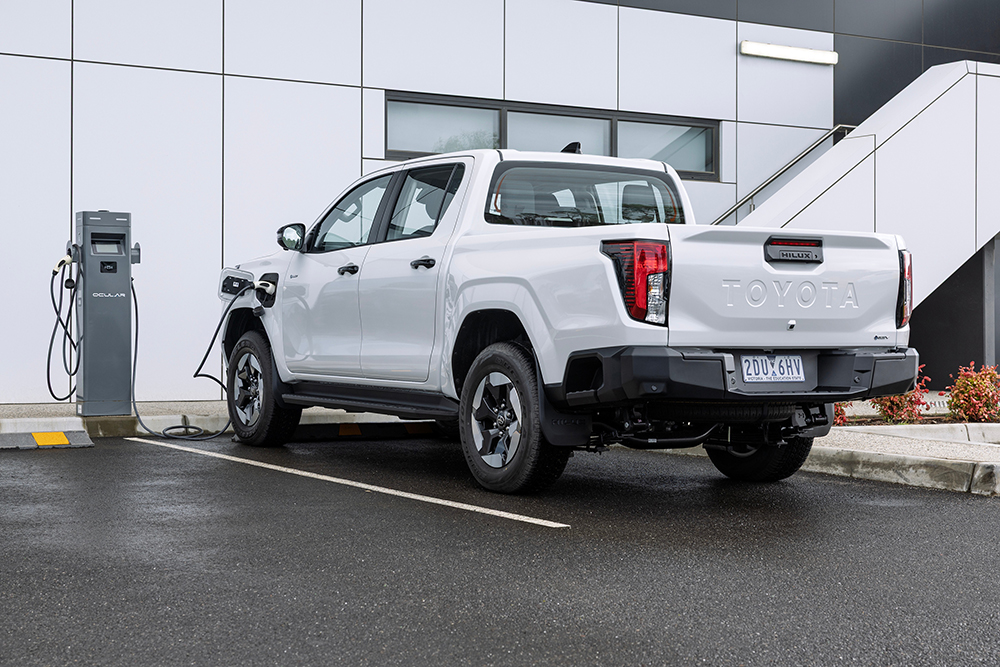
The twin motors draw power from a 59.2kWh lithium-ion battery enabling a driving range for the pickup grades of 315km on the more lenient NEDC cycle, while the SR cab-chassis is rated at 245km.
The pickup’s 315km converts to around 268km on the more realistic WLTP cycle.
The battery offers 150kW DC charging capability, so can be replenished from 10-80% in around 30 minutes, while 10kW three-phase AC charging takes about 6.5 hours from 10-100%.
Toyota claims the battery’s location within the vehicle frame ensures a low centre of gravity and no compromise or intrusion into the cabin space or tub.
Fitment within the chassis rails also ensures the battery is protected from twisting forces when driving off-road, with dedicated underbody protection plates adding further protection.
Toyota’s Multi-Terrain Select traction control system offers a range of drive modes to suit different off-road conditions, including Rock, Sand, Mud, Dirt and Moguls.
Off-road capability and trade-offs
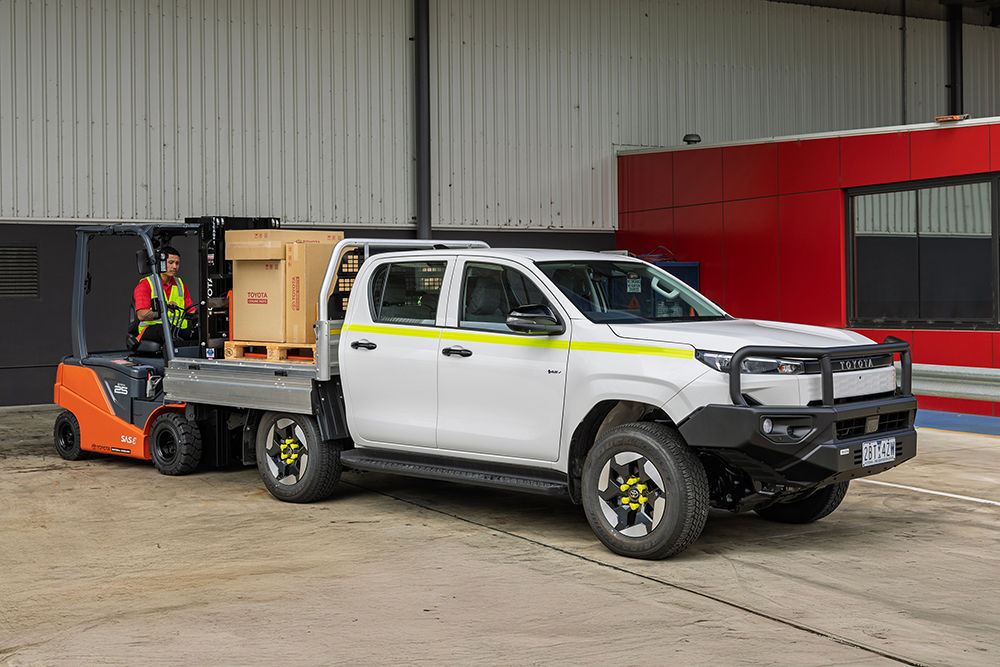
The HiLux BEV also maintains the same off-road capability as its diesel-powered counterparts, with a 700mm wading depth, 29-degree approach and 25-degree departure angles, and 218mm of ground clearance.However, a key area where the HiLux BEV departs from its diesel stablemates is the drivetrain’s torque distribution being variably controlled between the front and rear axles during on-road driving, making this the first HiLux to offer a full-time electronically-controlled all-wheel drive system.
While the HiLux BEV’s combined system outputs of 144kW/468Nm are broadly comparable with the diesels’ 150kW/500Nm, the 2,000kg maximum braked towing capacity is well short of the 3,500kg offered by the diesel.
Likewise, the estimated maximum driving range of 315km range is around 700km less than you could travel on a full tank in a diesel HiLux.
Where the HiLux BEV wins back major ground is the fact it emits zero tailpipe emissions compared to the diesel variants, which emits over 200grams of C02 for every kilometre travelled.
Scaled over a year, a typical diesel HiLux will emit around three tonnes of CO2, meaning the HiLux BEV charged on green electricity can make a significant environmental difference.
Modest expectations for sales
While Toyota’s sales expectations for the HiLux BEV are expected to be relatively modest, representing only a fraction of the diesel-powered versions sold, Toyota dealers will no doubt be happy to have some ammunition to counter the growing threat from the BYD Shark 6 plug-in hybrid (PHEV) which forced its way into the top five of the 4x4 dual cab market with 18,073 sales last year.
The Ford Ranger, the HiLux’s main rival in the dual cab ute space, also has a PHEV variant available, while several other Chinese brands are poised to launch rivals later this year.
While PHEVS are growing strongly in popularity, sales volumes of full battery electric utes are still relatively small.
Chinese car maker LDV has the distinction of being first into the segment with its eT60, while late last year Korean car maker KGM launched a fully electric version of its Musso dual cab.
Available in both 4x2 and 4x4 variants, the Musso EV 4WD costs $62,000, is powered by an 80.6 kWh Lithium Iron Phosphate (LFP) blade battery, delivers combined system outputs of 266kW/630Nm, and has a claimed 380km driving range.


More articles
Related topics
Things to note
The information in this article has been prepared for general information purposes only and is not intended as legal advice or specific advice to any particular person. Any advice contained in the document is general advice, not intended as legal advice or professional advice and does not take into account any person’s particular circumstances. Before acting on anything based on this advice you should consider its appropriateness to you, having regard to your objectives and needs.
Insurance Products (excluding Travel Insurance) are issued by RACQ Insurance Limited ABN 50 009 704 152 (RACQI) and arranged by RACQ Distribution Services Pty Ltd (RDS) ABN 35 116 361 650, AFSL 567130 and RDS' authorised representatives (including RACQ Operations Pty Ltd ABN 80 009 663 414, AR No. 234978 (RACQO)). Conditions, limits and exclusions apply.
Any advice provided by RDS and RACQO is general advice only and does not take into account your personal objectives, financial situation or needs and you will need to consider whether the advice is appropriate for you. Read the Product Disclosure Statement (PDS) before making a purchase decision on the product. You can also access our Target Market Determinations on this website.
RDS receives a commission from RACQI for the policies it arranges. RACQO receives fees paid for services it provides to RDS. Further details about remuneration are available on request prior to purchasing.
Banking and loan products issued by Members Banking Group Limited ABN 83 087 651 054 AFSL/Australian credit licence 241195 trading as RACQ Bank. Terms, conditions, fees, charges and lending policies apply. This is general advice only and may not be right for you. This information does not take your personal objectives, circumstances or needs into account. Read the disclosure documents for your selected product or service, including the Financial Services Guide and the Terms and Conditions, and consider if appropriate for you before deciding.
Except for RACQ Bank, any RACQ entity referred to on this page is not an authorised deposit-taking institution for the purposes of the Banking Act 1959 (Cth). That entity’s obligations do not represent deposits or other liabilities of RACQ Bank. RACQ Bank does not guarantee or otherwise provide assurance in respect of the obligations of that entity, unless noted otherwise.
RACQ Bank subscribes to the Customer Owned Banking Code of Practice which establishes higher standards than the law requires. The Code reflects modern consumer expectations and developments in approaches to issues such as consumer vulnerability, guarantors, and supporting customers through financial hardship. Please read our Customer Owned Banking Code of Practice page for more information.
RACQ Operations Pty Ltd (ABN 80 009 663 414, AR No. 234978) and Members Travel Group Pty Ltd (ABN 45 144 538 803, AR No.432492) (RACQ) are authorised representatives of the RACQ Travel Insurance insurer Tokio Marine & Nichido Fire Insurance Co., Ltd. (ABN 80 000 438 291 AFSL 246 548) (Tokio Marine). Tokio Marine Management (Australasia) Pty Ltd (ABN 69 001 488 455, AR No. 1313066) is an authorised representative of Tokio Marine, and administers RACQ Travel Insurance as the managing agent on behalf of Tokio Marine. Terms, conditions (including eligibility criteria), exclusions, limits and sub-limits apply. Any advice is general advice only, and does not take into account your specific objectives, financial situation or needs. Before you purchase, please consider the Combined Product Disclosure Statement (PDS) / Financial Services Guide (FSG) and Target Market Determinations (TMDs) available at racq.com or on request from RACQ.