

The road to self-driving cars
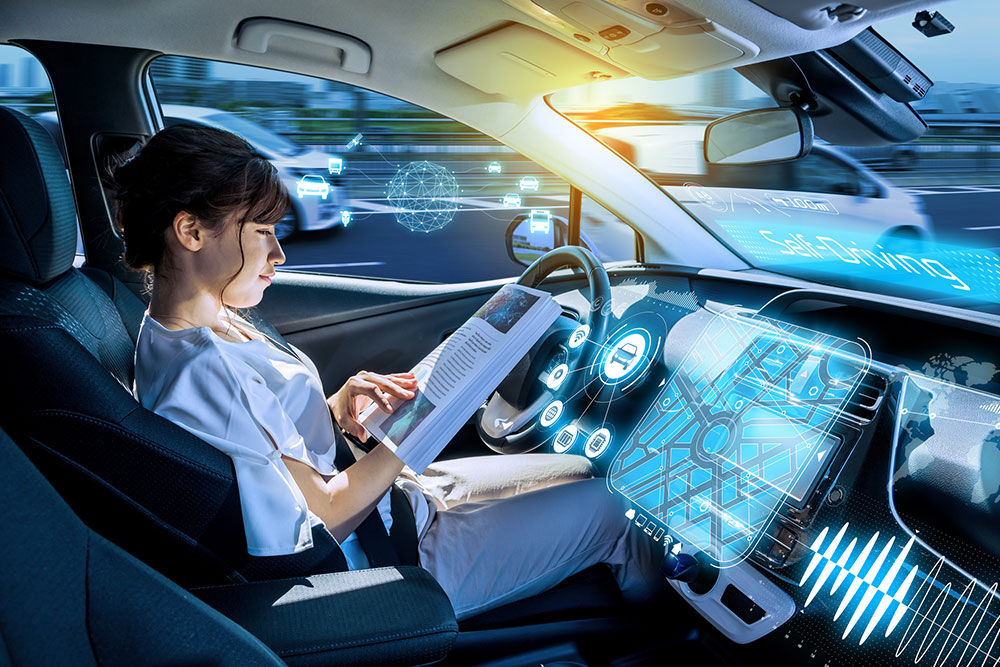
Imagine a world where you can hop into your vehicle and instead of taking the wheel you get into the back seat, take out the laptop and finish some work, or don a face mask and grab some shut-eye, leaving it to your self-driving car to ferry you autonomously to the destination requested.
This is the ‘glorious future’ that tech-entrepreneur and Tesla CEO Elon Musk envisages, telling an audience in October 2024 that the car-maker’s Level 3 driverless technology would be ready for roll-out on the brand’s Model 3 sedan and Model Y SUV in California and Texas in 2025.
“We’ll move from supervised Full Self-Driving to unsupervised Full Self-Driving, where you can fall asleep and wake up at your destination,” said Musk.
At the time of writing, the promised Level 3 roll-out in the USA had not occurred, but Tesla has since released in Australia the same Level 2 autonomous driving technology its vehicles in the USA and elsewhere are capable of.
Labelled ‘Full Self-Driving (Supervised)’, the feature costs $10,100 or $149 per month and is available as an Over the Air (OTA) update on vehicles equipped with the company’s HW4 computer hardware.
Earlier model Tesla’s equipped with HW3 software are currently unable to access the feature, despite some owners having paid for the technology in advance at the time of purchase.
How levels of autonomous driving are rated
Levels of autonomous driving are certified internationally by the Society of Automotive Engineers (SAE), which defines six levels, ranging from 0 (no automation) to five (full automation).
These levels describe the extent to which a vehicle can perform dynamic driving tasks.
Many modern cars already offer Level 1 technology, which includes features like adaptive cruise control, autonomous emergency braking and lane-keep assist, and a growing number of new vehicles have Level 2 capability.
Level 2, as deployed by Tesla in September, is the highest level of automation currently available to the public in Australia.
It means a vehicle can automatically steer, brake and accelerate, but only with a human driver supervising and being ready to take over the controls.
Level 3 autonomous driving, as promised by Musk last year, is a higher level of automation again, where the vehicle can handle all driving tasks under specific conditions, but the driver must be ready to take control when prompted by the system.
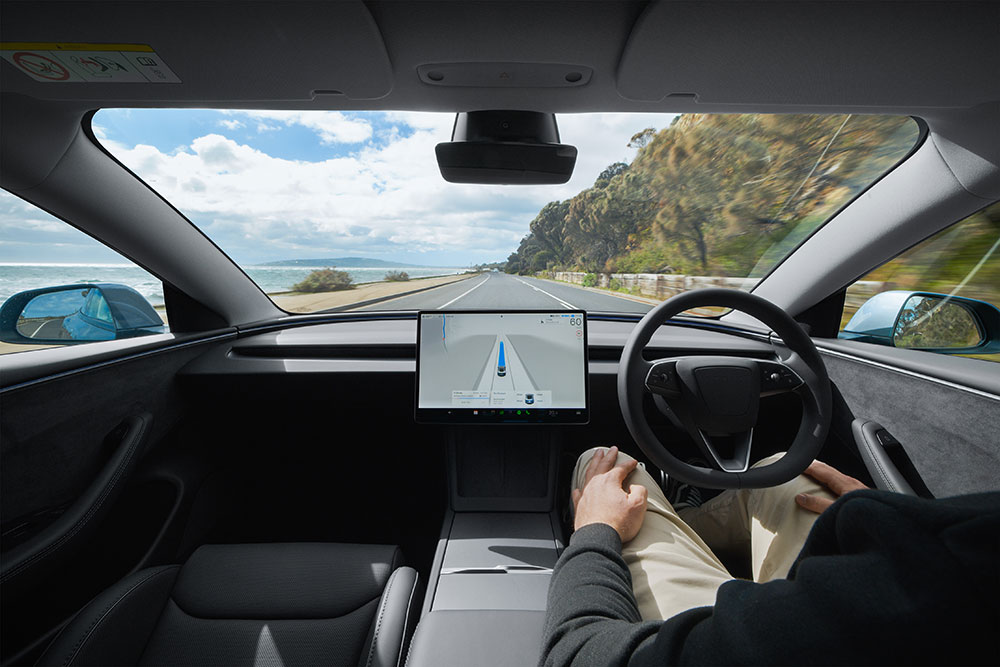
A Tesla with autonomous driving capability.
What are the rules in Australia?
Under current Australian law, a licensed human driver must always be in control of the vehicle, meaning more advanced systems, including Level 3 and above, are not yet permitted on public roads.
A statement on Queensland’s Department of Transport and Main Roads (TMR) website says there are currently no commercially available Level 3 or above automated vehicles approved to drive on Queensland roads, with no expected timeframe for release.
“There is no vehicle currently available in Australia safe enough to operate in 'self-driving' mode without a driver monitoring the driving task,” TMR says.
“Until completely self-driving cars are available without any monitoring or support from a human, the driver will always need to be an attentive while operating an automated vehicle.”
Most car makers are working towards increasing the level of autonomous driving tech in their cars, with Tesla one of the keenest advocates.
But the company has drawn criticism from some quarters for being too eager to deploy the technology on public roads before it is fully proven.
The car maker has faced lawsuits in the States in relation to crashes involving its vehicles, some of which have been fatal, and over the potentially misleading naming of its ‘Full Self-Driving’ technology.
Ironically, it was German luxury car maker Mercedes-Benz and not Tesla that won the race to sell the first Level 3 autonomous driving system in the USA with its Drive Pilot system gaining approval in Nevada in 2023 and California the following year.
The on-road development of autonomous vehicles is mostly being carried out with robotaxis.
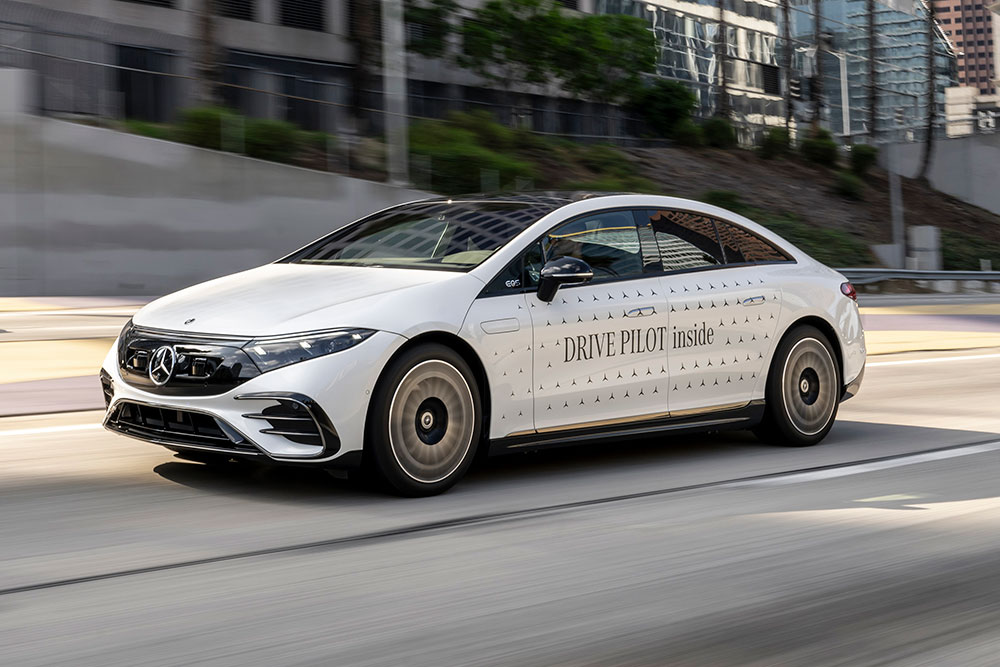
A Mercedes with Drive Pilot Level 3 autonomous driving.
Robotaxis on the road
Tesla, in June of this year, launched its Robotaxi pilot in Austin, Texas, using Model Y vehicles.
The program is available by invitation only, operates in a limited geographic area and requires a safety monitor seated in the passenger seat to oversee and intervene if necessary.
Tesla says it plans to roll out the service to other cities and countries, pending regulatory approvals.
There are other robotaxi autonomous vehicle trials being conducted without in-car driver monitors by Waymo in the US, and by Uber in the UK.
Of these, the Waymo trial is by far the biggest and most advanced, with the subsidiary of Google’s parent company Alphabet Inc. having tested fully driverless cars on public roads since 2015.
In 2020 Waymo became the first company to offer fully driverless robotaxi rides to the public in Phoenix, a service it has since expanded to San Franciso, Los Angeles and Austin.
These fully driverless vehicles are overseen by human-staffed control rooms where operators can remotely take control of a vehicle if necessary.
In a December 2024 report Waymo stated its cumulative robotaxi driverless miles had surpassed 50 million miles.
During this time Waymo vehicles have been involved in traffic accidents but the company claims its extensive data set, which is publicly available, shows its robotaxis are involved in fewer crashes and injuries than human drivers, with significant reductions in pedestrian, cyclist, and intersection crashes.
Challenges facing autonomous driving
Clearly, vehicles that can drive themselves raise some significant legal, moral and ethical issues, including the question of who is liable if a self-driving car crashes.
These questions and many more like them are currently being discussed and navigated by various governments worldwide, including here in Australia.
RACQ’s Head of Public Policy Michael Kane said the Club broadly supports driver assistance technologies and the ongoing improvement of vehicle safety technology, with certain caveats.
“If and when fully autonomous vehicles are proven to be safer than human drivers and we have the right regulatory framework in place, then it will be a good thing as it will mean less road trauma,” Mr Kane said.
However, he cautions that even with self-driving switched on the driver is still legally responsible and must be ready to take back control of the wheel at any time.
"The worst thing you can do if you buy a car fitted with Level 2 software is to think you can relax and let the car do the driving,” he said.
“If there is a crash and the fault is at your end, you may be charged."
The six levels of autonomous driving
Level 0: No automation
The human driver performs all driving tasks. The vehicle may have audible warnings but no automated control.
Level 1: Driver assistance
The vehicle can assist with either steering or acceleration/deceleration, but not simultaneously.
Level 2: Partial driving automation
The vehicle can control both steering and acceleration/deceleration at the same time. The driver must remain fully engaged and ready to take control.
Level 3: Conditional driving automation
The vehicle can handle all driving tasks under certain conditions, but the human driver must be ready to take over when prompted.
Level 4: High driving automation
The vehicle can handle all driving tasks in most situations without a human driver, and can intervene if something goes wrong.
Level 5: Full driving automation
The vehicle can handle all driving tasks in all conditions. The car can operate without any human input and may not need a steering wheel or pedals.


Related topics
Things to note
The information in this article has been prepared for general information purposes only and is not intended as legal advice or specific advice to any particular person. Any advice contained in the document is general advice, not intended as legal advice or professional advice and does not take into account any person’s particular circumstances. Before acting on anything based on this advice you should consider its appropriateness to you, having regard to your objectives and needs.
Insurance Products (excluding Travel Insurance) are issued by RACQ Insurance Limited ABN 50 009 704 152 (RACQI) and arranged by RACQ Distribution Services Pty Ltd (RDS) ABN 35 116 361 650, AFSL 567130 and RDS' authorised representatives (including RACQ Operations Pty Ltd ABN 80 009 663 414, AR No. 234978 (RACQO)). Conditions, limits and exclusions apply.
Any advice provided by RDS and RACQO is general advice only and does not take into account your personal objectives, financial situation or needs and you will need to consider whether the advice is appropriate for you. Read the Product Disclosure Statement (PDS) before making a purchase decision on the product. You can also access our Target Market Determinations on this website.
RDS receives a commission from RACQI for the policies it arranges. RACQO receives fees paid for services it provides to RDS. Further details about remuneration are available on request prior to purchasing.
Banking and loan products issued by Members Banking Group Limited ABN 83 087 651 054 AFSL/Australian credit licence 241195 trading as RACQ Bank. Terms, conditions, fees, charges and lending policies apply. This is general advice only and may not be right for you. This information does not take your personal objectives, circumstances or needs into account. Read the disclosure documents for your selected product or service, including the Financial Services Guide and the Terms and Conditions, and consider if appropriate for you before deciding.
Except for RACQ Bank, any RACQ entity referred to on this page is not an authorised deposit-taking institution for the purposes of the Banking Act 1959 (Cth). That entity’s obligations do not represent deposits or other liabilities of RACQ Bank. RACQ Bank does not guarantee or otherwise provide assurance in respect of the obligations of that entity, unless noted otherwise.
RACQ Bank subscribes to the Customer Owned Banking Code of Practice which establishes higher standards than the law requires. The Code reflects modern consumer expectations and developments in approaches to issues such as consumer vulnerability, guarantors, and supporting customers through financial hardship. Please read our Customer Owned Banking Code of Practice page for more information.
RACQ Operations Pty Ltd (ABN 80 009 663 414, AR No. 234978) and Members Travel Group Pty Ltd (ABN 45 144 538 803, AR No.432492) (RACQ) are authorised representatives of the RACQ Travel Insurance insurer Tokio Marine & Nichido Fire Insurance Co., Ltd. (ABN 80 000 438 291 AFSL 246 548) (Tokio Marine). Tokio Marine Management (Australasia) Pty Ltd (ABN 69 001 488 455, AR No. 1313066) is an authorised representative of Tokio Marine, and administers RACQ Travel Insurance as the managing agent on behalf of Tokio Marine. Terms, conditions (including eligibility criteria), exclusions, limits and sub-limits apply. Any advice is general advice only, and does not take into account your specific objectives, financial situation or needs. Before you purchase, please consider the Combined Product Disclosure Statement (PDS) / Financial Services Guide (FSG) and Target Market Determinations (TMDs) available at racq.com or on request from RACQ.