
Recharging the Aussie garage
Fifth-generation Queenslander, long-time RACQ member and former Holden Gemini owner Graeme Johnston explains why having two BYDs in his garage, alongside an old Mitsubishi Triton, isn't an un-Australian betrayal.
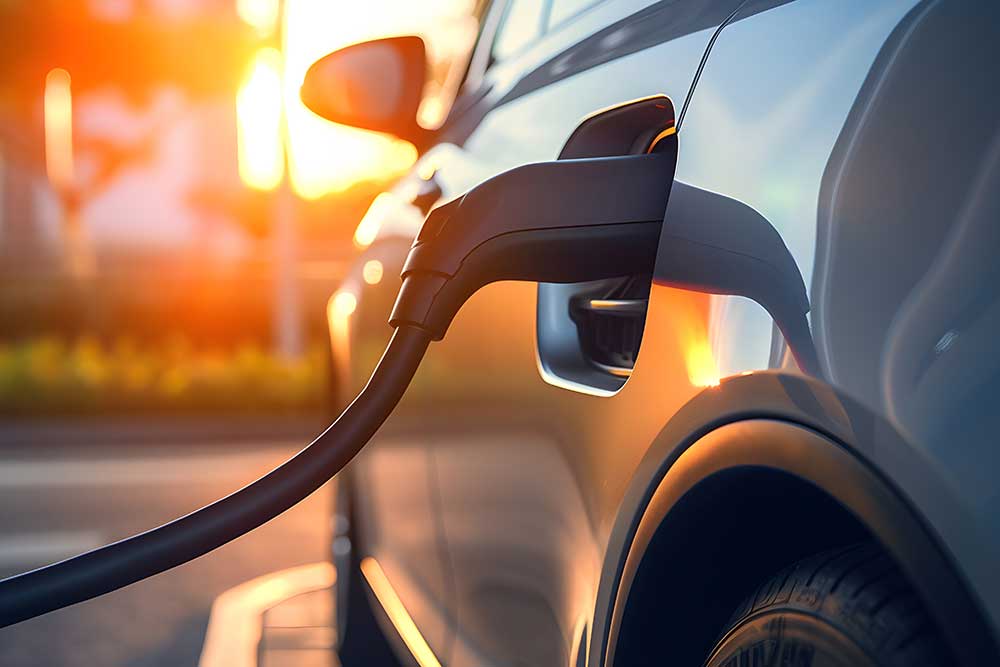
For generations, the Australian driveway was a loud declaration of identity. You were either a Holden family or a Ford family.
We were Holden, of course!
For families with deep roots in this country, buying Australian wasn't just a marketing slogan; it was a civic duty that supported your neighbours, built communities, and kept local manufacturing alive.
Today, that landscape is completely unrecognisable.
If you look at driveways in my street, the setup has evolved dramatically.
Take a peek into a Brisbane suburban driveway, and you might find a pair of sleek, high-tech electric vehicles, specifically in my case, a BYD Sealion 7 mid-size SUV used for family duties, alongside a nimble BYD Dolphin hatchback which is perfect for my wife doing the regular city commute.
They park right next to a trusted, 15-year-old Mitsubishi Triton workhorse.
The Triton represents Australia's rugged, internal-combustion past. The BYDs represent an efficient, silent future.
Yet, as I unplug my EV for the morning run, a nagging question lingers at the back of my mind: Is bringing Chinese-manufactured vehicles into a proud Australian home a betrayal of my traditional Aussie values?
As a fifth-generation Queenslander, my answer is a definitive ‘no’.
In fact, it may just be the ultimate expression of modern Aussie self-reliance.
The ghost of Acacia Ridge
The emotional guilt I feel surrounding Chinese-made vehicles is rooted in a nostalgia that no longer matches reality.
I feel that nostalgia deeply.
I once proudly owned a Holden Gemini, a car built right here in Brisbane. It was manufactured at the old GMH Acacia Ridge assembly plant on the edge of Inala, a few clicks from where I live in Coopers Plains.
My own neighbour used to work on that very production line. We took immense pride in knowing our cars were put together by the blokes down the street.
When the local factories turned off the lights, the option to buy a truly local vehicle died with them.
Every single new car on Australian bitumen today is an import.
Whether my hard-earned dollars head to China for a BYD, the United States for a Ford Ranger, or Japan for a Toyota HiLux, those local manufacturing jobs are long gone.
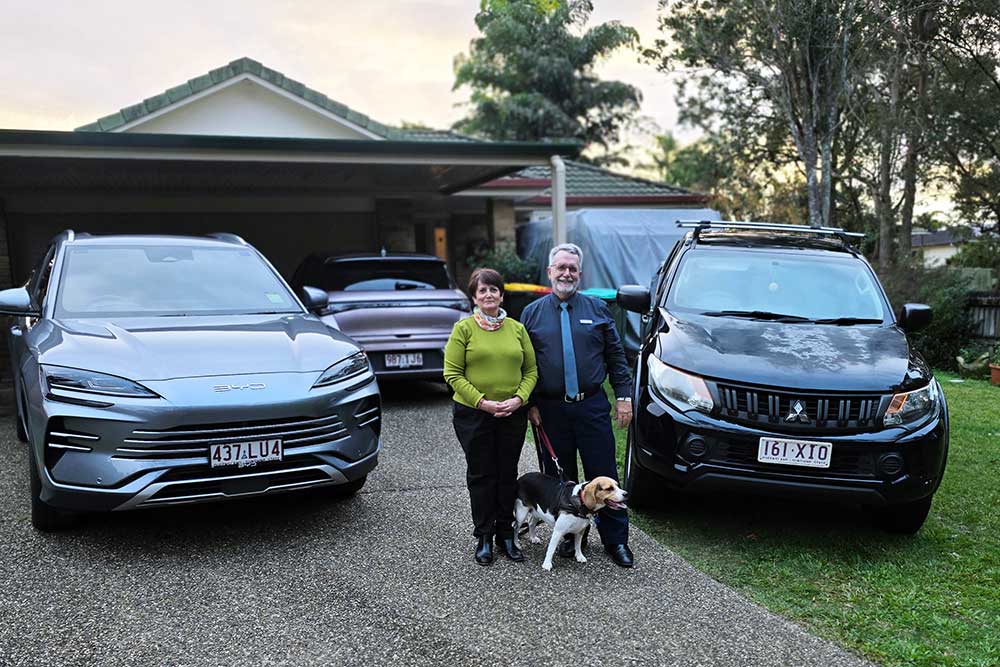
RACQ member Graeme Johnston with his wife Lyn, dog Poppy and their cars.
The surveillance scare: Is your car spying on you?
The latest weapon used to fuel the guilt of owning a Chinese-made EV is the geopolitical fear factor.Turn on the news, and you will hear warnings about Chinese EVs being "computers on wheels," packed with cameras, microphones, and GPS tracking.
In mid-2026, the Australian Security Intelligence Organisation (ASIO) even warned politicians against discussing classified secrets inside connected vehicles.
So, could the Chinese government use our BYD to spy on me?
If you are a federal cabinet minister or a defence contractor handling national security secrets, you probably shouldn't be holding classified briefings in your car. But for the average Queenslander driving between Brisbane and the coast, the ‘spy car’ narrative misses the broader reality of modern technology.
My ‘secrets’ are just not that interesting.
The smartphone in my pocket, the smart TV in my lounge room, and the social media apps on my screen already log my location, track your habits, and harvest more personal data than my car ever could.
Powering the commute with local energy
Queenslanders are fundamentally practical people who despise wasting money and hate being reliant on outside forces. This is where the dual EV strategy becomes a masterclass in local economics.Using my Sealion 7 for family road trips and, for my wife, the Dolphin for the urban hustle isn't about fitting into a global trend. It is about taking control of my own budget.
The real irony is that these imported cars unlock genuine Australian energy independence.
When I fuel my daily commute using electricity generated by our local grid or better yet, harvested right off your own roof from the Queensland sun, you stop sending cash overseas.
Every single kilometre driven on domestic power is money kept completely away from volatile global oil markets and Middle Eastern refineries.
You are no longer at the mercy of international pump prices or foreign supply disruptions.
The final verdict
I was a little skeptical when we bought our EVs.
They have no spares, they have no engine noise for me to monitor, and I can't tow with them, but the safety convenience and economy is hard to beat.
Clinging to my 15-year-old Triton for the heavy towing while letting a pair of high-tech EVs handle the daily routine is not a betrayal, it is a brilliant, common-sense strategy, but I still miss my Gemini a bit.
We cannot buy a Queensland-made car anymore, but we can absolutely choose to power our daily lives with Queensland energy.
Keeping my fuel-spend right here in my own backyard, instead of sending it to overseas oil executives, is about as true blue as it gets.
Do you agree with Graeme? Share your thoughts


More articles
Related topics
Things to note
The information in this article has been prepared for general information purposes only and is not intended as legal advice or specific advice to any particular person. Any advice contained in the document is general advice, not intended as legal advice or professional advice and does not take into account any person’s particular circumstances. Before acting on anything based on this advice you should consider its appropriateness to you, having regard to your objectives and needs.
Insurance Products (excluding Travel Insurance) are issued by RACQ Insurance Limited ABN 50 009 704 152 (RACQI) and arranged by RACQ Distribution Services Pty Ltd (RDS) ABN 35 116 361 650, AFSL 567130 and RDS' authorised representatives (including RACQ Operations Pty Ltd ABN 80 009 663 414, AR No. 234978 (RACQO)). Conditions, limits and exclusions apply.
Any advice provided by RDS and RACQO is general advice only and does not take into account your personal objectives, financial situation or needs and you will need to consider whether the advice is appropriate for you. Read the Product Disclosure Statement (PDS) before making a purchase decision on the product. You can also access our Target Market Determinations on this website.
RDS receives a commission from RACQI for the policies it arranges. RACQO receives fees paid for services it provides to RDS. Further details about remuneration are available on request prior to purchasing.
Banking and loan products issued by Members Banking Group Limited ABN 83 087 651 054 AFSL/Australian credit licence 241195 trading as RACQ Bank. Terms, conditions, fees, charges and lending policies apply. This is general advice only and may not be right for you. This information does not take your personal objectives, circumstances or needs into account. Read the disclosure documents for your selected product or service, including the Financial Services Guide and the Terms and Conditions, and consider if appropriate for you before deciding.
Except for RACQ Bank, any RACQ entity referred to on this page is not an authorised deposit-taking institution for the purposes of the Banking Act 1959 (Cth). That entity’s obligations do not represent deposits or other liabilities of RACQ Bank. RACQ Bank does not guarantee or otherwise provide assurance in respect of the obligations of that entity, unless noted otherwise.
RACQ Bank subscribes to the Customer Owned Banking Code of Practice which establishes higher standards than the law requires. The Code reflects modern consumer expectations and developments in approaches to issues such as consumer vulnerability, guarantors, and supporting customers through financial hardship. Please read our Customer Owned Banking Code of Practice page for more information.
RACQ Operations Pty Ltd (ABN 80 009 663 414, AR No. 234978) and Members Travel Group Pty Ltd (ABN 45 144 538 803, AR No.432492) (RACQ) are authorised representatives of the RACQ Travel Insurance insurer Tokio Marine & Nichido Fire Insurance Co., Ltd. (ABN 80 000 438 291 AFSL 246 548) (Tokio Marine). Tokio Marine Management (Australasia) Pty Ltd (ABN 69 001 488 455, AR No. 1313066) is an authorised representative of Tokio Marine, and administers RACQ Travel Insurance as the managing agent on behalf of Tokio Marine. Terms, conditions (including eligibility criteria), exclusions, limits and sub-limits apply. Any advice is general advice only, and does not take into account your specific objectives, financial situation or needs. Before you purchase, please consider the Combined Product Disclosure Statement (PDS) / Financial Services Guide (FSG) and Target Market Determinations (TMDs) available at racq.com or on request from RACQ.