

Seven gems of Korea: A local's guide to must-visit locations
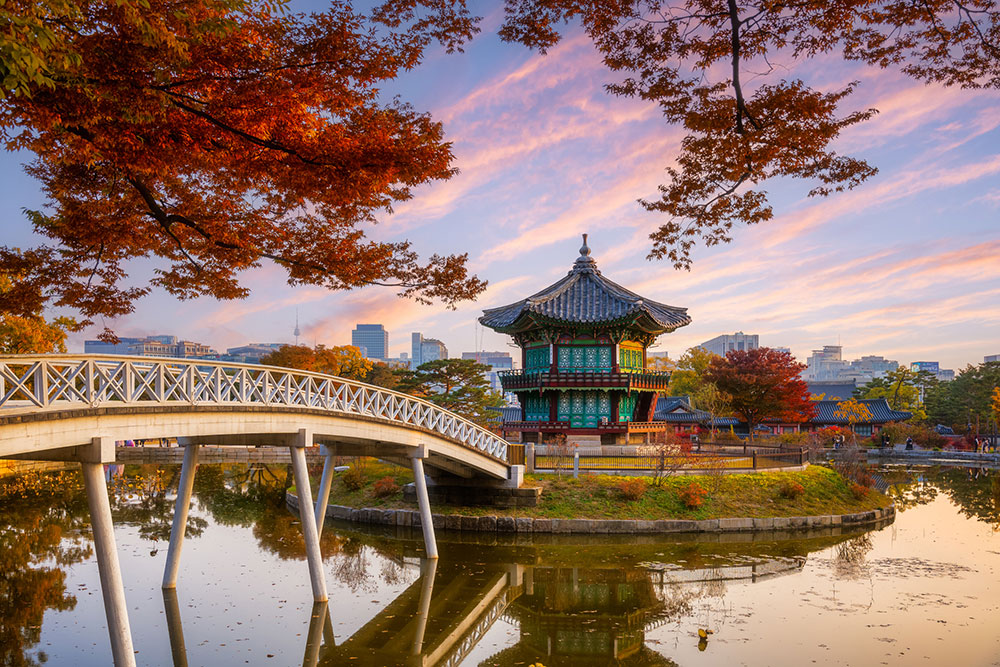
Beyond the usual tourist showcase, local resident Yunhye Jeong, introduces RACQ members to the seven must-visit places in Korea that are cherished and unforgettable.
1. Step into history: Traditional palaces in Seoul
Seoul's most iconic tourist attractions are its traditional palaces.
Experience life as a prince or princess of the Joseon Dynasty by visiting Gyeongbokgung Palace, the first palace established during the Joseon era.
Don't miss Changdeokgung Palace, known for its stunning gardens that harmonise beautifully with nature, and Changgyeonggung Palace, where the Joseon royal family resided.
For a memorable experience, consider renting traditional hanbok costumes from nearby rental shops and capturing breathtaking photos during your visit.
Getting there: Gyeongbokgung Palace is just a five-minute walk from Gyeongbokgung Station on Line 3, while Changdeokgung Palace is a 10-minute walk from Anguk Station on Line 3, and Changgyeonggung Palace can be reached in 10 minutes on foot from Hyehwa Station on Line 4.
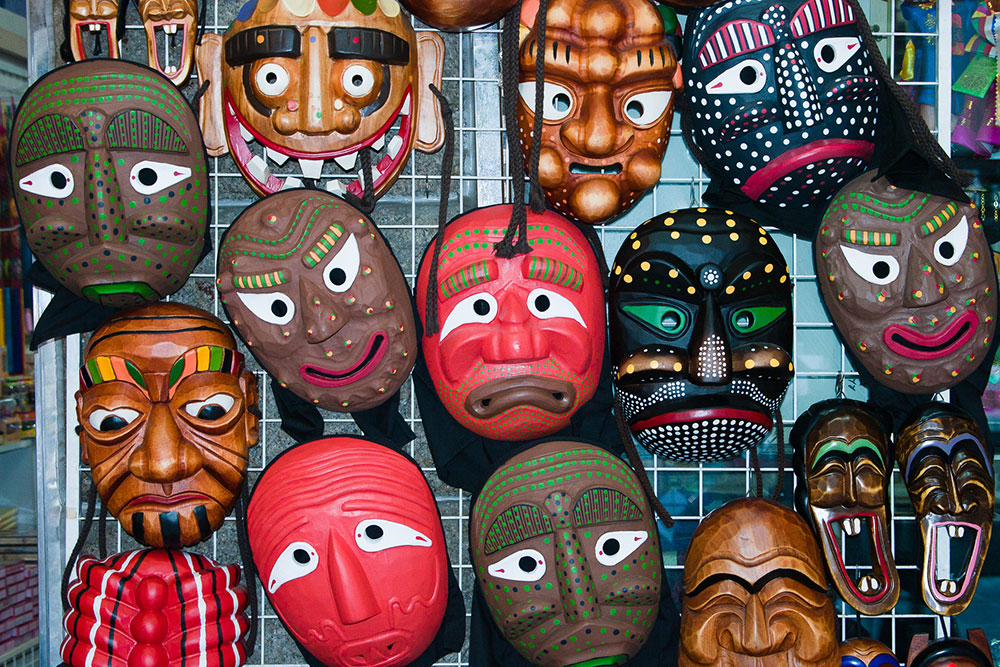
A shop selling traditional masks in Insadong.
2. Cultural charm meets modern art in Insadong
Insadong is a vibrant area where traditional Korean culture beautifully merges with modern architecture.
The cultural and artistic elements are harmoniously integrated into the buildings, featuring boutique galleries like the Tea Museum and the Sabina Gallery.
Insadong is one of the best places to purchase souvenirs, especially if you're looking for items with a Korean touch.
Getting there: You can easily reach Insadong within a 10-minute walk from Jonggak Station on Line 1, Anguk Station on Line 3, and Jongno 3-ga Station on Line 5.
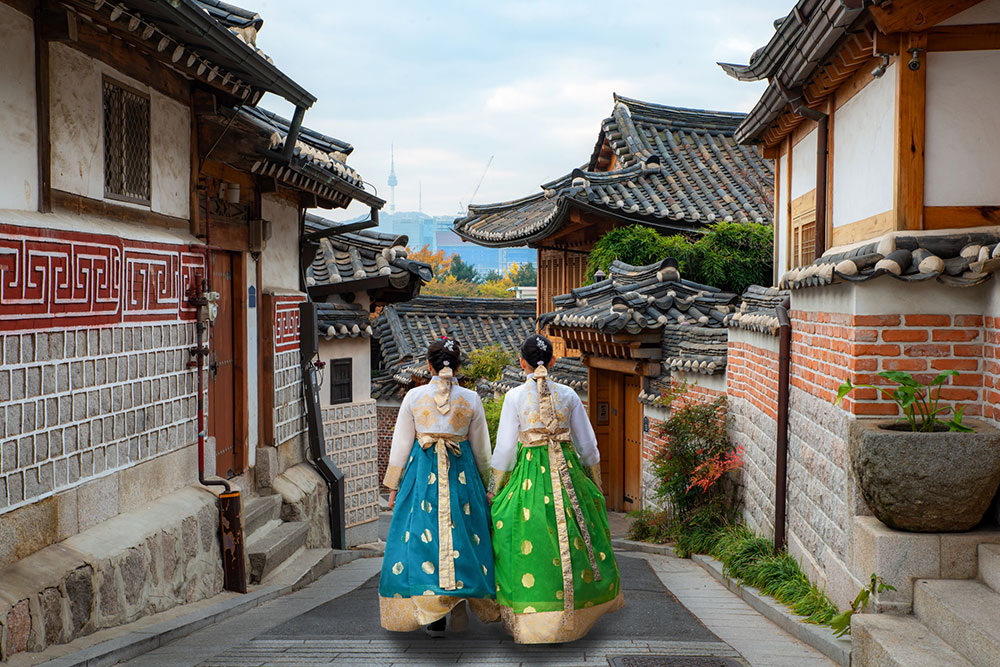
Women walking through the streets of Bukchon Hanok Village.
3. Bukchon Hanok Village: Where time stands still
Bukchon Hanok Village is a must-visit area in Seoul.
It features a traditional Korean village with about 900 historic houses, known as hanoks.
You can admire the unique wooden architecture and elegantly curved roofs of these homes. Additionally, you can enjoy the tranquil design cafes and restaurants that are also housed in hanoks.
Getting there: The village is conveniently located just a five-minute walk from Anguk Station on Subway Line 3.
4. K-beauty and bites on Myeongdong Shopping Street
Are you interested in K-beauty? Would you like to try some delicious Korean street food?
Myeongdong Shopping Street is the perfect place to experience both.
Here you can shop for face masks and a variety of cosmetics from both affordable and high-quality Korean brands.
Don’t worry if you don’t speak Korean; the stores in Myeongdong have multilingual staff who can assist you in English, Japanese, and Chinese. If you get hungry while shopping for cosmetics, treat yourself to an array of affordable and mouth-watering street food, including skewers, waffles, Tanghulu, and more.
Getting there: Myeongdong Station on Line 4.
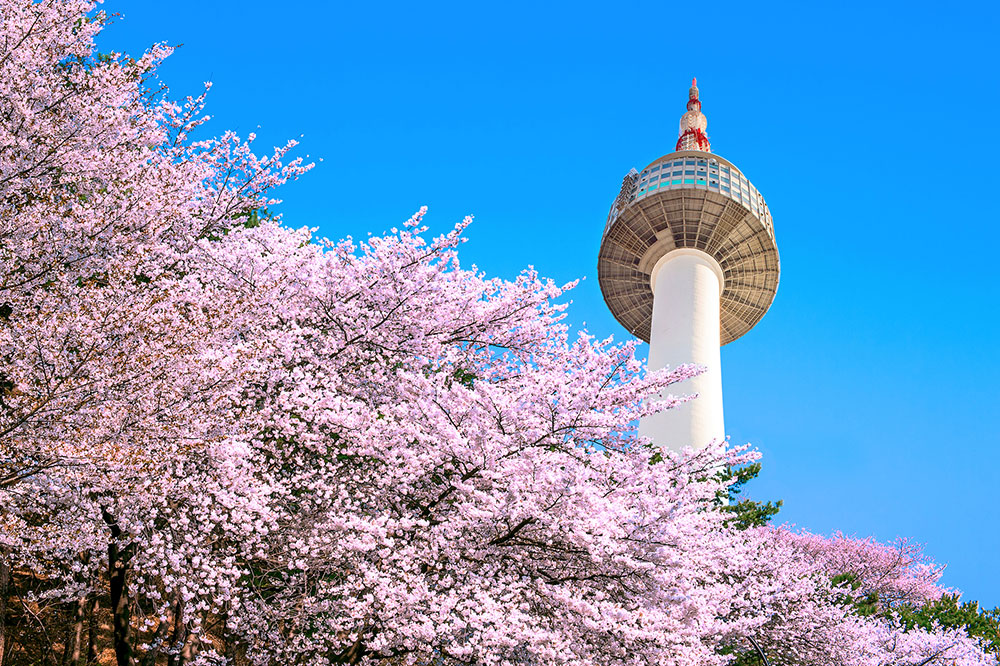
Cherry blossoms in full bloom with Namsan Tower in the background.
5. Soar Above Seoul at Namsan Park and Tower
Namsan Tower is a famous landmark in Seoul, located within Namsan Park. Standing at 480m above sea level, it offers stunning panoramic views of the city.
You can reach Namsan Park either on foot or by taking a cable car. If you visit during the cherry blossom season from late March to early April, you'll be able to see the beautiful blossoms in full bloom.
Alternatively, if you visit during the autumn leaves season, from late October to early November, the mountain roads will be adorned with vibrant red foliage.
Getting there: To get to Namsan Park, take the cable car from the Namsan Cable Car Stop, which is a 10-minute walk from Myeongdong Station on Line 4. You can also reach the park by getting off at Chungmuro Station or Dongguk University Station on Line 3, then taking bus 01A or 01B and disembarking at the Namsan Seoul Tower stop.
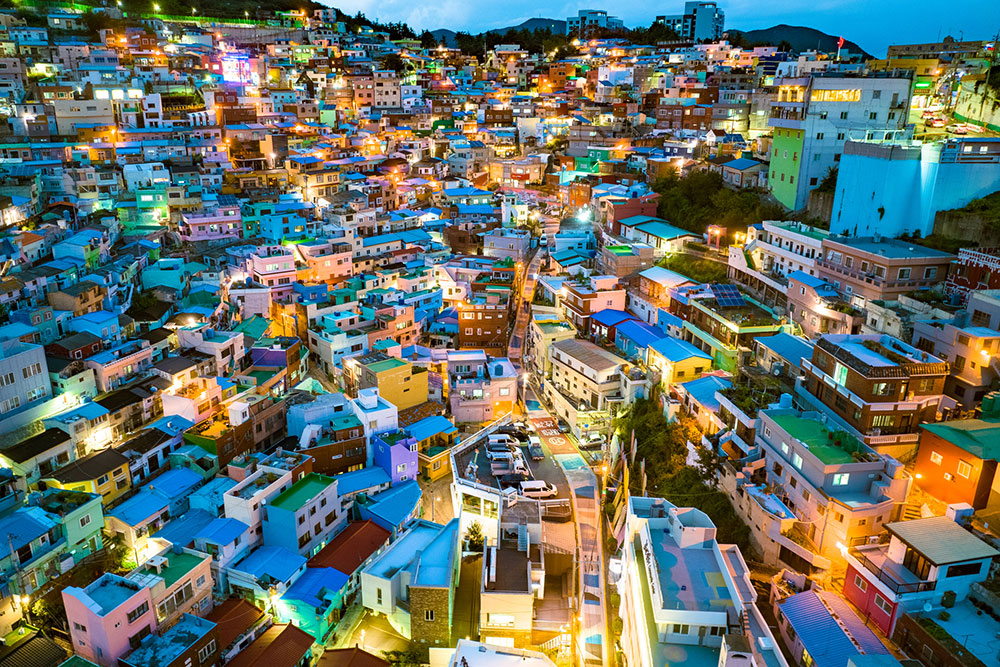
A view of Gamcheon Culture Village on sunset.
6. Gamcheon Culture Village: Busan’s artistic hillside
If your schedule allows, consider adding Busan, South Korea's second-largest city, to your itinerary.
You can take the KTX train to Busan Station and visit Gamcheon Culture Village, where colourful rooftops are clustered together along the ridge.
Often referred to as Korea's Machu Picchu or Santorini, this area offers picturesque scenery perfect for taking photos, including adorable fish murals and a BTS mural that will help you create unforgettable memories.
Getting there: To reach Gamcheon Culture Village, get off at Toseong Station on Busan Subway Line 1. Then, take village bus Saha 1-1, Seo-gu 2, or Seo-gu 2-2 from the Busan National University Hospital bus stop, and disembark at Gamcheon Culture Village.
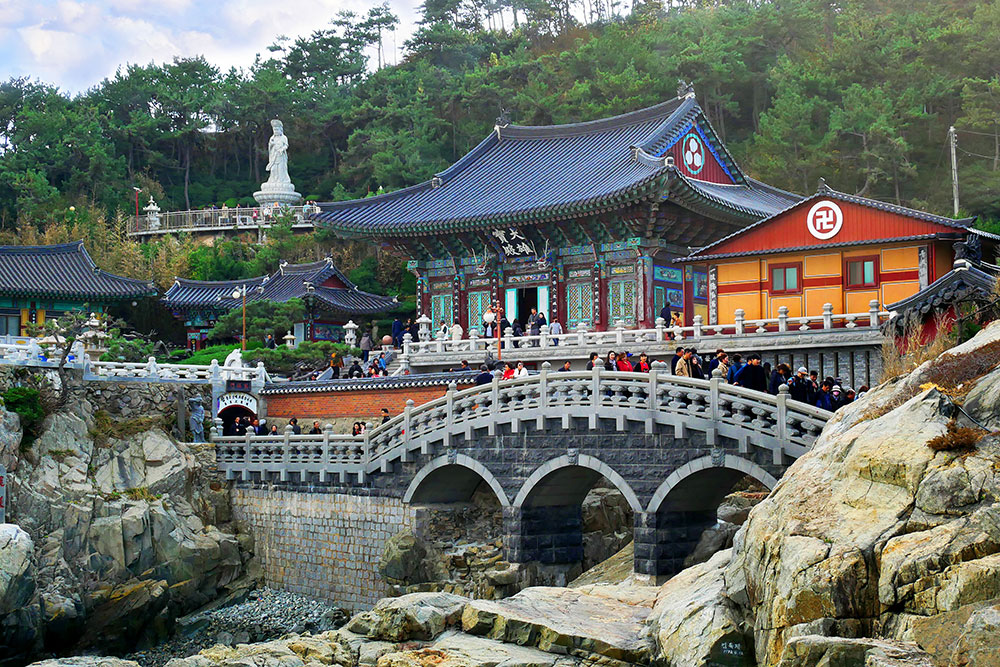
The famous Haedong Yonggungsa Temple in Busan.
7. Haedong Yonggungsa Temple: Scenery by the sea
Haedong Yonggungsa Temple is the most famous Buddhist temple in Busan.
It is situated along the coastal cliffs and is renowned for its picturesque scenery. Visitors can admire the traditional atmosphere of a Korean temple against the breathtaking backdrop of the blue sea.
The temple is particularly beautiful in spring when cherry blossoms bloom and in autumn when colourful foliage fills the landscape.
Getting there: To reach Haedong Yonggungsa Temple, take Busan Subway Line 1 to Haeundae Station, then transfer to bus 181 and get off at the Yonggungsa Temple stop.
Planning your Korean adventure
When is the best time to visit Korea?
In my opinion, the best times to visit Korea are during the spring and autumn. Korea experiences four distinct seasons, and both spring and autumn have relatively mild weather, making them ideal for travelling in light clothing.
In particular, the cherry blossoms in April are stunning in spring, while the mountains and trees display beautiful, colourful foliage in autumn around October.
Is the accommodation and food expensive?
When traveling in Korea, a two- to three-star hotel typically costs about $150 to $250 per night.
These hotels are well-equipped and offer good amenities, making them a great choice for enjoying the beautiful night view of the city. If you want to save money, consider staying at a motel or an Airbnb, which can range from $50 to $150 per night.
This option not only allows you to experience the local vibe but also helps you cut down on expenses.
Food prices in Korea are comparable to those in Australia or slightly lower, with a delicious meal at a restaurant costing approximately $15 to $20.
Will the language barrier be a problem?
Subway stations, information signs, and bus stations in Korea feature both Korean and English. Don’t worry, many restaurants and shops often have staff who can communicate in basic English as well. However, learning a few simple Korean greetings can enhance your travel experience.
- Annyeong-haseyo (Hello)
- Kamsahamnida (Thank you)
- (Product name) hana juseyo (Please give me one (product name))
- Eolmayeyo? (How much is this?)
- (Place name) eodieyo? (Where is (place name)?)
Is South Korea a safe country to visit?
South Korea is generally a safe destination for travellers, with a relatively low crime index.
Restaurants, cafes, and pubs stay open late into the night, keeping the streets well-lit. In areas with many people, police officers are present to patrol.
However, it’s important not to let your guard down. Be mindful of your belongings and avoid going out alone if it’s very late.
How long should I stay?
If you're travelling to Seoul, the capital of South Korea, I recommend staying for about five days to fully enjoy the Hanok villages, historic palaces, and the vibrant atmosphere of the city. If your schedule allows, consider extending your trip to 10 days to include a visit to Busan, Korea's second-largest city.
There, you can experience the stunning scenery of a beautiful seaside destination that offers a completely different vibe from Seoul.
How do I get a visa?
To travel to South Korea, you will need a K-ETA visa.
You must apply at least 72 hours before departure via the official K-ETA website or mobile app. The fee at the time of writing was 10,000 KRW (about $11).
Once approved, you can enter Korea without submitting an arrival card.
What smartphone applications should I install when travelling in Korea?
When travelling in Korea, it's highly recommended to install a map application that is specifically designed for the country.
Google Maps may not provide accurate information due to government security policy, so it's best to use either ‘Naver Map’ or ‘Kakao Map’, which also include bus and subway routes.
If you plan to use a taxi, consider installing the ‘Kakao T’ app instead of Uber. Kakao T is a common taxi service in South Korea, and many drivers are familiar with it.
Lastly, I suggest downloading the ‘T Locker’ app. This app helps you find and book luggage lockers at subway stations, allowing you to explore without the burden of heavy luggage.
Store your bags in a locker and enjoy your trip!
Next story →
Related topics
Things to note
The information in this article has been prepared for general information purposes only and is not intended as legal advice or specific advice to any particular person. Any advice contained in the document is general advice, not intended as legal advice or professional advice and does not take into account any person’s particular circumstances. Before acting on anything based on this advice you should consider its appropriateness to you, having regard to your objectives and needs.
Insurance Products (excluding Travel Insurance) are issued by RACQ Insurance Limited ABN 50 009 704 152 (RACQI) and arranged by RACQ Distribution Services Pty Ltd (RDS) ABN 35 116 361 650, AFSL 567130 and RDS' authorised representatives (including RACQ Operations Pty Ltd ABN 80 009 663 414, AR No. 234978 (RACQO)). Conditions, limits and exclusions apply.
Any advice provided by RDS and RACQO is general advice only and does not take into account your personal objectives, financial situation or needs and you will need to consider whether the advice is appropriate for you. Read the Product Disclosure Statement (PDS) before making a purchase decision on the product. You can also access our Target Market Determinations on this website.
RDS receives a commission from RACQI for the policies it arranges. RACQO receives fees paid for services it provides to RDS. Further details about remuneration are available on request prior to purchasing.
Banking and loan products issued by Members Banking Group Limited ABN 83 087 651 054 AFSL/Australian credit licence 241195 trading as RACQ Bank. Terms, conditions, fees, charges and lending policies apply. This is general advice only and may not be right for you. This information does not take your personal objectives, circumstances or needs into account. Read the disclosure documents for your selected product or service, including the Financial Services Guide and the Terms and Conditions, and consider if appropriate for you before deciding.
Except for RACQ Bank, any RACQ entity referred to on this page is not an authorised deposit-taking institution for the purposes of the Banking Act 1959 (Cth). That entity’s obligations do not represent deposits or other liabilities of RACQ Bank. RACQ Bank does not guarantee or otherwise provide assurance in respect of the obligations of that entity, unless noted otherwise.
RACQ Bank subscribes to the Customer Owned Banking Code of Practice which establishes higher standards than the law requires. The Code reflects modern consumer expectations and developments in approaches to issues such as consumer vulnerability, guarantors, and supporting customers through financial hardship. Please read our Customer Owned Banking Code of Practice page for more information.
RACQ Operations Pty Ltd (ABN 80 009 663 414, AR No. 234978) and Members Travel Group Pty Ltd (ABN 45 144 538 803, AR No.432492) (RACQ) are authorised representatives of the RACQ Travel Insurance insurer Tokio Marine & Nichido Fire Insurance Co., Ltd. (ABN 80 000 438 291 AFSL 246 548) (Tokio Marine). Tokio Marine Management (Australasia) Pty Ltd (ABN 69 001 488 455, AR No. 1313066) is an authorised representative of Tokio Marine, and administers RACQ Travel Insurance as the managing agent on behalf of Tokio Marine. Terms, conditions (including eligibility criteria), exclusions, limits and sub-limits apply. Any advice is general advice only, and does not take into account your specific objectives, financial situation or needs. Before you purchase, please consider the Combined Product Disclosure Statement (PDS) / Financial Services Guide (FSG) and Target Market Determinations (TMDs) available at racq.com or on request from RACQ.