

Stories of culture, pearling and heritage on Thursday Island
.jpg?h=667&iar=0&w=1000&rev=91c5e65cfc6e44c39be6560dd771d8d4&hash=A7EF20426C6CD89FB3101F958269A463)
Arriving in the Torres Strait
Where I’ve come from is obvious, having stepped onto Thursday Island’s jetty off the daily ferry from Seisia, close to Cape York. Far less clear, though, are the origins of those who live here.
That much becomes apparent during a performance by Island Star Cultural Experience’s Joey Laifoo and his young dance troupe. Joey founded the group with the earnest intention of educating young Torres Strait Islanders about their cultural heritage.
Cultural connections and ancestry
Song lyrics touch on the role fishing and pearling have played in their lives, or how changes in seasons are determined by when the sharks come to feed, the direction of the winds or the sudden appearance of dragonflies.
Also sprinkled throughout their 30‑minute set are songs detailing their bloodlines – where they’ve come from, or their clan’s totem, be they stingrays, snakes or crocodiles.
“I was born here on Waiben,” Joey says, using the Kawrareg name for Thursday Island. “But I grew up on Badu. Others have ancestry from Malaysia, Japan, China and Indonesia, or they have Aboriginal heritage from the mainland.”
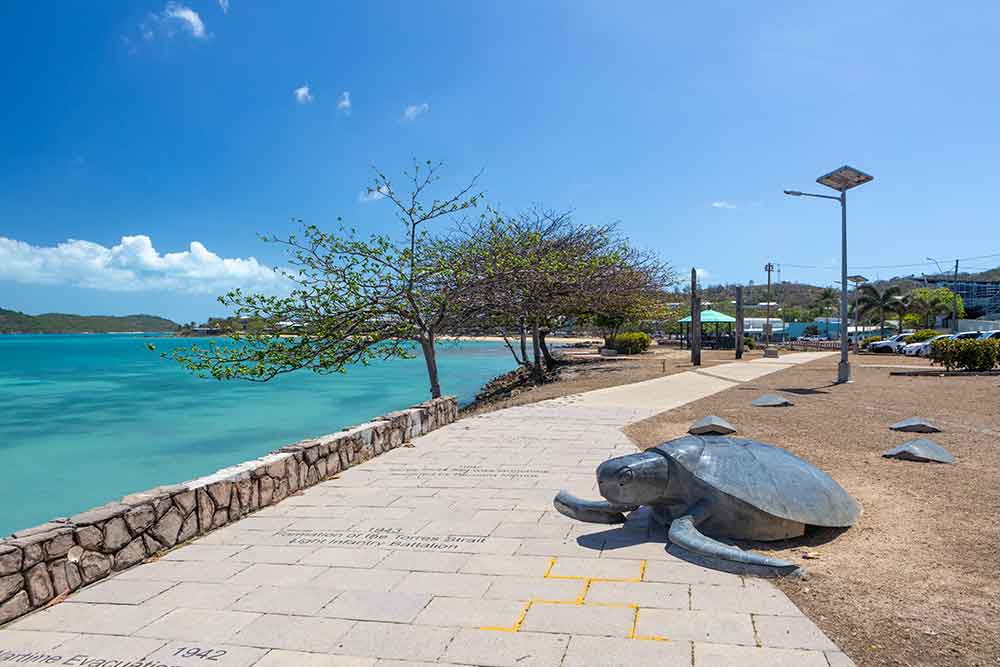
Thursday Island's waterfront.
A multicultural Strait
While the 270‑odd islands in the Torres Strait have been occupied for thousands of years, the family trees of those who live here can be tangled – an Indonesian grandfather here, an Aboriginal uncle there. None of which should come as a surprise.
Papua New Guinea, an island that was connected to the Australian mainland up until the last Ice Age roughly 12,000 years ago, is a mere four‑hour journey to the north by motorised dinghy.
Historically, these islands have been popular waypoints along seafaring trade routes to Asia and Europe. And of course, Aborigines have occupied the Cape York Peninsula for tens of thousands of years.
It makes sense that they’d all cross paths along the way.
A legacy of pearling
Christine Connor was born on Thursday Island to mixed parentage. Her mother grew up on the islands, while her father is Aboriginal.
“Just about anyone who lives on the island has a multicultural background and a history in pearl diving,” Christine says.
She operates Peddells, the ferry service that delivered our tour group to Thursday Island from Cape York.
She’s also our guide during a bus tour of the island, where our first stop is Green Hill Fort, built at the island’s highest point in 1891 in response to fears of a Russian naval attack.
While the Russians never came, Japanese pearl divers did. “At one point, the Torres Strait supplied half the world’s pearl shell supply,” Christine says. “Many of the divers came from Japan.”
Echoes of the pearling era
Christine tells us that towards the end of the 19th century, when pearl shells were used to make shirt buttons, 200 pearling vessels anchored off the island.
Further evidence of Thursday Island’s link to the pearling industry can be found in the cemetery along its north coast, opposite a mangrove forest inhabited by saltwater crocodiles.
Seven hundred Japanese divers are believed to have perished over the years, with the graves of many sprinkled among a frangipani and eucalyptus tree garden.
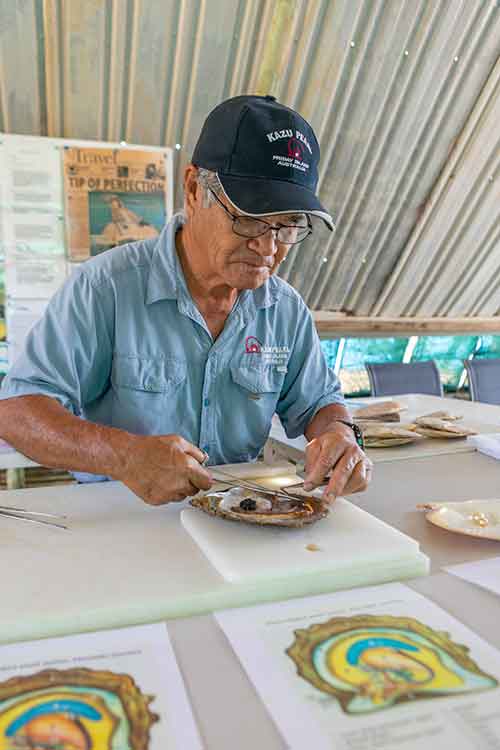
Takami Kazu at work on Friday Island.
Friday Island and the art of cultured pearls
Over on Friday Island (there’s also a Wednesday Island, all named during a British charting expedition in 1848), Takami Kazu has been culturing pearls from his waterside base since 1985, yet his strong accent heavily betrays his Japanese origins.
His occupation requires patience and a surgeon’s precision, and he demonstrates the seeding process from inside his breezy A‑frame workshop. Using tweezers, scalpels, scalers and a magnifying glass,
Takami plants a Mississippi mussel shell crumb on a shell’s fleshy membrane in the hope that it will evolve into a lustrous pearl worth several hundred dollars.
While pearl farming is now considered a dying art practised by a dedicated few, two Japanese university students have nevertheless come to learn the trade from Kazu. When they’re not helping out by serving homemade coconut, sago and custard slices to visitors, their free time is spent reeling in monster fish before they can be stolen off the line by opportunistic sharks or crocodiles.
War history and resilience
Kazu relishes the slow pace and serenity of his island life, unlike some of his predecessors who were interned in camps for the duration of World War II. But their presence on Thursday Island is directly attributable to it being spared from bombing by Japanese planes.
Not so fortunate was the neighbouring Horn Island, which endured eight Japanese air raids. Bunkers and trenches littered with artillery guns and bullet casings are scattered around an airfield that served as a base for 5,000 soldiers and Australia’s first defence against invasion.
They came, then they left. Just as they always have here.
The author Mark Daffey was a guest of Outback Spirit (outbackspirittours.com.au).


Related topics
Things to note
The information in this article has been prepared for general information purposes only and is not intended as legal advice or specific advice to any particular person. Any advice contained in the document is general advice, not intended as legal advice or professional advice and does not take into account any person’s particular circumstances. Before acting on anything based on this advice you should consider its appropriateness to you, having regard to your objectives and needs.
Insurance Products (excluding Travel Insurance) are issued by RACQ Insurance Limited ABN 50 009 704 152 (RACQI) and arranged by RACQ Distribution Services Pty Ltd (RDS) ABN 35 116 361 650, AFSL 567130 and RDS' authorised representatives (including RACQ Operations Pty Ltd ABN 80 009 663 414, AR No. 234978 (RACQO)). Conditions, limits and exclusions apply.
Any advice provided by RDS and RACQO is general advice only and does not take into account your personal objectives, financial situation or needs and you will need to consider whether the advice is appropriate for you. Read the Product Disclosure Statement (PDS) before making a purchase decision on the product. You can also access our Target Market Determinations on this website.
RDS receives a commission from RACQI for the policies it arranges. RACQO receives fees paid for services it provides to RDS. Further details about remuneration are available on request prior to purchasing.
Banking and loan products issued by Members Banking Group Limited ABN 83 087 651 054 AFSL/Australian credit licence 241195 trading as RACQ Bank. Terms, conditions, fees, charges and lending policies apply. This is general advice only and may not be right for you. This information does not take your personal objectives, circumstances or needs into account. Read the disclosure documents for your selected product or service, including the Financial Services Guide and the Terms and Conditions, and consider if appropriate for you before deciding.
Except for RACQ Bank, any RACQ entity referred to on this page is not an authorised deposit-taking institution for the purposes of the Banking Act 1959 (Cth). That entity’s obligations do not represent deposits or other liabilities of RACQ Bank. RACQ Bank does not guarantee or otherwise provide assurance in respect of the obligations of that entity, unless noted otherwise.
RACQ Bank subscribes to the Customer Owned Banking Code of Practice which establishes higher standards than the law requires. The Code reflects modern consumer expectations and developments in approaches to issues such as consumer vulnerability, guarantors, and supporting customers through financial hardship. Please read our Customer Owned Banking Code of Practice page for more information.
RACQ Operations Pty Ltd (ABN 80 009 663 414, AR No. 234978) and Members Travel Group Pty Ltd (ABN 45 144 538 803, AR No.432492) (RACQ) are authorised representatives of the RACQ Travel Insurance insurer Tokio Marine & Nichido Fire Insurance Co., Ltd. (ABN 80 000 438 291 AFSL 246 548) (Tokio Marine). Tokio Marine Management (Australasia) Pty Ltd (ABN 69 001 488 455, AR No. 1313066) is an authorised representative of Tokio Marine, and administers RACQ Travel Insurance as the managing agent on behalf of Tokio Marine. Terms, conditions (including eligibility criteria), exclusions, limits and sub-limits apply. Any advice is general advice only, and does not take into account your specific objectives, financial situation or needs. Before you purchase, please consider the Combined Product Disclosure Statement (PDS) / Financial Services Guide (FSG) and Target Market Determinations (TMDs) available at racq.com or on request from RACQ.