


Reversing and manoeuvring a caravan can feel daunting, particularly for newer caravanners or when arriving at a tight campsite with ‘spectators’ watching.
The good news is that reversing is a skill anyone can learn.
With the right techniques, clear communication and a calm mindset, it becomes a manageable and often satisfying part of setting up camp.
How to reverse using mirrors
Your mirrors are your primary guides when reversing a caravan, so they must be set up correctly.
Extension mirrors are essential, allowing you to clearly see both sides of the caravan and, ideally, its rear corners.
Before you begin, adjust them so you don’t need to move your head excessively to check each side.
A popular technique is placing your hands at the bottom of the steering wheel.
When reversing, your caravan will move in the same direction as your hands – move your hand left and the caravan moves left, move it right and the caravan follows.
This method makes steering far more intuitive when watching the mirrors.
As you reverse, constantly scan from mirror to mirror, watching how the caravan responds to your inputs.
Small steering movements are key. If the caravan begins to drift too far to one side and disappears from a mirror, gently steer towards that side to bring it back into view.
If things start to feel rushed or messy, stop completely, straighten the wheels and regroup.
Spotter communication tips
Using a spotter can significantly reduce stress and improve safety.
The spotter’s job is to guide the driver, watch for obstacles and maintain an overall view of how the caravan is tracking into the site.
Before reversing, agree on clear and simple communication.
Hand signals should be basic and consistent – pointing the direction the rear of the caravan needs to go, a clear ‘stop’ signal, and a signal for straight wheels. Handheld UHF radios or mobile phones on speaker mode are also useful communication options for the driver and spotter.
The spotter should always stand where the driver can clearly see them, never directly behind the caravan.
Staying calm and using steady, deliberate signals keeps both driver and spotter focused and prevents tension from building during the manoeuvre.
How to position on a site
Good positioning starts before the vehicle goes into reverse.
Take a moment to get out and inspect the site. Look for obstacles such as bollards, taps, trees, slopes or uneven ground that may not be visible from the driver’s seat.
Planning your path before reversing saves time and reduces mistakes.
Whenever possible, reverse with the caravan entering the site on the driver’s side, as visibility is far better.
Begin with the tow vehicle and caravan in a straight line and slightly past the bay entrance. From there, use slow, deliberate steering inputs to guide the caravan into position.
If alignment isn’t quite right, pull forward a little, straighten the wheels and try again. Reversing is about control, not getting it perfect on the first attempt.
Once positioned, ensure there’s adequate room for awnings, annexes and access to services before disconnecting.
Common mistakes to avoid
One of the most common mistakes is rushing. Speed magnifies errors and leads to oversteering or jack-knifing. Reversing slowly gives you time to think, observe and correct.
Another mistake is trying to ‘save’ a bad angle instead of stopping and resetting.
Pulling forward to straighten up isn’t failure, it’s smart driving.
Ignoring pressure from onlookers is also important; everyone in a caravan park has been in the same situation at some point.
Confidence is built through repetition.
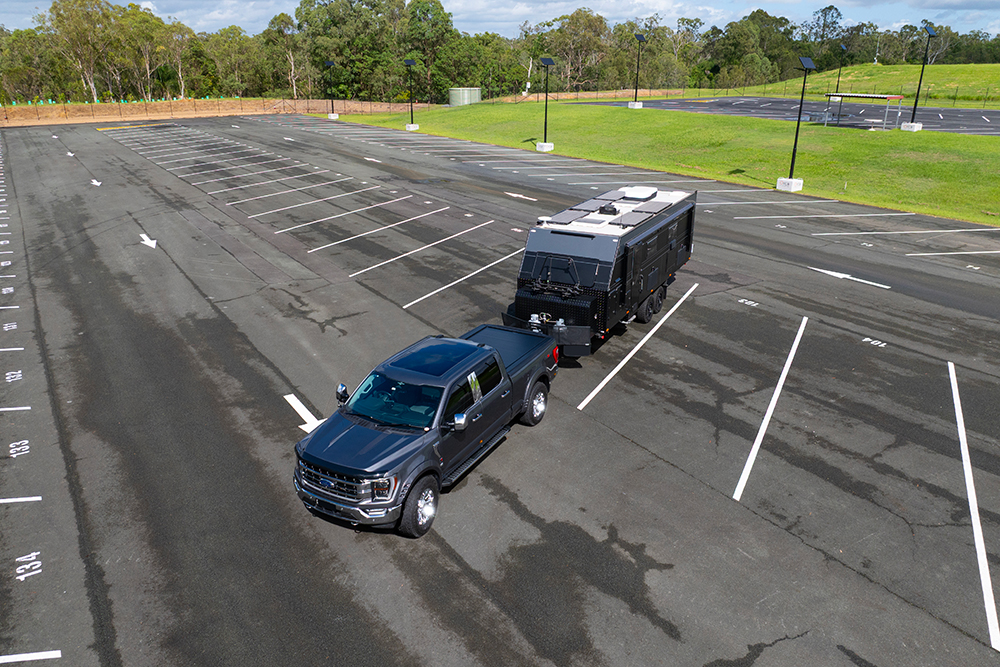
Set up cones or markers in an empty car park to practise straight reverses and gentle turns before tackling tight campsites.
Learn how your caravan pivots and how quickly it responds to steering inputs. With repetition, movements become instinctive.
Learn caravanning skills with RACQ
RACQ conducts caravan workshops at its Mobility Centre at Mount Cotton in Brisbane. The course teaches the basics of caravanning, including how to reverse. Members are offered a discount on the course cost.
Final thoughts on reversing a caravan
Reversing a caravan is less about skill and more about patience, planning and communication.
By trusting your mirrors, working smoothly with a spotter, positioning carefully and accepting the learning process, you’ll find that reversing becomes just another part of enjoying the caravanning lifestyle.