
Nissan Ariya Advance+ car review
It's been a long time coming but Nissan's second battery electric vehicle after the Leaf shows plenty of promise.
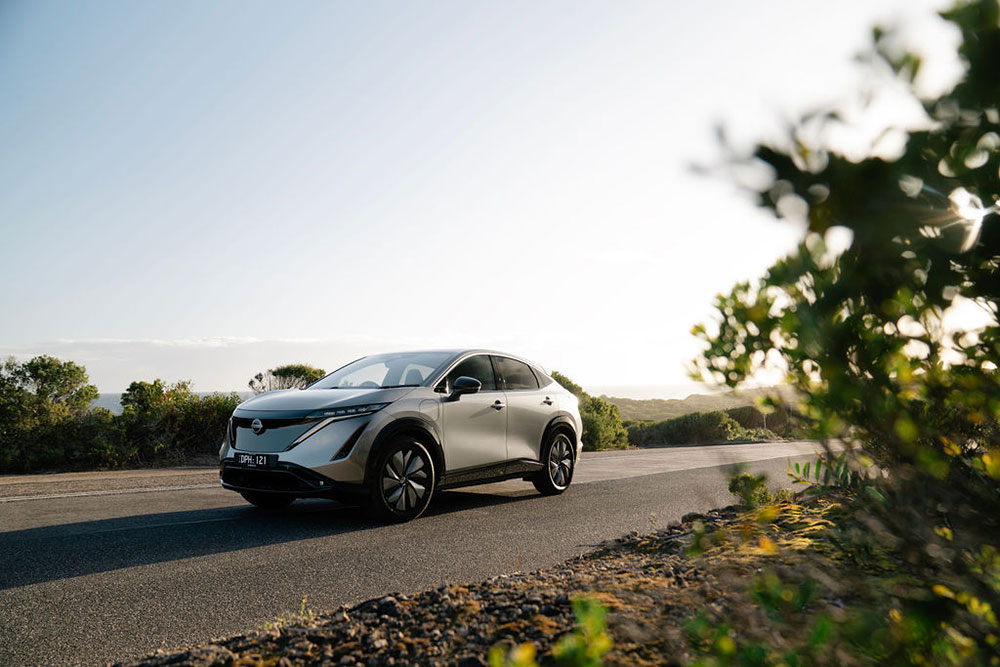
The Ariya battery-electric medium SUV arrives a decade after Nissan launched the world’s first mass-market EV, the Leaf, which has since gone on to sell over 700,000 units worldwide.
Despite being a first mover in the EV space, Nissan was slow to capitalise on the Leaf, only releasing the second-generation model in 2017.
The delay allowed it to be outflanked by rivals including Tesla, Kia and Hyundai, and more recently by new Chinese rivals.
In July 2020, Nissan announced the all-new Ariya electric crossover, its most important new model in years, and described by then Nissan CEO Makoto Uchida as the vehicle that would set the pace and direction for future Nissan vehicles.
Designed from the ground up to be part of Nissan’s electric and autonomous future, the Ariya subsequently went on sale in global markets, including Japan, the US, and Europe in early 2022, but has taken until late 2025 to reach Australia.
During this time the competitive landscape has changed dramatically.
How much does a Nissan Ariya Advance+ cost?
The Nissan Ariya is available in a four-grade line-up comprising Engage, Advance, Advance+, and Evolve e-4ORCE.
The entry-level Ariya Engage is priced from $55,840 (MRLP) and uses a single 160kW/300Nm electric motor to drive its front wheels, accelerating from 0-100km/h in a claimed 8.0 seconds.
Its 63kWh battery is good for a claimed maximum range of 385km (WLTP).
Stepping up to the Nissan Ariya Advance adds $4,000 for a list price of $59,840 and brings the same 2WD drivetrain, battery and range as the Engage but adds a raft of extra kit including heated steering wheel, hands-free automatic tailgate, Bose 10-speaker sound system, and synthetic leather-accented seats among other gear.
Next up comes the Nissan Ariya Advance+ which we're reviewing here and which costs $63,840 (MRLP).
It adds such additional features as black synthetic leather with Ultrasuede trim, Head-Up Display, panoramic glass roof, a power sliding centre console, and heated and cooled front seats.
Like its lower-grade stablemates, the Ariya Advance+ is front-wheel drive but gets the larger capacity 87kWh battery and a bump in power output to 178kW.
It’s good for a claimed range of 504km (WLTP), which is the most of any variant, but at 8.1 seconds is one-tenth slower than its lighter stablemates over the 0-100km/h dash.
The final stop on the grade walk is the Nissan Ariya Evolve e-4ORCE priced at $71,840 (MRLP).
It’s the only dual motor all-wheel drive variant in the range with the front and rear motors each delivering 160kW, along with combined torque of 600Nm.
The extra punch of the dual motors fires the Evolve e-4ORCE from 0-100km/h in brisk 5.6 seconds, but the extra draw of the motors on its 87kWh battery limits range to 487km (WLTP).
As expected for a range-topping variant, the Evolve e-4ORCE comes fully loaded with such features as Blue Nappa leather trim, 20-inch alloy wheels, intelligent rear-view mirror, and automatic LED headlights with adaptive driving beam.
Nissan Ariya Advance+ exterior design
Stylistically, the Ariya looks a lot like the concept car of the same name showcased at the 2019 Tokyo motor show.
The crossover features attractive and futuristic SUV-like styling and is built on an entirely new EV platform designed to incorporate the latest in autonomous and connectivity features.
The design features a typically elevated crossover stance, with short front overhangs and a windscreen base that’s been pushed forward to enhance the car’s sleek aerodynamic profile.
In side profile the design looks clean and powerful, with a single, clean horizontal line striking through the car’s mid-section, and a plunging rear roofline complete with integrated spoiler.
The front-end features thin LED headlights and distinctive LED daytime running lights that frame what Nissan calls its ‘tech-shield grille,’ with the now trademark closed-grille look favoured by EVs.
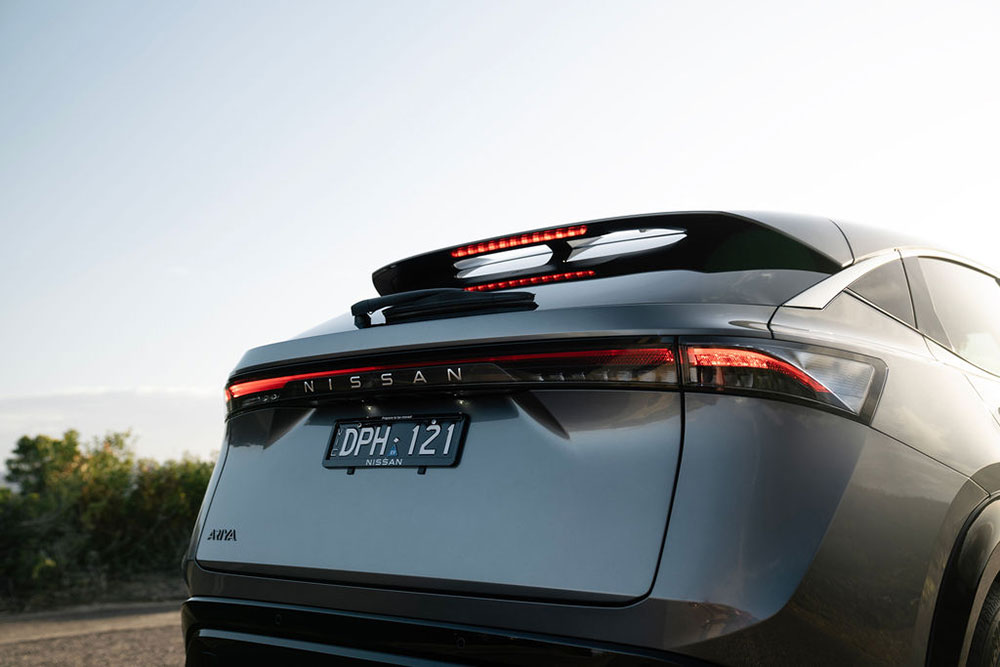
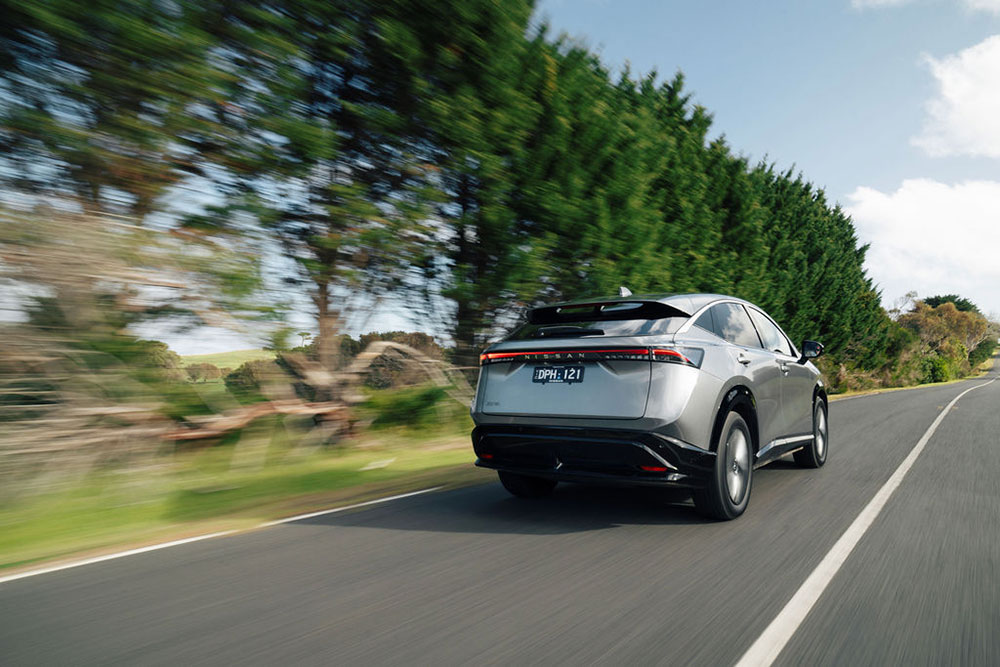
At the rear, there's a roof spoiler, shark-fin antenna and large air diffuser below a wide, horizontal light blade.
LED rear fog lights and taillights giving the Ariya a modern and distinctive lighting signature.

Nissan Ariya Advance+ interior design
The interior of the Ariya is modern and pleasingly roomy, thanks in large part to it being a dedicated EV design, meaning there's no need for an intrusive transmission tunnel.
Nissan has taken advantage of this to leave the centre console area entirely open, meaning there's nothing in the footwell area between the driver's left knee and the passenger's right knee, which helps reinforce the sense of space.
The dash features a contemporary twin-screen digital display comprising two 12.3-inch screens integrated into a single strip of glass with a small kink at the halfway point that helps bring the touchscreen closer to the driver.
The touchscreen incorporates swipe, pinch and zoom capability and in the Advance+ variant there's also a head-up display (HUD) projected onto the windscreen.
The interior features some interesting design details, including thin pinstripes of copper-coloured trim linking the doors to the dash, faux timber effects on the dash and centre console, and eye-catching ‘Andon’ lighting in the lower doors and footwell.
The word 'Andon' refers to a traditional Japanese paper-enclosed lantern, hence the visual effect is best appreciated at night.
The driving position is comfortable, with good visibility and plenty of adjustment for the shapely sports seats, which are heated and cooled and clad in synthetic leather with Ultrasuede inserts.
The nicely proportioned leather-trimmed steering wheel is heated and features a sporty flat-bottom design and thumb tabs.
To the driver's left is a centre console with the Advance+ and Evolve incorporating an electric-sliding feature, allowing the console to be slid forward or back to suit your driving position.
It's an interesting idea but, curiously, there's no storage in the console itself, with the padded armrest lifting to reveal a wireless phone-charging pad and a lower, lidded section with twin cupholders.
There's another, smaller area located below the main sliding armrest that provides a slot for a mobile phone and houses twin USB ports, but there's nowhere to put oddments such as keys, wallets, and purses, other than in one of the Ariya's two side-by side gloveboxes.
One of these is located immediately ahead of where a console would be so it's not a great inconvenience to use, but it does seem unusual that the centre console takes up so much space but provides little practical storage.
The gloveboxes are fully flocked to avoid the contents rattling when driving but are not very deep, limiting storage.
Large door bins provide some additional space for a water bottle and other items.
Atop the sliding centre console and falling easily to hand is a computer-mouse style gear selector, and alongside that two capacitive touch icons integrated into the timber-effect trim, one to control the
Ariya's drive modes (Standard, Sports, Eco) and the another to activate its e-Pedal mode.
The same touch-sensitive icons are integrated into the dash trim for HVAC (Heating, Ventilation and Air Conditioning) control.
Access to the rear seats is easy thanks to doors that open to a generous width, and once back there occupants are treated to comfortably shaped seats with seat heating for both outboard occupants, a fold-down centre armrest incorporating twin cupholders, twin USB ports and individual vent controls, but no individual temperature control.
A panoramic glass roof adds to the sense of space, with tinted privacy door glass and enough head and legroom for all but the tallest of occupants.
Foot room is tight, though, so anyone with large feet or wearing chunky boots may need to ask the front seat occupants to raise their seat base to be comfortable.
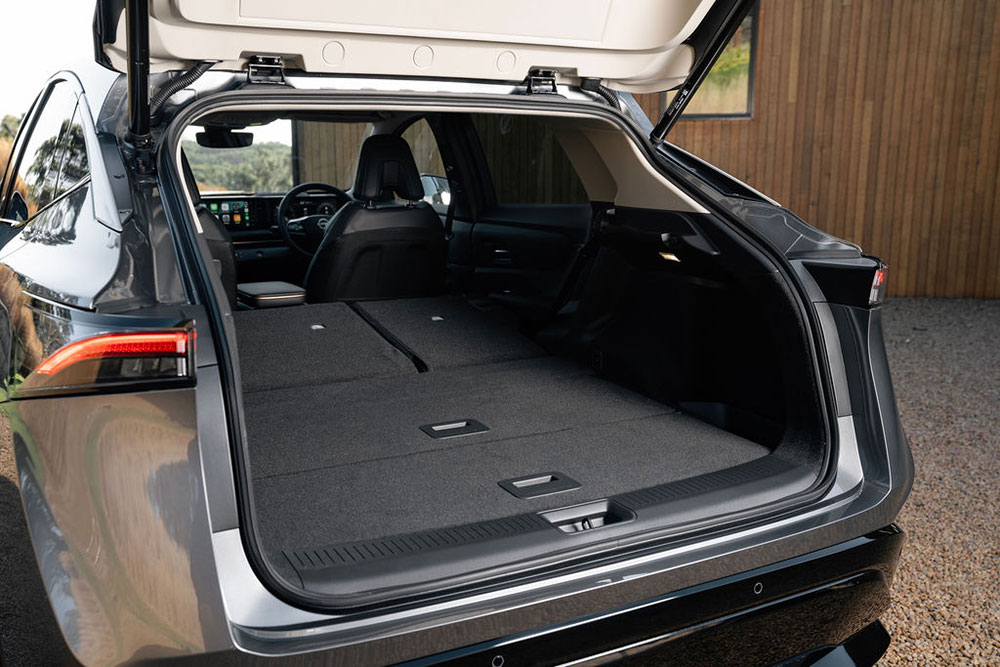
Access to the boot is via a hands-free electric tailgate which opens to reveal a good-sized space with a flat floor.
There are466 litres of boot space in front-wheel-drive models, with the all-wheel-drive e-4orce variant having a slightly smaller capacity of 408 litres.
That's competitive, but rivals including the BYD Sealion 7 (500 litres), Skoda Enyaq (585 litres), and Tesla Model Y (854 litres) offer superior boot space. When the Ariya's rear seats are folded down, the total cargo space expands to a maximum of 1,350 litres.
A twin floor design allows the user to remove part of the boot base and stand it vertically to create separate luggage areas.
Under the main floor is a tyre repair and inflator kit (in lieu of a full-size spare or a space-saver), 12V battery, and a sub-woofer for the 10-speaker Bose stereo system. The supplied charging cables are stored in a recess on the left-hand side of the boot.

What standard features does the Nissan Ariya Advance+ have?
Even in base trim the Ariya is quite generously equipped, with all models boasting:
- Automatic dimming frameless rearview mirror
- Intelligent key with approach unlock and walkaway lock function
- Automatic dual-zone climate control
- Power adjustable/ folding
- Heated door mirrors with LED turn indicator
- Leather-accented multi-function steering wheel controls
- One-touch power windows with remote up/down function
- Vanity mirrors with illumination
- ‘Follow Me Home’ headlights
- 60/40 split folding rear seats
- Intelligent cruise control
- Rain-sensing wipers.
- Wireless Apple CarPlay and wired Android Auto
- Wireless phone charger
- Voice recognition
- USB for charging (2 front and 2 rear – Type A & C)
- 12V accessory socket
- AM/FM radio & DAB digital radio
- Bluetooth with audio streaming.
To this the Ariya Advance adds:
- Heated front seats and heated steering wheel
- Intelligent Around View Monitor+ with Moving Object Detection
- Hands-free automatic opening power tailgate
- Bose 10-speaker premium sound system
- Rear privacy glass
- LED front fog lights.
The Advance+ ups the luxury ante further by adding:
- Black synthetic leather seats with Ultrasuede inserts
- Windscreen Head-Up Display
- Panoramic glass roof
- Power sliding centre console
- Eight-way power adjustable driver and front passenger seats with memory function
- Four-way power lumbar driver seat
- Ventilated (heat and cooled) front seats
- Heated rear seats
- ED front and rear sequential turn signals.
For buyers prepared to push into the $70k-plus range the top-spec Ariya Evolve e-4ORCE brings:
- Dual motor performance
- All-wheel drive grip
- 20-inch alloy wheels
- Blue Nappa leather seat trim
- Intelligent rear-view mirror
- Automatic LED headlights with Adaptive Driving Beam
- Power adjustable/folding/heated door mirrors with memory function and tilt to reverse
- Power tilt and telescopic steering wheel adjustment with memory function.
What safety features does the Nissan Ariya Advance+ have?
All Nissan Ariya variants come with a five-star ANCAP rating, which is based on 2022 Euro NCAP testing.
The Ariya achieved strong scores in the 2022 Euro NCAP assessments, with 86% for adult occupant protection, 89% for child occupants, 74% for vulnerable road users, and a very high 93% for its safety assist systems.
Standard on all models is dual frontal, side chest-protecting and side head-protecting (curtain) airbags, plus a centre airbag which provides added protection to front seat occupants in side impact crashes.
Also standard is:
- Autonomous Emergency Braking (Car to Car
- Vulnerable Road User
- Junction Assist and Backover
- Lane Keep Assist (LKA)
- Lane Departure Warning (LDW)
- Emergency Lane Keeping (ELK)
- Advanced Speed Assistance System (SAS).
The Ariya's comprehensive list of active and passive safety features includes:
- ProPilot (Lane Keep Assist)
- Rearview camera
- Front and rear parking sensors
- Front, front side and curtain airbags
- Predictive Forward Collision Warning
- Forward Emergency Braking with pedestrian and cyclist detection
- Lane Departure Warning and Lane Departure Prevention
- Blind-Spot Warning & Blind Spot Intervention
- Tyre pressure monitoring system
- Traffic Sign Recognition
- Rear Seat Alert
- Driver Attention Alert
- Rear Cross Traffic Alert and Back-up Collision
- Vehicle Dynamic Control (VDC)
- Traction Control System (TCS)
- Anti-lock Braking System (ABS)
- Electronic Brakeforce Distribution (EBD)
- High Beam Assist
- High-mounted LED rear stop light
- Seatbelt reminder (all rows)
- Vehicle sound for pedestrians.
Is the Nissan Ariya Advance+ good to drive?
Like its lower-grade stablemates, the Ariya Advance+ features a single motor front-wheel drive layout but gets the larger capacity 87kWh battery and a bump in power output to 178kW.
Its torque figure of 300Nm is the same as the lower grades, however, meaning there's no tangible performance benefit to show for the extra power.
In fact, the Advance+ is one-tenth of a second slower than its smaller-battery stablemates over the benchmark 0-100km/h dash at 8.1 seconds, probably due to the extra weight of its larger battery.
It's also a yawning 2.5 seconds slower than the dual motor Evolve e-4ORCE from 0-100km/h, with the dual motor version delivering notably more assertive 0-100km/h acceleration of 5.6-seconds.
That's around three-tenths of a second quicker than a Tesla Model Y single motor, but eight-tenths of second slower than a comparable Tesla Model Y Dual Motor.
A drive mode selector gives the option to drive in Eco, Standard, and Sport modes, with the all-wheel drive Evolve e-4ORCE adding an additional Snow mode. All variants also feature E-Pedal drive mode and Hill Start Assist.
If being first away from the lights, or regularly driving in wet and slippery conditions is part of your requirements, then best gravitate to the dual motor all-wheel drive e-4ORCE.
The front-wheel drive variants don't have the sort of pin-you-to-the-seat thrust of that model, but their acceleration is hardly tardy, and it's delivered in the typically quiet, strong and linear fashion of an EV drivetrain.
Certainly, there's ample urge from the single motor variants for rapid traffic light get-aways, and to despatch slower vehicles at highway speeds.
The bigger battery and single motor do, however, endow the Advance+ with the best claimed range of any Ariya variant, its 504km (WLTP) comfortably superior to the 385km offered by the base models, and better even than the 487km range of the Ariya Evolve e-4ORCE.
Out on the road the Ariya's ride and handling balance is quite well judged, with impressive isolation from road and wind noise.
Underneath, the Ariya features independent strut front suspensions and a multi-link independent rear suspension, with front and rear stabiliser bars.
Braking is via discs front and rear with an electric park brake and electric power steering as standard.
All three single-motor variants ride on 19-inch alloy wheels clad with 235/50R19 tyres which provides better ride quality than the 20s fitted exclusively to the top-grade Evolve e-4ORCE, an advantage that particularly noticeable on lumpy and pothole-riddled roads.
In terms of driving efficiency, we saw figures of between 18.2kWh/100km in a front-wheel drive car over 400km of open road driving including freeway, so you'd expect to do better than that around town with more regenerative braking.
Braked towing capacity is 750kg across all three front-drive variants, rising to 1500kg for the dual motor Evolve e-4ORCE.

What sort of technology does the Nissan Ariya Advance+ have?
All Ariya variants boast twin 12.3-inch screens, satellite navigation, wireless Apple CarPlay and wired Android Auto, wireless phone charger, voice recognition, USB for charging (2 front and 2 rear – Type A & C), 12V accessory socket, AM/FM radio & DAB digital radio, and Bluetooth with audio streaming.
In addition, the Ariya's intelligent driver control system feature’s Amazon’s Alexa voice control technology, meaning you can control the car from home and vice versa with the appropriate home installation.
The system includes ‘Hey Nissan’ voice control activation and among other tricks can lock and unlock the car remotely, control the vehicle temperature, and manage the entertainment system.
It can also learn your preferences and set your journey automatically for you.
The Ariya also includes the latest in connectivity features, including Over The Air (OTA) firmware updates for mapping and other features.
On the charging front, all variants can charge at up to 130kWDC, resulting in a 0-80% charge time of approximately 35-40 minutes, but only the Evolve e-4ORCE gets a three-Phase AC Onboard charger enabling 22kW AC charging as standard.
The Advance+ also offers three-phase capability as an option, but during the Ariya's launch phase Nissan is offering three-phase charging compatibility as standard on all variants.
While 130kW is not an especially high DC charging rate, with some rivals offering up to 350kW, Nissan claims the Ariya delivers a consistent charging speed rather than just a high peak.
How does a Nissan Ariya Advance+ compare?
It's inevitable that an electrically powered medium SUV is going to find itself compared with the class-leading Tesla Model Y and BYD Sealion 7.
Other noteworthy rivals in this particularly busy segment include the Skoda Enyaq, Deepal S07, Ford Mustang Mach-E, Geely EX5, Kia EV5, and Xpeng G6.
Prices for the Model Y range start at $58,900 (plus on-road costs) for the entry level Rear Wheel Drive variant, rising to$68,900 (plus on-road costs) for the Long-Range All-Wheel Drive.
The BYD Sealion 7 starts at $54,990 for the rear-wheel drive Premium, rising to $63,990 for the all-wheel drive Performance.
This means the Ariya is competitively priced with both Tesla variants and with the entry-level Sealion 7, but the Evolve e-4ORCE is almost $7,000 more expensive than the top-shelf BYD Sealion 7 all-wheel drive Performance.
The fact Nissan offers four versions of the Ariya at different price points does, however, allow buyers a bit more flexibility and choice.
When it comes to range and performance, the Tesla Model Y RWD’s 62.5 kWh battery delivers a range of 466km (WLTP), and 0-100km/h acceleration in 5.9 seconds, while the equivalent BYD
Sealion 7 Premium variant gets an 82.56kW battery delivering a driving range of 482km (WLTP) and 0-100km/h acceleration of 6.7 seconds.
The means the Ariya Advance+ has them both comfortably covered with its 504km (WLTP) range, but it won't see which way either the Tesla or BYD single motor variants went in a straight line drag race.
Should I buy a Nissan Ariya Advance+?
Most EV buyers are looking for more nuance than simply comparing 0-100km/h sprint times and range.
Suffice to say the Ariya is competitive against key rivals with its range, but if you're obsessed with winning the traffic light grand-prix then best step up to the dual motor Evolve e-4ORCE, or buy the rival offerings from Tesla and BYD.
What the Ariya does have going for it is an exceptional 10-year manufacturer warranty on vehicle and battery, if you service through Nissan's national dealer network.
That network is also one of Australia's largest, which should give buyers in regional areas confidence that vehicle service and repair will be convenient and reliable.
Also playing in the Ariya's favour is the fact that Nissan is a brand with a long history in Australia and a solid reputation for quality and reliability, something we have yet to establish with some of the newer Chinese brands.
There's also the important fact this isn't Nissan's first EV, and with some 700,000 Leafs on the road and counting, the brand has more EV expertise many car makers.
In summary, the Ariya is a worthy contender in the most competitive segment of the battery electric vehicle market.
It falls short of being particularly groundbreaking in any area, possibly due to the fact it has taken three years to get here after launching elsewhere, during which time the competition, particularly from
Chinese rivals, has ratcheted up dramatically.
But for buyers who want the comfort of dealing with a well-established and familiar brand in Nissan, rather than a newly arrived challenger brand, it represents a sound choice with few major compromises.

More articles
Related topics
Things to note
The information in this article has been prepared for general information purposes only and is not intended as legal advice or specific advice to any particular person. Any advice contained in the document is general advice, not intended as legal advice or professional advice and does not take into account any person’s particular circumstances. Before acting on anything based on this advice you should consider its appropriateness to you, having regard to your objectives and needs.
Insurance Products (excluding Travel Insurance) are issued by RACQ Insurance Limited ABN 50 009 704 152 (RACQI) and arranged by RACQ Distribution Services Pty Ltd (RDS) ABN 35 116 361 650, AFSL 567130 and RDS' authorised representatives (including RACQ Operations Pty Ltd ABN 80 009 663 414, AR No. 234978 (RACQO)). Conditions, limits and exclusions apply.
Any advice provided by RDS and RACQO is general advice only and does not take into account your personal objectives, financial situation or needs and you will need to consider whether the advice is appropriate for you. Read the Product Disclosure Statement (PDS) before making a purchase decision on the product. You can also access our Target Market Determinations on this website.
RDS receives a commission from RACQI for the policies it arranges. RACQO receives fees paid for services it provides to RDS. Further details about remuneration are available on request prior to purchasing.
Banking and loan products issued by Members Banking Group Limited ABN 83 087 651 054 AFSL/Australian credit licence 241195 trading as RACQ Bank. Terms, conditions, fees, charges and lending policies apply. This is general advice only and may not be right for you. This information does not take your personal objectives, circumstances or needs into account. Read the disclosure documents for your selected product or service, including the Financial Services Guide and the Terms and Conditions, and consider if appropriate for you before deciding.
Except for RACQ Bank, any RACQ entity referred to on this page is not an authorised deposit-taking institution for the purposes of the Banking Act 1959 (Cth). That entity’s obligations do not represent deposits or other liabilities of RACQ Bank. RACQ Bank does not guarantee or otherwise provide assurance in respect of the obligations of that entity, unless noted otherwise.
RACQ Bank subscribes to the Customer Owned Banking Code of Practice which establishes higher standards than the law requires. The Code reflects modern consumer expectations and developments in approaches to issues such as consumer vulnerability, guarantors, and supporting customers through financial hardship. Please read our Customer Owned Banking Code of Practice page for more information.
RACQ Operations Pty Ltd (ABN 80 009 663 414, AR No. 234978) and Members Travel Group Pty Ltd (ABN 45 144 538 803, AR No.432492) (RACQ) are authorised representatives of the RACQ Travel Insurance insurer Tokio Marine & Nichido Fire Insurance Co., Ltd. (ABN 80 000 438 291 AFSL 246 548) (Tokio Marine). Tokio Marine Management (Australasia) Pty Ltd (ABN 69 001 488 455, AR No. 1313066) is an authorised representative of Tokio Marine, and administers RACQ Travel Insurance as the managing agent on behalf of Tokio Marine. Terms, conditions (including eligibility criteria), exclusions, limits and sub-limits apply. Any advice is general advice only, and does not take into account your specific objectives, financial situation or needs. Before you purchase, please consider the Combined Product Disclosure Statement (PDS) / Financial Services Guide (FSG) and Target Market Determinations (TMDs) available at racq.com or on request from RACQ.