

Ford Ranger Super Duty MY26 review
Boasting a heavily reengineered chassis, suspension and drivetrain, the Ranger Super Duty is Ford’s best shot yet at taking on the heavy-duty LandCruiser 70 Series.
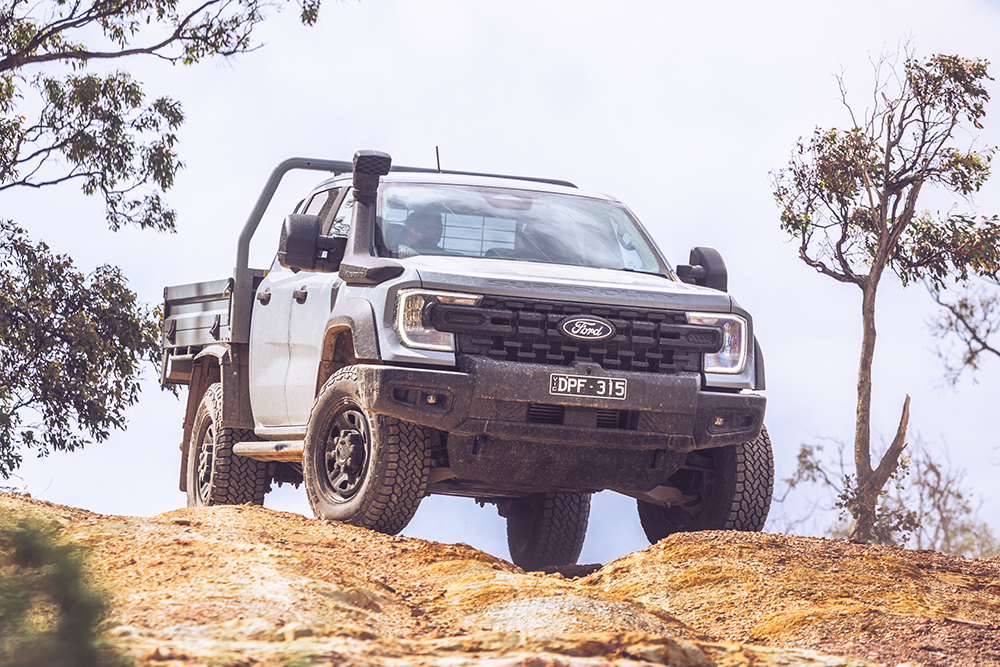
Boasting a heavily reengineered chassis, suspension and drivetrain, the Ranger Super Duty is Ford’s best shot yet at taking on the heavy-duty LandCruiser 70 Series.
Ford Australia turned 100 in 2025 and ended its centenary year on a high with the Ranger ute claiming its third consecutive gong as Australia’s best-selling vehicle.
That may be enough for some car makers to rest on their laurels but Ford instead launched the Super Duty, a new addition to the Ranger lineup that tows and goes where its stablemates dare not tread.
The dual cab 4x4 ute category has a well-established history of brands modifying vehicles with body kits, lift kits, bar-work and sticker packs in a bid to compete with Australia's booming aftermarket accessory industry.
Ford itself has form in this space with the likes of the Ranger Tremor and other variants. But the Super Duty is something else again. Unlike these mildly modified versions of a base ute, Ford has gone all out with the Super Duty to create a distinctive new variant, one that promises to further extend the Ranger’s capability and appeal.
As with the rest of the Ranger lineup, Ford Australia was charged with leading development of the Super Duty for global markets, and appears to have few stones unturned in its quest to create the ultimate Ranger and a credible rival to the LandCruiser.
The development process was particularly arduous and included extensive real-world testing while fully laden in a range of remote and sometimes extreme locations.
This included being driven while fully laden along rugged tracks in Victoria’s High Country with numerous steep ascents, descents and water crossings.
Fully laden Super Duties were also put through their paces on cattle stations in Outback Queensland, the sandy beaches of South Australia’s Coorong, and on sandy tracks and dunes in the Simpson Desert.
One notable test was a 600km desert trek carting 4,500kg of sand bags from Birdsville to Mt Dare on the western edge of the Simpson, a feat Ford claims was achieved on a single tank of diesel.
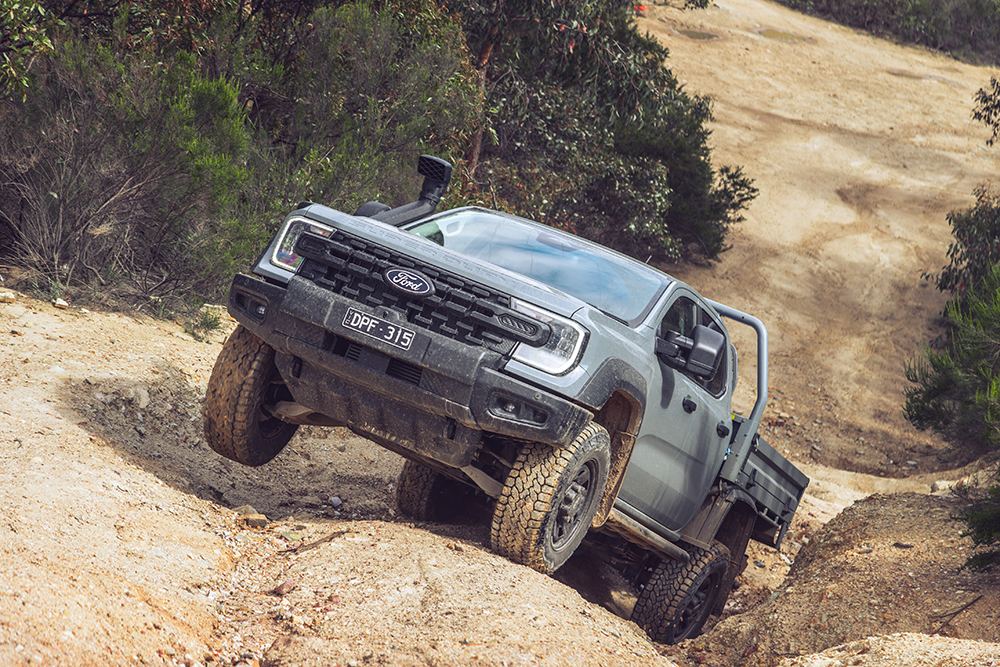
How much does a Ford Ranger Super Duty Double Cab Chassis cost?
Available in Single, Super, Double Cab-Chassis and Double Cab-Pickup body styles, pricing for Ford’s rugged new ute starts at $82,990 (MRLP) and rises to $99,990 (MRLP) for the XLT Double Cab Pickup.
The latter won’t be available until mid-year, however, meaning that at the time of writing the Double Cab-Chassis was the most expensive variant, priced at $89,990 (MRLP) plus an extra $5,966 for Ford’s galvanized steel tray.
That places the Ranger Super Duty above both the previous range-topping twin-turbo petrol V6 Raptor ($90,690) and its most obvious rival, the venerable Toyota LandCruiser 70-Series which retails for between $76,800 and $81,500 dependant on body style and in four-cylinder turbodiesel form.
Ford Ranger Super Duty Double Cab Chassis exterior design
Stylistically, the Super Duty doesn’t stray too far from the Ranger’s successful exterior design template, sitting as it does on the same wheelbase and with broadly similar overall dimensions.
Key exterior design changes include a new bonnet panel with stamped Super Duty lettering, a more open grille design for better cooling, and larger wheel arches to accommodate its widened tracks and bigger tyres.
More noticeable is the fact it sits up higher than other Rangers with superior ground clearance, riding on sturdy eight-stud steel wheels clad with 33-inch 275/70R18 Light Truck all-terrain tyres.
What is the Ford Ranger Super Duty Double Cab Chassis like inside?
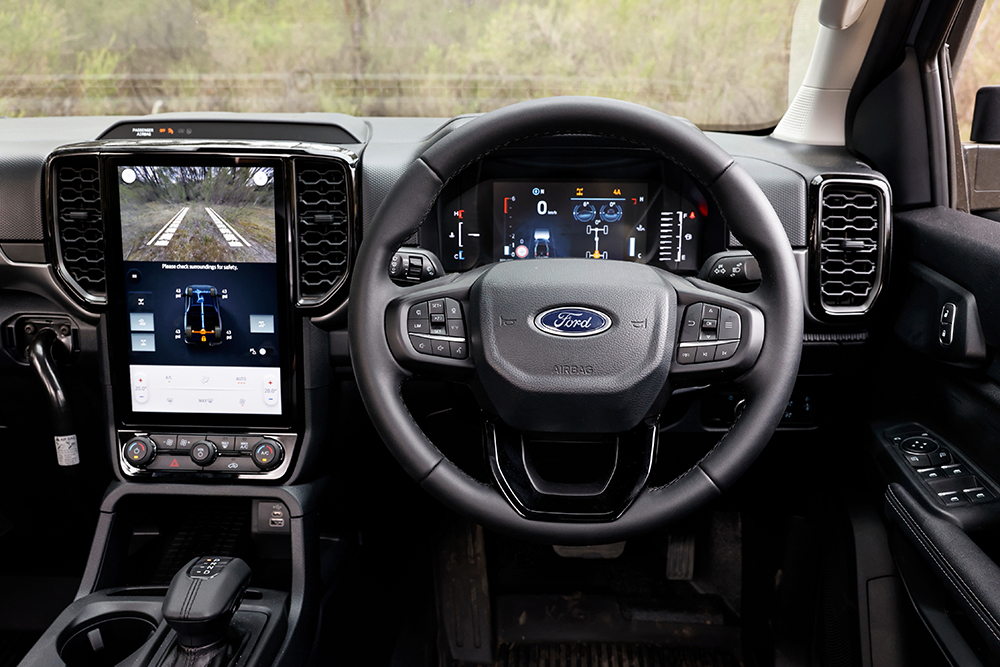
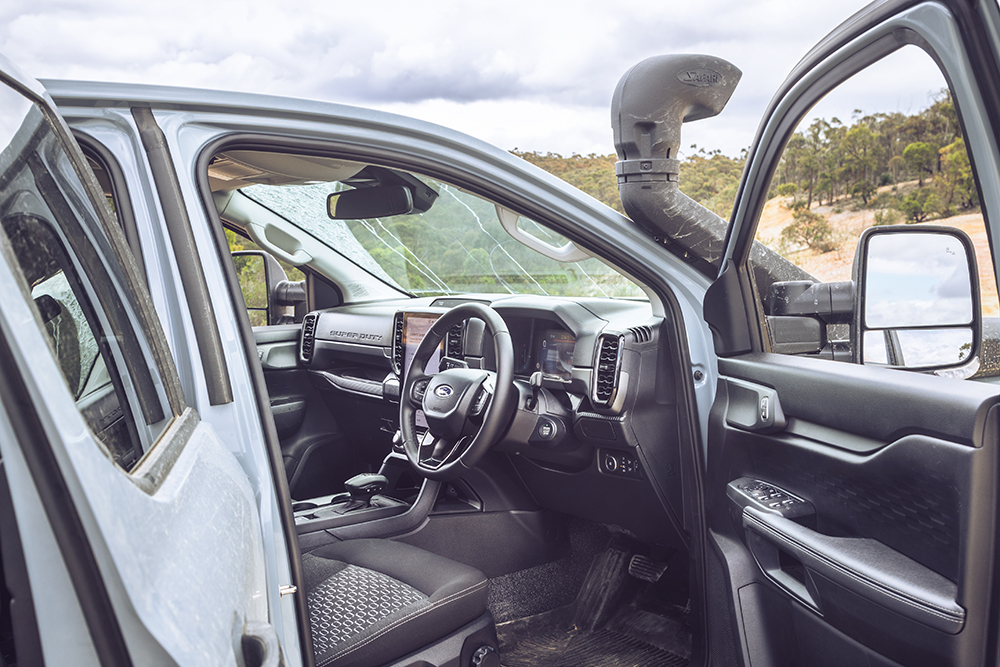
The interior mirrors that of regular Ranger but with vinyl floors and durable fabric seats with manual height adjustment for the driver, unless you step up to the carpeted and leather-clad XLT.
Other notable changes include auxiliary switches in the overhead console with 60A capacity for wiring aftermarket equipment, and an optional integrated device mounting system for tablets.
Ahead of the driver is Ford’s familiar 8.0-inch digital instrument cluster while at dash centre sits a vertically-oriented 12.0-inch touchscreen running Ford’s user-friendly SYNC 4 infotainment system, with features including a 360-degree camera system, selectable off-road drive modes and a raft of other functions.
What’s under the bonnet of the Ford Ranger Super Duty Double Cab Chassis?
The Super Duty retains the Blue Oval’s proven 3.0-litre V6 turbo-diesel used elsewhere in the Ranger and Everest range, but the engine has been retuned for this application, with a new calibration that retains the full 600Nm of torque at 1750rpm, but winds power back from 184kW to 154kW at 3,250rpm.
The V6 also adopts AdBlue diesel exhaust emissions technology in this more heavy-duty application, while the cooling system has been upgraded to ensure dependable performance when fully laden.
Another notable feature is the ability to invoke the Diesel Particulate Filter (DPF) regeneration process at a time that suits the operator, rather than having it occur in potentially dangerous conditions such as over long grass.
The V6 is hitched to a recalibrated version of Ford's proven 10-speed automatic transmission, with the new engine tune designed to ensure its healthy 600Nm of torque is available at lower revs.
Other changes include the adoption of a 130-litre long-range fuel tank which, with average fuel consumption of approximately 12.0L/100km delivers a circa-1000km driving range, depending on load and conditions.
What else is different about the Ford Ranger Super Duty Double Cab Chassis?
Ford's new Ranger variant won’t necessarily be welcomed by Australia’s booming GVM-upgrade workshops, which have been doing great business converting Rangers, HiLux and similar 4x4 utes from their standard 3500kg braked tow rating to the sturdier 4500kg benchmark set by big US pickups.
The Super Duty makes such expensive conversions redundant, at least for those who choose to remain in the Ford family
Under its skin the Super Duty has been comprehensively reengineered, with Ford adding stronger and more heavy-duty frame rails, reinforced suspension mounts, larger front and rear driveshafts, heavier-duty front and rear axles, larger 18-inch brake rotors, uprated springs and shocks, a new transfer case and a better cooling system.
The chassis and suspension upgrades, along with the engine and cooling system changes puts the Super Duty in another league versus other mid-sized utes, resulting in a class-leading 4,500kg maximum braked towing capacity, versus the standard Ranger’s 3500kg rating, a 4,500kg GVM (Gross Vehicle Mass), 8,000kg GCM (Gross Combined Mass), and a payload of up to 1,982kg depending on variant.
Looking at the Super Duty model by model, the single Cab-Chassis variant has the highest Payload of 1,982kg, followed by the Super Cab-Chassis at 1,896kg, and the Double Cab-Chassis at 1,825kg.
These high payload figures are enabled by higher Gross Axle Weight Ratings (GAWR), which are rated at 1,900kg for the front axle and 2,800kg for the rear axle, versus 1,450kg and 1,959kg for conventional Rangers.
What are some other notable features of the Ford Ranger Super Duty Double Cab Chassis?
Along with its beefed-up mechanicals the Super Duty boasts such towing-friendly kit as a 4.5-tonne rated tow-bar and hitch, larger exterior mirrors, and an integrated trailer brake controller.
It also comes standard with a range of handy digital aids including Pro-Trailer Backup Assist, Smart Hitch and Onboard scales which are very useful features for a vehicle designed with towing in mind.
The Super Duty’s ride height sensor on all four wheels and Smart Hitch scales are new and useful features not offered by rival makes, allowing the operator to calculate the weight of the trailer and adjust the weight to get the right balance for safe towing.
Another useful feature is the Smart Trailer function which requires fitment of an electronic black box (supplied) to the trailer and allows the operator to reverse a trailer using the rotary console dial and an auto steer function that automatically self-straightens, with the driver needing only to adjust throttle and braking.
There’s also a standard 400W inverter to convert 12V DC battery power into 230-240V AC power for tools and camping equipment.
What sort of options are there for the Ford Ranger Super Duty Double Cab Chassis?
Ford offers an extensive range of factory-backed options for the Super Duty including three specialised accessory packs (Farm, Work, Adventure), along with heavy-duty steel trays (galvanized, body-colour, or black), ARB-sourced bull bars, Warn winches, and rock sliders.
The Work Pack costs $10,479 at the time of writing and includes a heavy-duty steel tray, water tank and tool box, integrated device mounting system, instrument panel top console, wheel nut indicators, and all-weather floor mats.
The Farm Pack costs $14,629 and includes a heavy-duty steel tray, water tank and tool box, ARB Summit bull-bar, and all-weather floor mats.
There's also a more recreationally oriented Adventure Pack which costs $20,161 and includes heavy-duty steel tray, water tank and tool box, ARB Summit bull-bar, all-weather floor mats, high-capacity winch, and rock sliders.
Buyers also have the option to have a tray fitted by their preferred supplier, or to choose one of three Ford Licensed Accessory steel trays in galvanized silver, body colour and matte black.
Prices for Ford’s Galvanized Steel Tray start at $5,966 for the Double Cab-Chassis, rising to $6,296 for the Super Cab-Chassis, and $7,121 for the Single Cab-Chassis.
Opting to have the tray painted body colour adds between $1200 and $1700 depending on the vehicle paint colour, with the matte-black tray around $1000 more on top of this, depending on variant.
All Ford's factory-fitted accessories come with a five-year unlimited kilometre warranty.
Is the Ford Ranger Super Duty Double Cab Chassis good to drive?
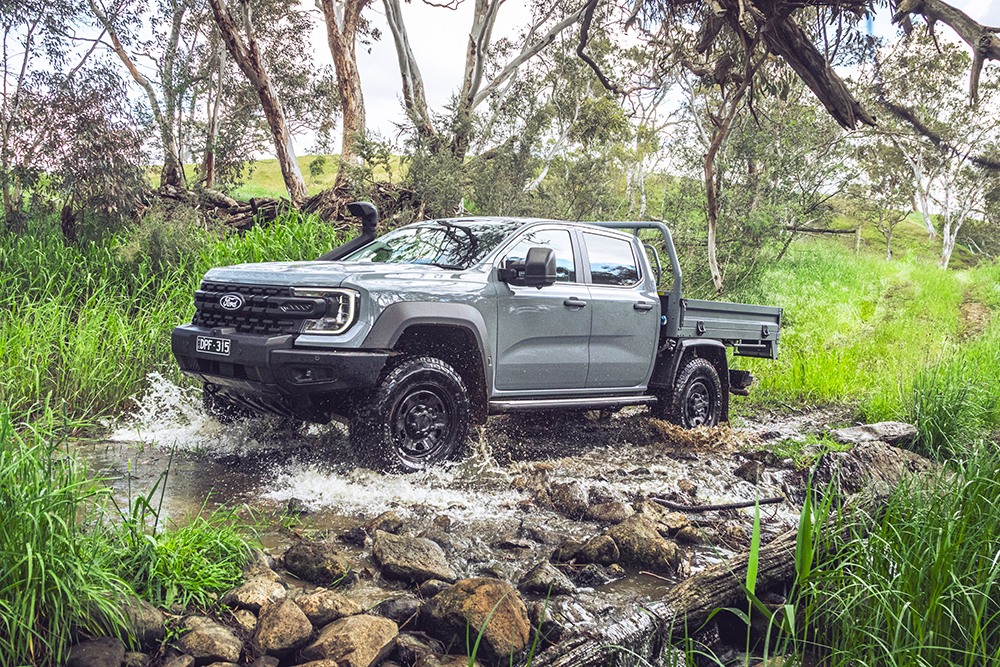
Ford put its money where its development R&D had been at the Super Duty launch, providing the opportunity to test drive its new ute both unladen and laden, with one test being a weighbridge confirmed 7780kg GCM courtesy of a triple-axle trailer loaded with hay bales packed to near the maximum 4500kg braked towing capacity.
That’s about as big as you’re going to get in an Australian trailer and the Super Duty pulled it assertively, the engine exhibiting impressive low-rev grunt and the auto moving smoothly up and down the ratios but hanging onto taller gears once out on the highway and avoiding fussy kick-downs.
While not as smooth and powerful as say, a Ram 1500 V8, and lacking both the plush ride and syrupy acoustics of that model, the Super Duty felt sure-footed and stable under load with sufficient braking power to haul it up when required.
Aside from its tremendous towing capability, one of the other big surprises was how impressive the Super Duty felt on the open road when unladen, particularly on an extended run over a sinuous section of tarmac that would provide a reasonable test of any car’s ride and handling balance, let alone that of a heavy-duty ute wearing chunky off-road rubber.
Here, the Super Duty showcased the sound fundamentals of the Ranger’s chassis, which has seen it lauded as one of the better ride and handling utes on the market for some years now. Pleasingly, despite all the stiffening, reinforcing and use of entirely different suspension components, the Super Duty remains effortlessly easy to drive.
The steering is nicely weighted and progressive, the brakes have enough bite without being grabby, and the suspension resists excessive body roll and pitch, even under hard braking and cornering turn-in. Even the tyres provide a decent level of grip despite their aggressive pattern, clearly signalling through the tiller and the ears when grip levels are being reached.
Unsurprisingly, given the beefed-up suspension, unladen ride quality is firm at low to medium speeds, but the suspension comes into its own as velocity and bump impacts increase, so that at highway speeds the unladen vehicle offers a decent level of compliance that is particularly well suited for larger amplitude bumps.
Out on less challenging roads the Ranger feels quiet and comfy, the torquey V6 offering plenty of low and mid-range grunt, shuffling up the gearbox ratios as quickly possible to optimise efficiency, while remaining responsive enough to kick down to a lower gear when needed without requiring much throttle pressure.
What's the Ford Ranger Super Duty Double Cab Chassis like off-road?
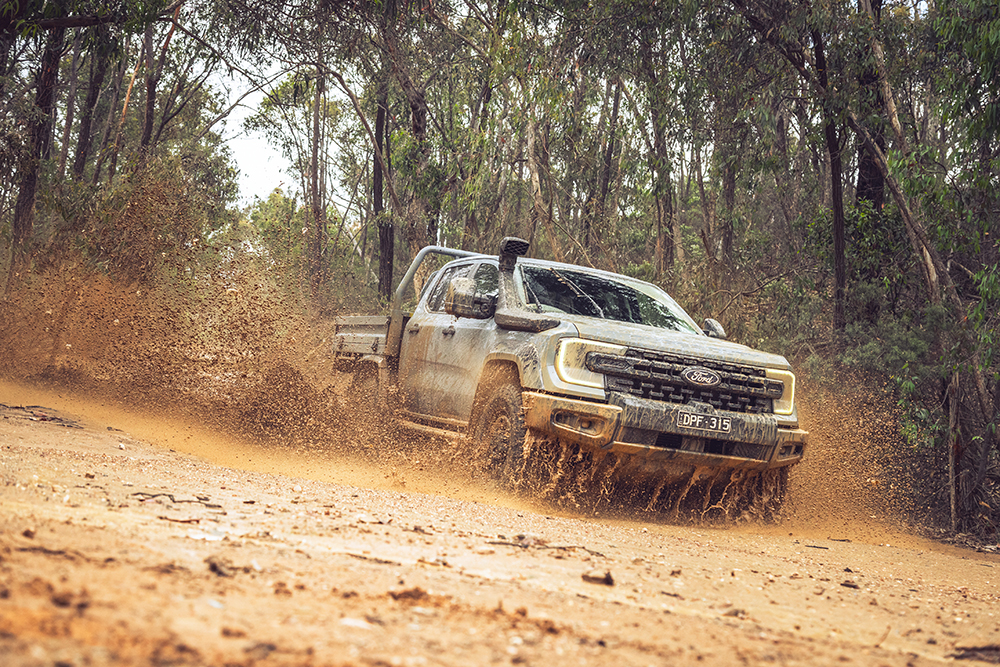
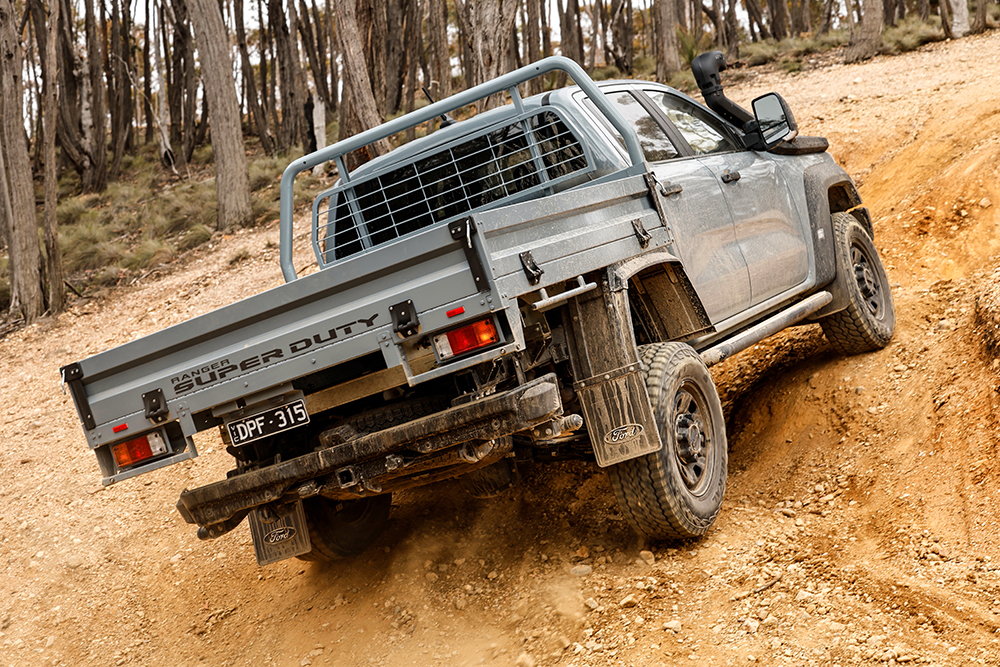
While towing is very much at the heart of what the Super Duty is designed to do, so too is off-roading.
The versatility and capability of Ford’s off-road terrain systems have long been an impressive part of the Ranger’s armoury.
But things go to the next level with the Super Duty, however, courtesy of its extra 299mm ground clearance, 850mm water wading depth, and wider tracks.
Add to this its chunky General Grabberall-terrain tyres, sealed snorkel, front and rear differential locks, heavy-duty underbody protection, dual rated front and rear recovery hooks, and selectable electronic trail modes including Rock Crawl, Trail Control and Trail Turn Assist technology, and it all adds up to a vehicle with serious go-anywhere capability.
The Super Duty's robust underpinnings should also ensure it can handle far more punishment than a regular Ranger, or other medium-duty 4x4 utes.
What safety features does a Ford Ranger Super Duty Double Cab Chassis have?
Unlike its LandCruiser 70-Series rival, which retains a rudimentary safety package, the Super Duty gets the full range of Advanced Driver Assistance Technologies available on other Rangers.
This includes nine airbags, a 360-degree camera, and advanced driver-assist technology like Autonomous Emergency Braking (AEB) with pedestrian detection, Intelligent Active Cruise Control, forward collision warning, lane centring assist, and Blind Spot Monitoring with trailer coverage.
Importantly, for a vehicle that will often be laden and have limited rear visibility, the Super Duty also includes a factory-fitted rear camera, rear park assist, and blind spot detection, features not usually available on cab-chassis variants.
However, the Super Duty does not have an ANCAP safety rating due to its increased weight and structural changes which means it effectively ‘sizes-out’ of the existing five-star rating assigned to the standard Ranger in 2022.
It joins the Ranger Raptor and Ranger PHEV as other untested Ranger variants.
How does the Ford Ranger Super Duty Double Cab Chassis compare?
Comparing the Super Duty to a regular Ranger 4x4 won't be flattering because this more heavy-duty version of Australia's most popular vehicle places its focus firmly on load carrying and off-road capability at the expense of some ride, handling and NVH niceties.
It rides more firmly and is noisier than a regular V6-powered Ranger, and performance is dulled somewhat by the vehicle's extra weight, higher rolling resistance tyres and the lower power output of the V6.
Buyers looking for a comfortable town ute that can also do a bit of towing and off-roading should stick with a Ranger Wildtrak or a Tremor, because these are simply nicer-driving utes. But buyers looking for an alternative to the LandCruiser 70 Series will find the Ford offers superior accommodation and technology, nimbler and more civilised handling, superior NVH, and better ride comfort.
This is also true of imported US pickups like F-150, RAM, Silverado and Tundra, which tend to be big, comfy, powerful and richly equipped, but not necessarily capable of the sort of hardcore off-road work the Super Duty eats up.
The fact the Super Duty is factory-built as opposed to reengineered, while also being less expensive, is another key point of difference with these rivals.
Should I buy a Ford Ranger Super Duty Double Cab Chassis?
Ford has gone all out with the Super Duty to create a vehicle that can step into the ring with the mighty Toyota LandCruiser, something few rival marques have attempted and even fewer have succeeded at.
The new Ranger variant fills an entirely different niche to other models in the lineup, pushing the boundaries of what mid-size utes are capable of and expanding the options for buyers previously restricted to expensive GVM upgrades of conventional pickups, digging deep for pricey reengineered full-size US pickups, or choosing the somewhat agricultural LandCruiser 70 Series.
The fact the Super Duty comes straight from the factory with a lot of the capability that customers previously might have taken six months of effort to get their car accessorised to that level is another part of its attraction.
In summary, Ford's new Ranger Super Duty is a seriously impressive medium-sized ute with heavy-duty capability. It should turn the heads of private owners who tow large caravans or boats, hardcore off-road adventurers, and fleets looking for a heavy-duty workhorse in a mid-size pickup body size.
Ford Ranger Super Duty Double Cab Chassis specifications
- PRICE: $89,990 (MRLP)
- WARRANTY: Five years, unlimited kilometres
- POWERTRAIN: 3.0-litre V6 turbodiesel, 10-speed automatic, full-time 4x4, dual range transfer case, (154kW/600Nm)
- ANCAP CRASH RATING: Not rated
- FUEL CONSUMPTION: 12.0L/100km (318g/km CO2) estimated
- FOR: Excellent towing, load-carrying and off-road performance; no need for expensive GVM upgrades; impressive on-road dynamics; packed with useful features; comfortable and well-equipped interior.
- AGAINST: Heavier chassis adds weight while recalibration of V6 dulls performance; expensive; thirsty; less refined than lighter-duty Rangers; no ANCAP rating.

Related topics
Things to note
The information in this article has been prepared for general information purposes only and is not intended as legal advice or specific advice to any particular person. Any advice contained in the document is general advice, not intended as legal advice or professional advice and does not take into account any person’s particular circumstances. Before acting on anything based on this advice you should consider its appropriateness to you, having regard to your objectives and needs.
Insurance Products (excluding Travel Insurance) are issued by RACQ Insurance Limited ABN 50 009 704 152 (RACQI) and arranged by RACQ Distribution Services Pty Ltd (RDS) ABN 35 116 361 650, AFSL 567130 and RDS' authorised representatives (including RACQ Operations Pty Ltd ABN 80 009 663 414, AR No. 234978 (RACQO)). Conditions, limits and exclusions apply.
Any advice provided by RDS and RACQO is general advice only and does not take into account your personal objectives, financial situation or needs and you will need to consider whether the advice is appropriate for you. Read the Product Disclosure Statement (PDS) before making a purchase decision on the product. You can also access our Target Market Determinations on this website.
RDS receives a commission from RACQI for the policies it arranges. RACQO receives fees paid for services it provides to RDS. Further details about remuneration are available on request prior to purchasing.
Banking and loan products issued by Members Banking Group Limited ABN 83 087 651 054 AFSL/Australian credit licence 241195 trading as RACQ Bank. Terms, conditions, fees, charges and lending policies apply. This is general advice only and may not be right for you. This information does not take your personal objectives, circumstances or needs into account. Read the disclosure documents for your selected product or service, including the Financial Services Guide and the Terms and Conditions, and consider if appropriate for you before deciding.
Except for RACQ Bank, any RACQ entity referred to on this page is not an authorised deposit-taking institution for the purposes of the Banking Act 1959 (Cth). That entity’s obligations do not represent deposits or other liabilities of RACQ Bank. RACQ Bank does not guarantee or otherwise provide assurance in respect of the obligations of that entity, unless noted otherwise.
RACQ Bank subscribes to the Customer Owned Banking Code of Practice which establishes higher standards than the law requires. The Code reflects modern consumer expectations and developments in approaches to issues such as consumer vulnerability, guarantors, and supporting customers through financial hardship. Please read our Customer Owned Banking Code of Practice page for more information.
RACQ Operations Pty Ltd (ABN 80 009 663 414, AR No. 234978) and Members Travel Group Pty Ltd (ABN 45 144 538 803, AR No.432492) (RACQ) are authorised representatives of the RACQ Travel Insurance insurer Tokio Marine & Nichido Fire Insurance Co., Ltd. (ABN 80 000 438 291 AFSL 246 548) (Tokio Marine). Tokio Marine Management (Australasia) Pty Ltd (ABN 69 001 488 455, AR No. 1313066) is an authorised representative of Tokio Marine, and administers RACQ Travel Insurance as the managing agent on behalf of Tokio Marine. Terms, conditions (including eligibility criteria), exclusions, limits and sub-limits apply. Any advice is general advice only, and does not take into account your specific objectives, financial situation or needs. Before you purchase, please consider the Combined Product Disclosure Statement (PDS) / Financial Services Guide (FSG) and Target Market Determinations (TMDs) available at racq.com or on request from RACQ.