
Hyundai Kona Hybrid Premium N Line review
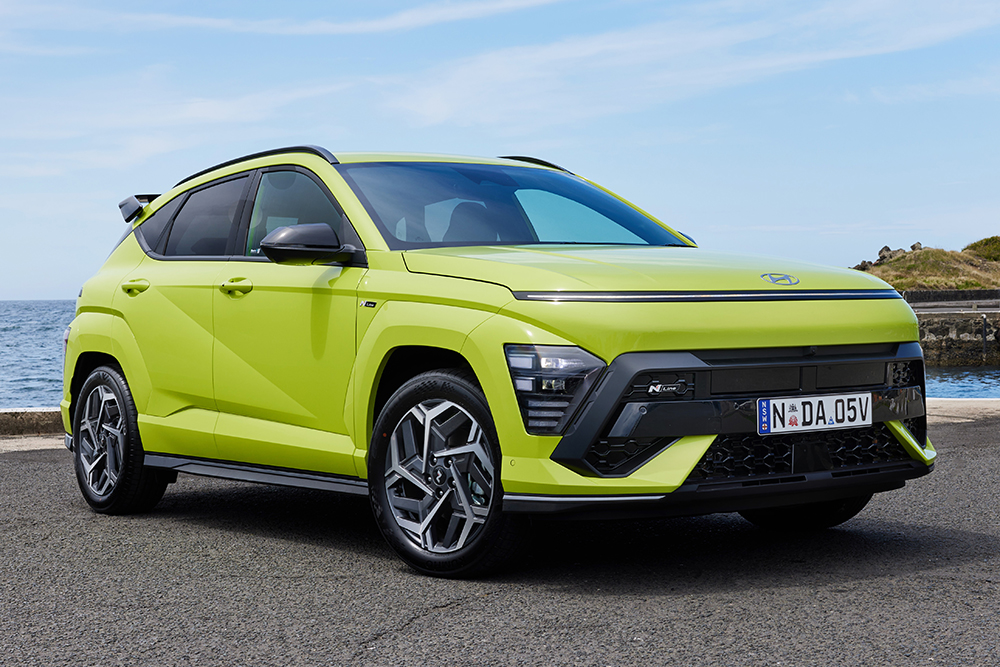
Buyers in the market for a small SUV have never been better served in Australia, with no less than 29 brands offering their wares across nearly 40 model variants.
Among these the Hyundai Kona has been a popular staple since the first-generation model launched here in 2019, with the all-new second-generation landing in mid-2023 in turbocharged and atmospheric (non-turbo) petrol four-cylinder guise.
Late last year Hyundai added additional hybrid electric (HEV) and battery electric (BEV) models, bringing the range of powertrain choices to four.
The Kona is unusual in offering consumers the choice of internal combustion engine (ICE), hybrid and electrified powertrains in a single model range.
The hybrid introduces a third internal combustion engine to the Kona lineup, in the form of the SmartStream G1.6 GDi Hybrid, which joins the two established four-cylinder petrol powerplants.
Petrol and hybrid powertrains
The latter includes the SmartStream G2.0 MPi, a naturally aspirated 2.0-litre four-cylinder petrol with outputs of 110kW/180Nm and fuel consumption of 6.6L/100km; and the SmartStream G1.6 T-GDi, a 1.6-litre turbocharged petrol that punches out a robust 146kW/265Nm and sips unleaded at a rate of 7.6L/100km.
The Kona Hybrid utilises a non-turbocharged 1.6-litre petrol engine delivering 77kW/144Nm, plus an additional 32kW/170Nm from the electric drive motor, for combined system outputs of 104kW/265Nm.
Arguably its key selling attribute is its thrifty 3.9L/100km combined cycle fuel consumption, but it also boasts identical peak torque to the turbo model, ensuring good performance and driveability.
Transmission and drivetrain options
The Kona’s various drivetrain combinations offer something for everyone; with the 2.0-litre petrol four providing a simple entry level powerplant, the 1.6-litre turbo adding some sporting spice, the HEV targeting fuel conscious motorists, and the EV offering a zero-tailpipe emissions alternative.
There are further variations in transmissions and drive systems too, with the petrol turbo driving all-four wheels via an eight-speed automatic transmission, the 2.0-litre four-cylinder driving its front wheels via a CVT, the hybrid driving its front hoops via a six-speed dual clutch with e-motor, and the EV using a single speed transmission.
Add the three new battery electric models – a 48.6kWh Standard Range ($54,000, 64.8kWh Extended Range ($58,000), and 64.8kWh Extended Range Premium ($68,000) – and it’s clear that Hyundai is not at all averse to the notion of model range complexity.
Pricing and variant structure
Regardless of engine, the ICE range is available in a simple two-trim lineup consisting of Kona and Kona Premium variants, with the option in both cases of adding an N-Line enhancement pack for an additional $4,000.
This effectively gives 10 variants across the Kona ICE-range, with the entry level Kona 2.0-litre petrol starting at $32,000, followed by the Kona Hybrid at $36,000.
Adding the N Line Pack to the Kona Hybrid raises the ask to $40,000, or $43,500 for the better-equipped Kona Premium Hybrid, topping out at $46,500 for the Premium Hybrid with N Line.
The sporty 1.6-litre turbocharged variants come only in N-Line trim in Kona and Kona Premium guises with pricing identical to the Hybrid with N-Line variants.
Despite a price premium of $4,000 over the comparable 2.0-litre petrol model, Hyundai expects the Kona HEV to be the most popular drivetrain choice in the new range.
The fact this model is taller and longer than the model it replaces, and offers more generous rear-seat accommodation and expanded luggage capacity, might also tempt some customers to consider downsizing.
Design, interior and features
Stylistically, Hyundai has adopted distinctive EV design attributes across the Kona range, with the ICE, HEV and EV models all differentiated by slightly different grille and front-end treatments.
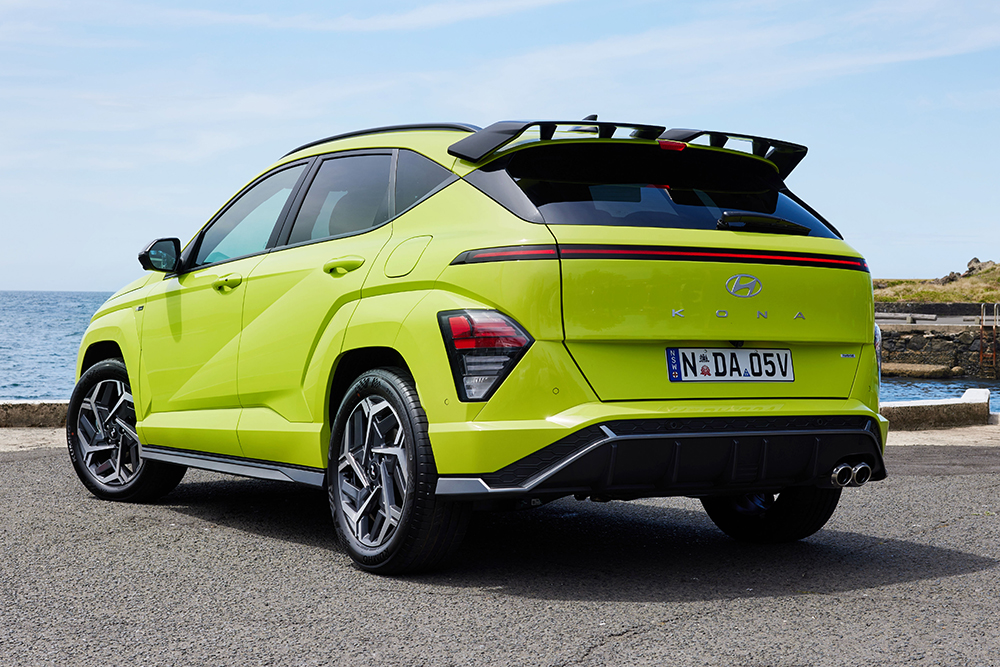
The N-Line trim adds a further layer of differentiation courtesy of a body kit that brings body-coloured cladding and side skirts, 18-inch alloy wheels, a wing-type spoiler, gloss black mirror caps, dual projector beam headlights and LED headlights.
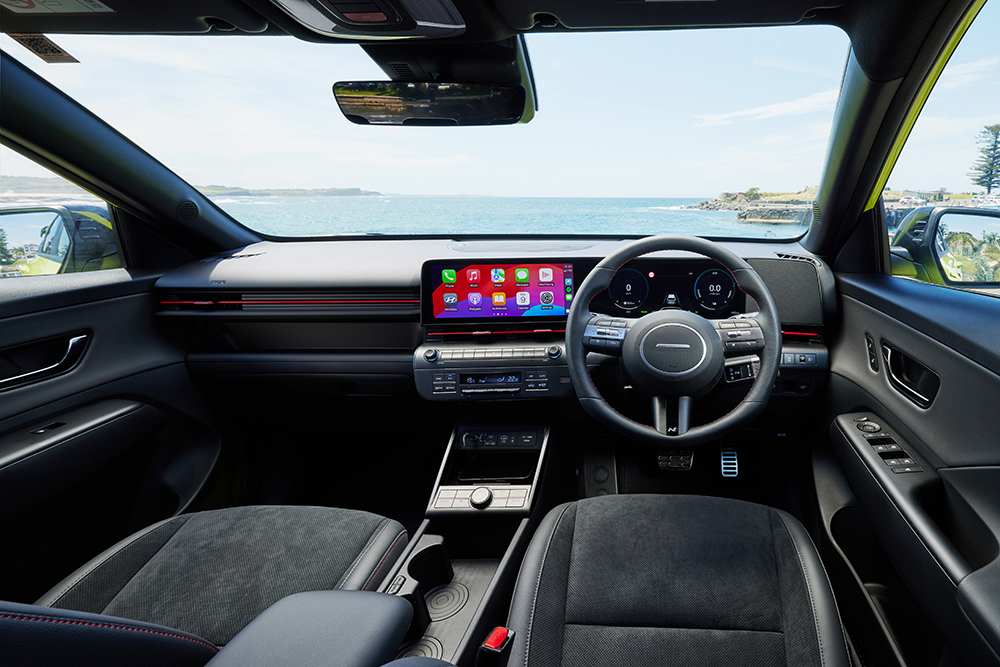
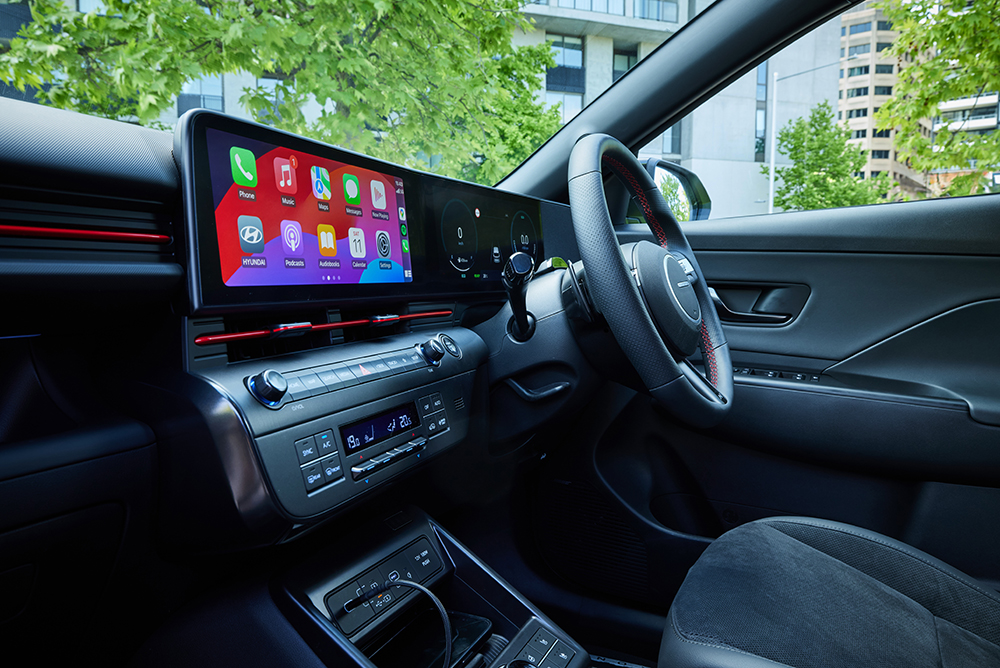
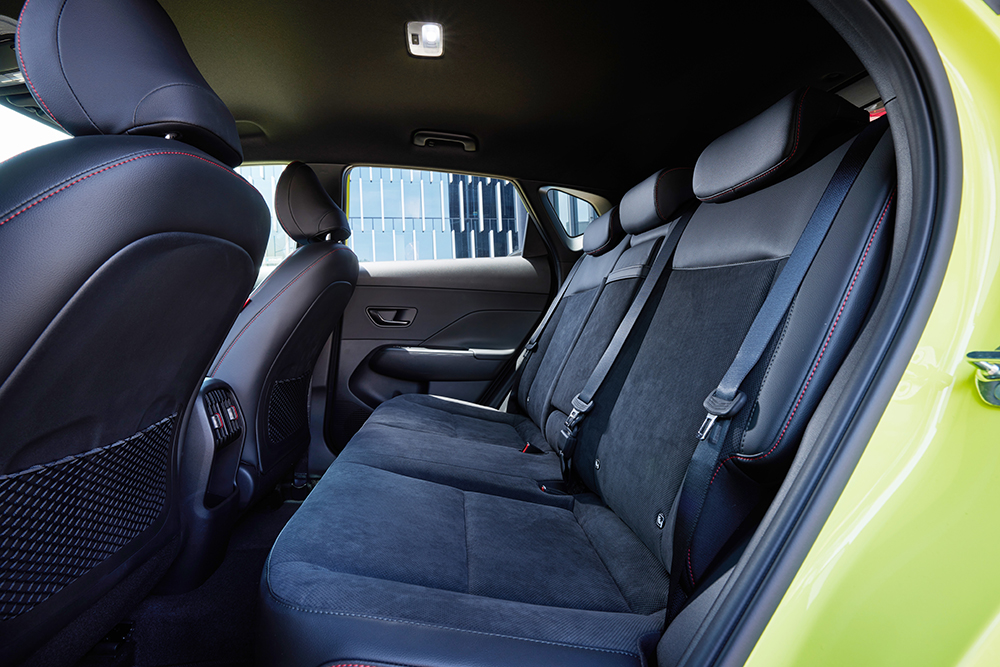
The interior is roomier than the small SUV classification might suggest, with an attractively designed dash, good quality finishes and a light and airy feel courtesy of an open console which incorporates a wireless charging pad and cup holders.
A column-mounted Shift-by-Wire gear selector also frees up console space.
A 12.3-inch multimedia display and additional 12.3-inch instrument cluster on the upper variants ensures a contemporary looking layout, with key N Line additions include leather-appointed seats with Alcantara inserts, red highlights and stitching on the seats and doors, black headlining and pillar trims, and splashes of dark metal trim.
On-road performance and safety
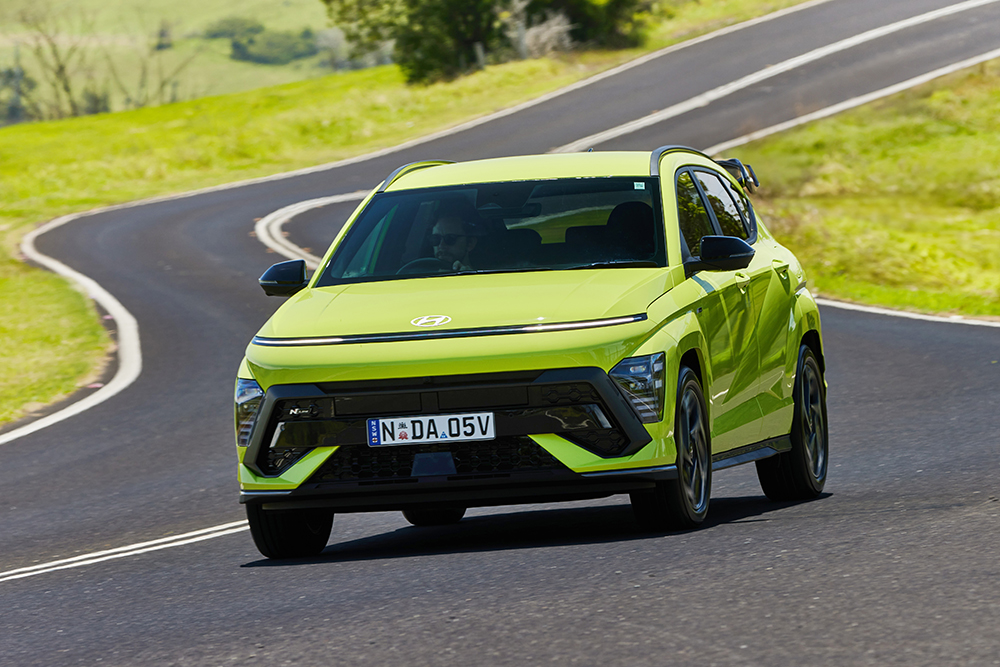
Out on the road the Kona Hybrid delivers quality driving dynamics, thanks in part to its uses of a multilink rear suspension, where the 2.0-litre MPi utilises a torsion beam.
Hyundai’s e-Motion Drive, an electric dynamic torque vectoring control system (e-DTVC) also does its bit to enhance handling by braking an inside wheel and sending drive to the outside when cornering.
The dual-clutch transmission also offers notably more engaging driving characteristics than rival CVT offerings and, with Sport mode engaged gear selection can be manually controlled by paddle shifts.
When in other modes the left paddle acts to control the three-stage regenerative braking system, which in maximum braking mode will bring the car to halt when you lift off the throttle, just like an EV.
On the safety front, the Kona boasts a long list of more than 20 advanced active safety and driver assistance features bundled together under Hyundai’s SmartSense Safety banner, plus seven-airbags including a front centre-side airbag. Despite this, the new model received only a four-star rating in recent ANCAP safety testing.
Hyundai Kona Hybrid Premium N Line key stats
- Price: $46,500 (MRLP)
- POWERTRAIN: 1.6-litre four-cylinder GDi engine (77kW/144Nm), electric motor (32kW/170Nm), 1.32kWh battery, six-speed dual-clutch transmission, front-wheel drive (Combined 104kW/265Nm).
- ANCAP CRASH RATING: Four Stars (2024)
- FUEL CONSUMPTION: 3.9L/100km (89g/km CO2)
- FOR: Well-built and nicely finished, expanded interior dimensions, thrifty fuel consumption, good dynamics, Premium grade comes loaded with kit, N Line kit adds flair.
- AGAINST: Four Star safety rating, intrusive driver-assist alerts, space saver spare.

More articles
Related topics
Things to note
The information in this article has been prepared for general information purposes only and is not intended as legal advice or specific advice to any particular person. Any advice contained in the document is general advice, not intended as legal advice or professional advice and does not take into account any person’s particular circumstances. Before acting on anything based on this advice you should consider its appropriateness to you, having regard to your objectives and needs.
Insurance Products (excluding Travel Insurance) are issued by RACQ Insurance Limited ABN 50 009 704 152 (RACQI) and arranged by RACQ Distribution Services Pty Ltd (RDS) ABN 35 116 361 650, AFSL 567130 and RDS' authorised representatives (including RACQ Operations Pty Ltd ABN 80 009 663 414, AR No. 234978 (RACQO)). Conditions, limits and exclusions apply.
Any advice provided by RDS and RACQO is general advice only and does not take into account your personal objectives, financial situation or needs and you will need to consider whether the advice is appropriate for you. Read the Product Disclosure Statement (PDS) before making a purchase decision on the product. You can also access our Target Market Determinations on this website.
RDS receives a commission from RACQI for the policies it arranges. RACQO receives fees paid for services it provides to RDS. Further details about remuneration are available on request prior to purchasing.
Banking and loan products issued by Members Banking Group Limited ABN 83 087 651 054 AFSL/Australian credit licence 241195 trading as RACQ Bank. Terms, conditions, fees, charges and lending policies apply. This is general advice only and may not be right for you. This information does not take your personal objectives, circumstances or needs into account. Read the disclosure documents for your selected product or service, including the Financial Services Guide and the Terms and Conditions, and consider if appropriate for you before deciding.
Except for RACQ Bank, any RACQ entity referred to on this page is not an authorised deposit-taking institution for the purposes of the Banking Act 1959 (Cth). That entity’s obligations do not represent deposits or other liabilities of RACQ Bank. RACQ Bank does not guarantee or otherwise provide assurance in respect of the obligations of that entity, unless noted otherwise.
RACQ Bank subscribes to the Customer Owned Banking Code of Practice which establishes higher standards than the law requires. The Code reflects modern consumer expectations and developments in approaches to issues such as consumer vulnerability, guarantors, and supporting customers through financial hardship. Please read our Customer Owned Banking Code of Practice page for more information.
RACQ Operations Pty Ltd (ABN 80 009 663 414, AR No. 234978) and Members Travel Group Pty Ltd (ABN 45 144 538 803, AR No.432492) (RACQ) are authorised representatives of the RACQ Travel Insurance insurer Tokio Marine & Nichido Fire Insurance Co., Ltd. (ABN 80 000 438 291 AFSL 246 548) (Tokio Marine). Tokio Marine Management (Australasia) Pty Ltd (ABN 69 001 488 455, AR No. 1313066) is an authorised representative of Tokio Marine, and administers RACQ Travel Insurance as the managing agent on behalf of Tokio Marine. Terms, conditions (including eligibility criteria), exclusions, limits and sub-limits apply. Any advice is general advice only, and does not take into account your specific objectives, financial situation or needs. Before you purchase, please consider the Combined Product Disclosure Statement (PDS) / Financial Services Guide (FSG) and Target Market Determinations (TMDs) available at racq.com or on request from RACQ.