
Subaru Trailseeker AWD MY26 review
Key points
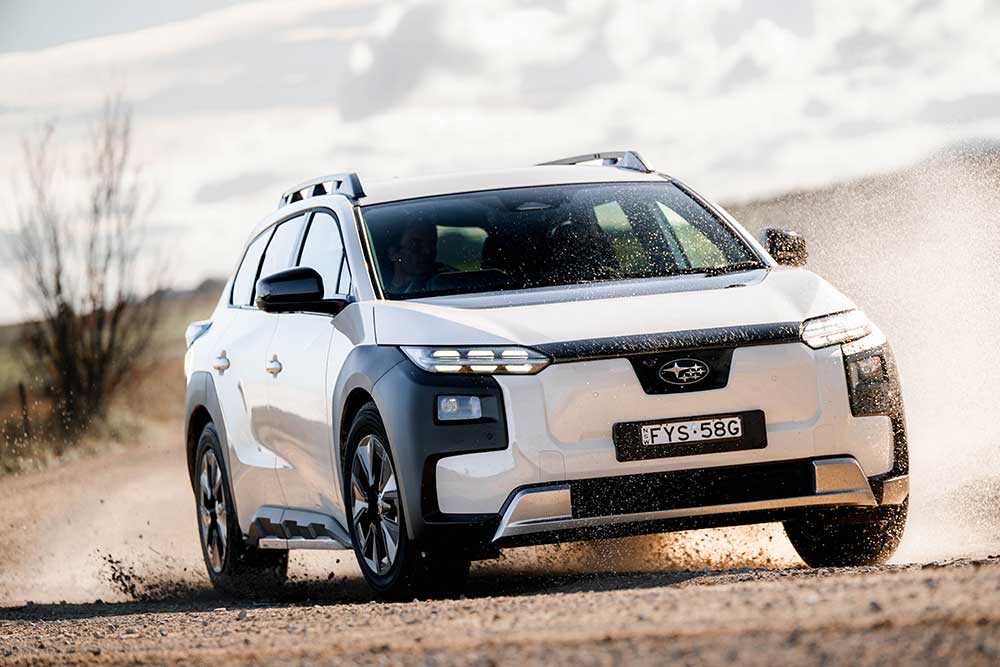
- Line-up: Two variants, priced from $63,990 (MRLP)
- Output: 280kW dual-motor AWD, Subaru’s most powerful to date
- Acceleration: 0–100km/h in 4.4 seconds
- Range: 74.7kWh battery delivering up to 533km (ADR)
- Fast charging: 150kW DC (10–80% in about 20 minutes)
- Off-road capability: Standard all-wheel drive, 211mm clearance, X-Mode system.
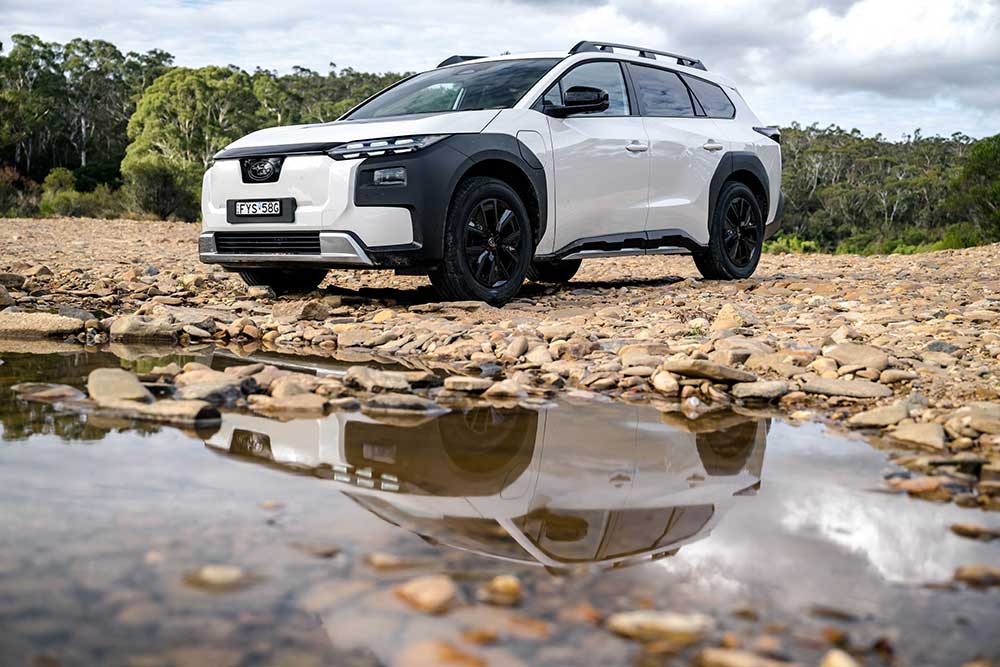
This is the new Subaru Trailseeker, a dual motor all-wheel drive medium SUV that’s based on the brand’s other electric model the Solterra.
Compared with the Solterra, the Trailseeker is longer and offers more passenger accommodation and luggage space, but it’s still only a five-seater.
It joins what will soon be a three-model Subaru EV lineup that includes the established Solterra, and the soon to be launched Uncharted compact SUV.
All three Subaru EVs are based on a common electrical architecture, a version of which also underpins Toyota equivalents the bZ4X and bZ4X Touring.
That’s courtesy of a long-standing technology sharing deal between the two Japanese car makers that also extends to the BRZ and GR 86 sports cars.
In this case, the deal sees the Subaru Trailseeker and the Toyota bZ4X Touring built at Subaru’s Gunma Yajima Plant in Japan, whereas the Solterra and bZ4X are built at Toyota's Motomachi assembly plant in Toyota City.
How much does a Subaru Trailseeker AWD cost?
The electric SUV is offered in a simple two-variant model lineup starting with the Trailseeker AWD at $63,990 (MRLP) and rising to the Trailseeker AWD Touring at $69,990 (MRLP).
Both models are mechanically identical, with the same dual-motor all-wheel drive system and the same 74.7kWh battery, with their main technical difference being wheel and tyre sizes.
What about the Subaru Trailseeker AWD’s standard features?
Standard features of the entry-level Trailseeker AWD include:
- 18-inch alloy wheels and tyres
- 14-inch colour touchscreen
- Dual wireless phone chargers
- Synthetic leather upholstery
- Heated leather steering wheel
- Heated front and outer rear seats
- Powered driver’s seat with electric lumbar.
The top-spec AWD Touring adds:
- 20-inch alloy wheels
- Leather-accented upholstery in blue-black combination
- Heated and ventilated front seats
- Eight-way electric adjustment for both front seats
- Panoramic sunroof
- 10-speaker Harmon Kardon audio system
- V2L (Vehicle to Load) functionality.
That’s a decent amount of kit for the $6,000 premium and would normally be a no-brainer, but for the fact the Touring delivers less range and a stiffer ride than the base model.
What about the Subaru Trailseeker AWD’s exterior design
In Europe and the UK, the Trailseeker is sold as the E-Outback, so it should be no surprise that Subaru’s newest high-riding wagon bears some similarities to that model.
It’s not that the two are technically related but with the design brief for both Trailseeker and Outback being a five-door, five-seat station wagon with SUV-like trim elements and extra ground clearance, it’s clear there’s going to be some crossover (if you’ll excuse the pun).
Dimensionally, the Trailseeker is slightly shorter, narrower and lower than the Outback, but it still sits up quite high with 211mm of ground clearance and rides on a longer wheelbase which is a good thing for both luggage space and rear seat legroom.
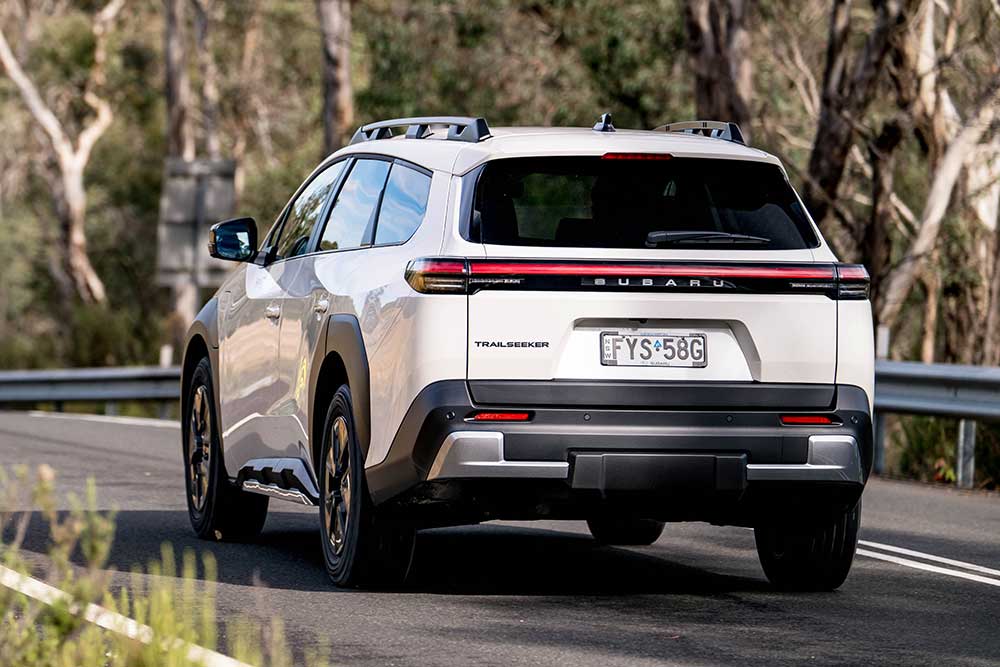
The design is a bit sleeker and more aerodynamic looking than the Outback, with a high front-end that features the characteristic grille-less look we associate with EVs, and distinctive six-point LED headlights.
Along the sides are chunky dark plastic wheelarch flares that extend over the front wheelarches and into the front fascia, along with rear privacy glass, roof rails and a raked rear windscreen.
The rear view features a full-width LED taillight that helps give the Trailseeker a suitably planted, squared-off stance, with backlit Subaru lettering proving the finishing touch.
What is the Subaru Trailseeker AWD like inside?
Based as it is on the Solterra the Trailseeker follows the dash design and layout of that model fairly closely.
It’s not an especially harmonious design, with lots of angles, edges, switches and other elements that look quite busy compared to the more minimalist designs that are becoming prevalent.
We also counted six different textures across the interior which contributes further to the slightly busy design, concluding that the basic grey colour palette of the base model was arguably more attractive than the high-grade model with its blue-trim highlights.
But each to their own on that front.
What isn’t in dispute is the quality of the materials and the way they are put together, with the Trailseeker exhibiting similar high-quality fit and finish to that which we’ve come to expect from other Subaru (and Toyota) models over the years.
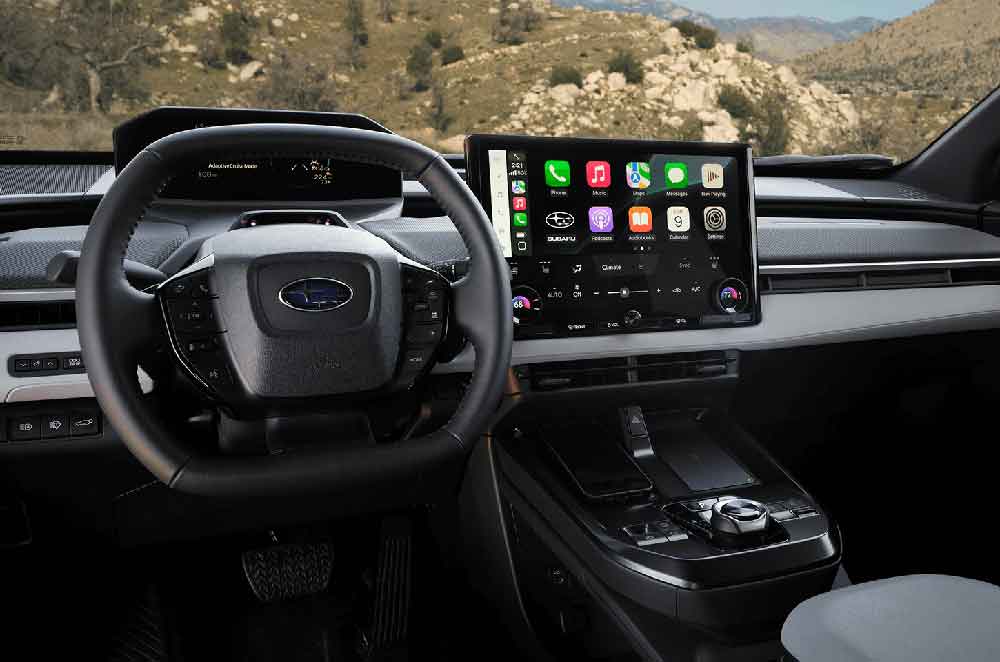
In both Trailseeker variants the central touchscreen is a large 14.0-inch unit and there’s a smaller 7.0-inch digital driver display located behind the oddly shaped steering wheel with its flat top and bottom sections.
The wheel’s relatively small diameter suggests the unusual design is intended to minimise blocking the driver’s view of the low-set dash display, which it mostly succeeds at.
Tucked behind the steering wheel with its array of buttons and switches are paddle shifts for the five-level regenerative braking system with the highest setting delivering what Subaru describes as ‘near’ one-pedal driving.
The main screen features good quality graphics and a fairly intuitive interface that responds promptly to inputs.
The system offers Wireless Apple Car Play and Android Auto, and there’s a pair of large dials at the outer edge of the screen that provide tactile control of the climate control system.
The front seats are comfortable and supportive although they don’t have a lot of lowering adjustment which may be a problem for taller drivers given the relatively low roof height.
Your 183cm correspondent had no issues with headroom but the bouffant of my slightly taller co-driver was close to the headlining.
A digital rear-view camera is fitted to both models with the option to switch to conventional mirror mode if the video image isn’t to your liking.
We’re not a fan of the video feed but can’t deny its efficacy when you have a rear seat full of taller passengers or a fully loaded luggage bay.
As with the Solterra (and bZ4X), there’s no glovebox on the front passenger side so occupants must make do with the moderately-sized lidded console, which at least opens from either side, and there’s extra storage in a void under the console area.
There’s also twin wireless phone chargers, two USB-C ports and a 12-V charger.
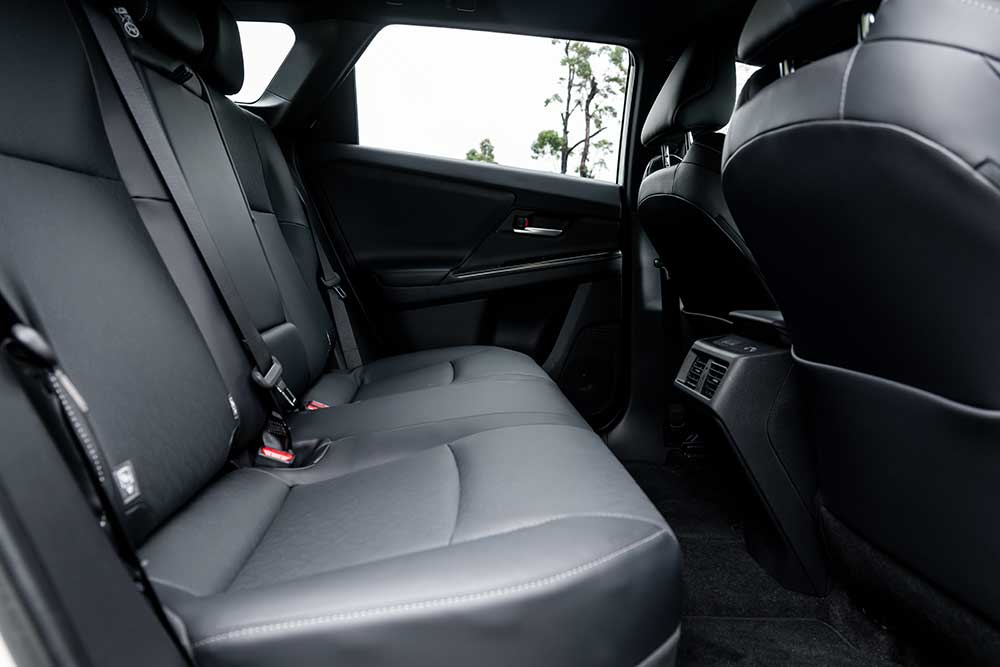
Moving to the rear, passengers are treated to the same generous legroom as you find in the Solterra, along with a flat floor thanks to the EV drivetrain, plus outer-position seat heating in both variants.
There’s also individual air vents (but no temperature controls), twin USB-C plugs, seatback map pockets and good-sized door bins.
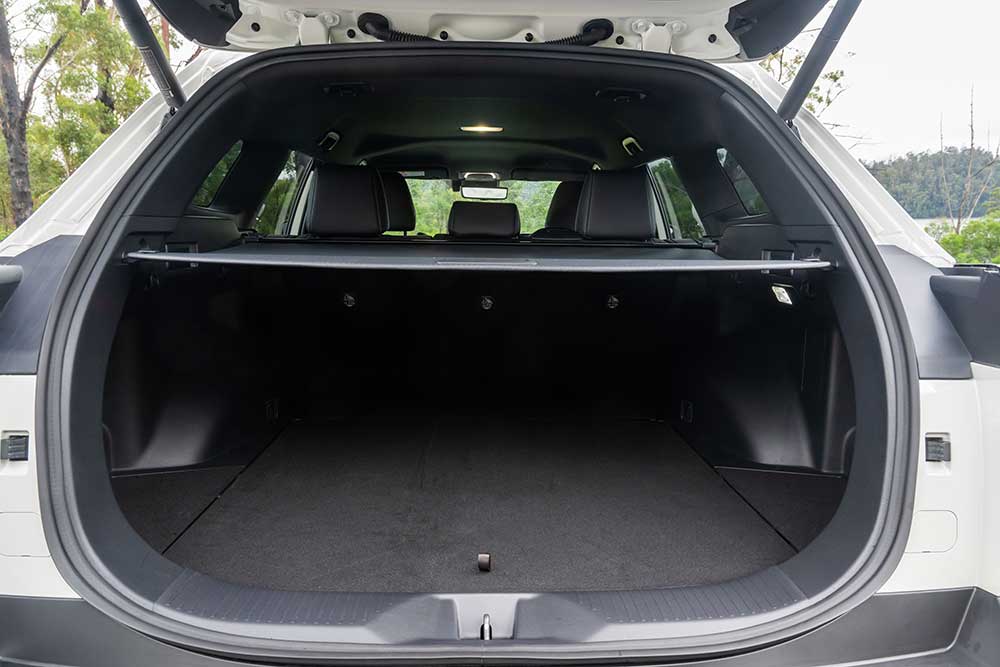
A powered tailgate provides access to the generously sized boot which at 609-litres for the Trailseeker AWD and 595 litres for the AWD Touring is bigger than that of both the Solterra and the Outback.
Folding the 60:40 split folding rear seats is easy thanks to quick-release levers in the boot which expand the available space to a yawning 1230 litres, or 1694 litres if you pack to the ceiling.
The AWD Touring offers slightly less in both cases but it’s a negligible difference.
The boot features a retractable cargo blind and underfloor storage for the charging cable but no spare wheel, which is a disappointing departure from Subaru’s usual commitment to offering a spare.
The brand says it is looking into options here.
There are tie-down points on the luggage bay floor, hooks to secure shopping bags but no V2L (Vehicle to Load) plug in the AWD.
That feature is reserved for the AWD Touring where it delivers up to 1,500W of power to run camping equipment and other electrical appliances.
What’s under the bonnet of the Subaru Trailseeker AWD?
It’s a good thing the boot is so big as there’s no frunk or front-trunk storage like that of rival the Tesla Model Y.
Instead, the Trailseeker’s under-bonnet is filled with electrical componentry including an electric motor that punches out 167kW/268Nm.
There’s another electric motor on the rear axle that produces identical outputs for a combined figure of 280kW.
Like most other brands, Subaru doesn’t provide a combined peak torque figure because the motors rarely reach peak torque at precisely the same time, and the battery's electrical limits restrict how much power both can draw simultaneously.
Nevertheless, Subaru claims the Trailseeker is its most powerful production vehicle yet and also its fastest, covering the benchmark 0-100km/h dash in a brisk 4.4 seconds.
That’s quite a claim from the brand that has given us such legendary high-performance models as the WRX and WRX STi models.
While both models get the same dual motor powertrain and 74.7kWh battery, the entry-level Trailseeker AWD travels further on a single charge than the AWD Touring on its 20-inch wheels.
The difference, 533km versus 488km is not enormous, but nor is it inconsequential and may be enough for some buyers to overlook the extra fruit of the AWD Touring.
Both models are capable of 150kW DC fast charge, and 22kW 3-phase AC charge, with the 74.7kWh battery located low and central in the vehicle structure.
Is the Subaru Trailseeker good to drive?
Less distance travelled between charges isn’t the only downside of opting for the AWD Touring variant, as those lower profile 20-inch wheels are a bit less forgiving over potholes and bumps the 18s of the standard variant.
It’s not exactly chalk and cheese and it would be harsh to focus too much criticism on this aspect, but the difference is tangible for anyone attuned to vehicle ride.
Conversely, the extra sidewall depth of the AWD variant absorbs typical Aussie B-road bumps with a degree more finesse, without conceding much in terms of steering feel and turn-in, which are among the usual benefits of the bigger wheel and tyre combination.
No doubt there’s some degree of handling benefit to be had and the 20s are certainly a better-looking wheel.
However, it’s debatable whether drivers of 2,040kg electric SUVs are looking to extract the last degree of outright cornering grip.
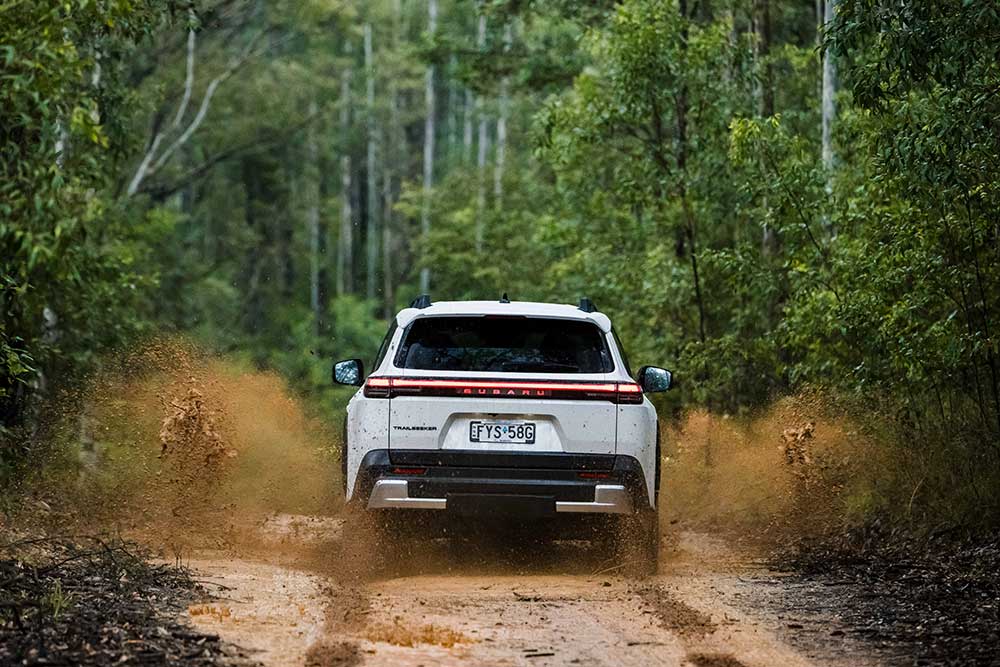
Subaru says the suspension has been optimised to avoid feeling ponderous when changing direction and the Trailseeker mostly does a good job of this, although it’s difficult to disguise the car’s substantial kerb weight.
Which makes Subaru’s decision to have us drive the Trailseeker on the tight and technical Pheasant Wood racetrack near Marulan, NSW, a slightly puzzling one.
Most road cars don’t excel on racetracks and the Trailseeker is no different, pushing its nose wide on corner apexes and requiring plenty of patience before getting on the accelerator and blasting out of the corner momentarily before braking hard for the next one.
Perhaps other commentators gained some unique revelations from the tyre-torturing exercise, but I much preferred the open road component on typical rough and ragged country roads between Canberra and Mollymook on the NSW south coast, which is the sort of environment the Trailseeker is far more likely to see regularly.
Here, the electric Subaru impressed with its smooth, effortless power delivery and its emphatic overtaking punch, along with pleasingly predictable handling that feels nicely linear and progressive in bends.
Both models deliver handsomely on Subaru’s promise of capable and comfortable cross-country travel with the main criticism being more road noise than is ideal on coarse chip bitumen.
Once again, this was more of an issue in the AWD Touring thanks to its 20-inch wheels, but both variants exhibited a somewhat high level of cabin noise on these surfaces.
What is the Subaru Trailseeker like off-road?
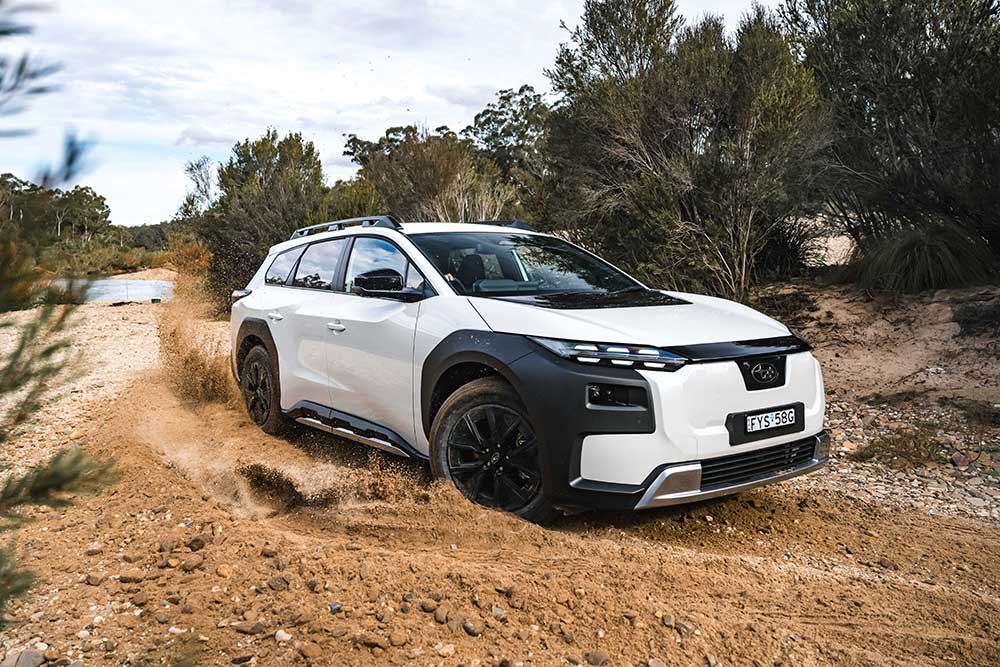
It’s a pity the Subaru drive program found the time to divert us onto a tarmac racetrack but not anything that resembled off-road driving, especially given the brand’s claim that the Trailseeker’s dual-motor AWD system, 211mm of ground clearance, and X-Mode terrain system deliver superior off-road performance to rival EVs.
We’re inclined to believe it, mainly because we’ve driven the technically similar Solterra over some moderately difficult tracks and lived to tell the tale, but there was nothing on the Trailseeker test drive that actually proved the point.
Granted, we did traverse some unsealed forestry fire trails and potholed beauty-spot access tracks but it was nothing that would trouble a carefully driven passenger car with sensible tyres and a modicum of ground clearance.
We didn’t have a chance to test it but Subarus says its X-Mode terrain control system adjusts traction control parameters of the AWD system according to the terrain, allowing the driver to select for options including Snow and Dirt, Deep Snow and Mud.
The Trailseeker also boast Downhill Asist Control with the ability to adjust off-road driving speed via the cruise control system, plus a handy multi-terrain monitor with a range of camera angles and views for off-road.
What safety features does a Subaru Trailseeker have?
The Trailseeker has a freshly minted five-star ANCAP safety rating achieved in March 2026, with the safety body describing its performance in key test areas as ‘impressive’.
The Trailseeker scored:
- 89% for Adult Occupant Protection
- 86% for Child Occupant Protection
- 82% for Safety Assist
- 80% for Vulnerable Road User Protection.
It has a full suite of eight airbags comprising:
- Driver and front passenger airbags
- Dual front-side chest airbags
- Dual side head-protecting curtain airbags (front and second-row seats)
- Driver’s knee airbag
- Front centre airbag (designed to prevent contact between the driver and front passenger in a side-impact crash).
Other standard safety features of both variants include:
- Subaru’s Pre-collision System
- Dynamic Radar Cruise Control
- Emergency Driving Stop System
- Emergency Steering Assist
- Lane Departure Alert
- Lane Tracing Assist
- Low-Speed Acceleration Suppression
- Road Sign Assist.
There’s also a driver monitor system with an in-cabin camera to provide distraction and drowsiness warnings, plus a Vision Assist suite that includes Adaptive High-Beam System, Blind Spot Monitor, Multi-Terrain Monitor, Panoramic 360 Degree View Monitor, Rear Cross Traffic Alert and Safe Exit Assist.
How does the Subaru Trailseeker compare?
The Trailseeker’s larger SUV-like body sets it somewhat apart from other rivals in the segment, with the most obvious rival being its Toyota twin the Toyota bZ4X Touring which comes in a single high-grade variant priced at $69,990 (MRLP).
The Kia EV6 ($72,660) and Tesla Model Y ($58,900) are other rivals but neither of these models have the clearance and theoretical all-road capability of the Subaru.
The Trailseeker does lacks some key features of some rivals including the absence of a front trunk or ‘frunk’, and lack of V2L on the base model which is disappointing given it’s technically capable of having this feature and less expensive rivals have it.
More problematic than that is the lack of connected services and Over the Air Update (OTA) capability which puts the new Subaru at a disadvantage against rival models form Tesla, Kia, Hyundai, BYD and others.
Should I buy a Subaru Trailseeker?
Subaru has stepped up its EV game significantly this year, announcing tech upgrades and price cuts of around $7000 for the Solterra in February, following that with the launch of the Trailseeker in June, and with the Uncharted compact SUV in the pipeline and due to launch any day now.
This gives the brand a fairly comprehensive lineup of compact, medium and medium-to-large SUVs for customers to choose from, right at the time when consumer appetite for the electric vehicle technology is surging thanks to high fuel prices and the Iran war.
The Trailseeker is a well built and practically designed electric SUV that offers strong performance and polished driving dynamics, and it’s competitive both in terms of range and pricing with its key rivals.
We’re inclined to choose the entry-level Trailseeker AWD over the Trailseeker AWD Touring based on its lower purchase price, superior range and more complaint ride quality.
The extra features of the AWD Touring are certainly tempting and the gap in range and ride is not enormous, so if you’re inclined to seek out a bit of luxury, go ahead and spoil yourself as there’s not a great deal of downside.
Specifications Subaru Trailseeker AWD MY26
- PRICE: $63,990 (MRLP)
- POWERTRAIN: Front and rear electric motors, 167kW/268Nm(f)/ 167kW/268Nm(r), 280kW Combined, all-wheel drive
- BATTERY: 74.7kWh lithium-ion, maximum DC Charge: 150kW
- RANGE: 533km (WLTP)
- ENERGY CONSUMPTION: 15.4kWh/100km (Combined Cycle)
- ANCAP SAFETY RATING: Five stars (2026)
- WARRANTY: Five years, unlimited km (vehicle); eight years, 160,000km (battery)
- FOR: Good range, ample power for swift overtaking, all-wheel drive grip, confident cornering performance, generous accommodation and boot space.
- AGAINST: No connected services or Over the Air update (OTA) ability, Modest 1500kg braked towing capacity, no spare wheel (mobility kit), no frunk storage, no V2L on AWD.

Related topics
Things to note
The information in this article has been prepared for general information purposes only and is not intended as legal advice or specific advice to any particular person. Any advice contained in the document is general advice, not intended as legal advice or professional advice and does not take into account any person’s particular circumstances. Before acting on anything based on this advice you should consider its appropriateness to you, having regard to your objectives and needs.
Insurance Products (excluding Travel Insurance) are issued by RACQ Insurance Limited ABN 50 009 704 152 (RACQI) and arranged by RACQ Distribution Services Pty Ltd (RDS) ABN 35 116 361 650, AFSL 567130 and RDS' authorised representatives (including RACQ Operations Pty Ltd ABN 80 009 663 414, AR No. 234978 (RACQO)). Conditions, limits and exclusions apply.
Any advice provided by RDS and RACQO is general advice only and does not take into account your personal objectives, financial situation or needs and you will need to consider whether the advice is appropriate for you. Read the Product Disclosure Statement (PDS) before making a purchase decision on the product. You can also access our Target Market Determinations on this website.
RDS receives a commission from RACQI for the policies it arranges. RACQO receives fees paid for services it provides to RDS. Further details about remuneration are available on request prior to purchasing.
Banking and loan products issued by Members Banking Group Limited ABN 83 087 651 054 AFSL/Australian credit licence 241195 trading as RACQ Bank. Terms, conditions, fees, charges and lending policies apply. This is general advice only and may not be right for you. This information does not take your personal objectives, circumstances or needs into account. Read the disclosure documents for your selected product or service, including the Financial Services Guide and the Terms and Conditions, and consider if appropriate for you before deciding.
Except for RACQ Bank, any RACQ entity referred to on this page is not an authorised deposit-taking institution for the purposes of the Banking Act 1959 (Cth). That entity’s obligations do not represent deposits or other liabilities of RACQ Bank. RACQ Bank does not guarantee or otherwise provide assurance in respect of the obligations of that entity, unless noted otherwise.
RACQ Bank subscribes to the Customer Owned Banking Code of Practice which establishes higher standards than the law requires. The Code reflects modern consumer expectations and developments in approaches to issues such as consumer vulnerability, guarantors, and supporting customers through financial hardship. Please read our Customer Owned Banking Code of Practice page for more information.
RACQ Operations Pty Ltd (ABN 80 009 663 414, AR No. 234978) and Members Travel Group Pty Ltd (ABN 45 144 538 803, AR No.432492) (RACQ) are authorised representatives of the RACQ Travel Insurance insurer Tokio Marine & Nichido Fire Insurance Co., Ltd. (ABN 80 000 438 291 AFSL 246 548) (Tokio Marine). Tokio Marine Management (Australasia) Pty Ltd (ABN 69 001 488 455, AR No. 1313066) is an authorised representative of Tokio Marine, and administers RACQ Travel Insurance as the managing agent on behalf of Tokio Marine. Terms, conditions (including eligibility criteria), exclusions, limits and sub-limits apply. Any advice is general advice only, and does not take into account your specific objectives, financial situation or needs. Before you purchase, please consider the Combined Product Disclosure Statement (PDS) / Financial Services Guide (FSG) and Target Market Determinations (TMDs) available at racq.com or on request from RACQ.