

Toyota HiLux Rogue MY26 review
The ninth-generation Toyota HiLux builds on the sturdy load-hauling ability and off-road capability the nameplate is renowned for.
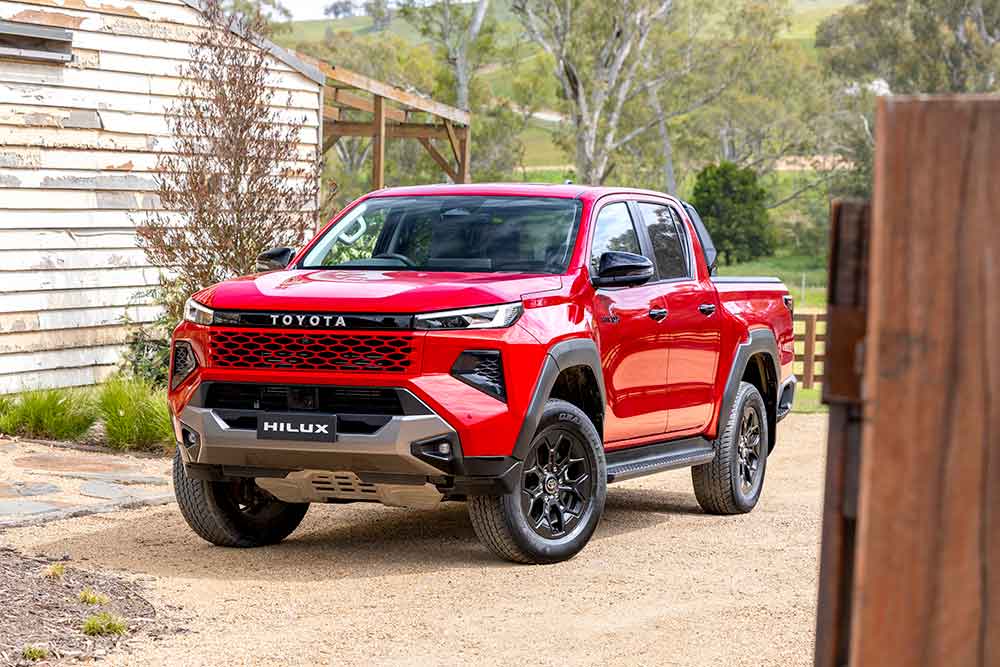
Toyota has responded to the threat posed by new dual-cab ute rivals including the Kia Tasman, Nissan Navara and various Chinese challengers by introducing a major overhaul of its strong-selling HiLux.
While this new model’s 'ninth-generation' labelling might suggest much of the vehicle is new, the MY26 HiLux is more of a conservative and practical update of the country’s second best-selling vehicle than a complete overhaul.
The Japanese philosophy of ‘kaizen’, or continuous improvement, sits at the heart of everything Toyota does and with a few notable exceptions, the company tends to move established models forward incrementally, rather than with giant leaps.
The new HiLux embodies this approach, introducing a series of worthwhile improvements that together add up to an improved vehicle but which stops well short of being a dramatic step-change over its well-regarded predecessor.
Among the major changes are refreshed exterior styling, a new dash design, additional safety technologies, upgraded suspension, and enhanced load carrying ability.
Toyota for its part says capability and reliability remain key customer cornerstones in this segment, which is why its model retains so many of its predecessor’s well-proven systems and components.
How much does a Toyota HiLux Rogue Dual Cab 4x4 cost?
The updated HiLux is offered with a choice of 16 different variants in single cab, cab-chassis and dual cab configurations, 4x2 or 4x4 drivelines, manual or automatic transmissions, and in WorkMate, SR, SR5, Rogue and newly reintroduced Rugged X grades.
The WorkMate and SR grades offer the choice of 4X2 or 4X4 drivelines, with SR5 variants and above are available exclusively as double-cab 4x4s.
Pricing for the new HiLux range starts at $33,990 for the 4X2 WorkMate single cab-chassis manual and goes all the way up to the range-topping Rugged X dual-cab 4x4 at $71,990.
The Rugged X returns to the HiLux fold as the brand’s off-road hero model, featuring a range of enhancements designed to improve its appearance, off-road capability and performance.
The Rogue sits one rung below the Rugged X in the brand hierarchy but is priced identically at $71,990 with premium paint a $675 option as it is on all variants.
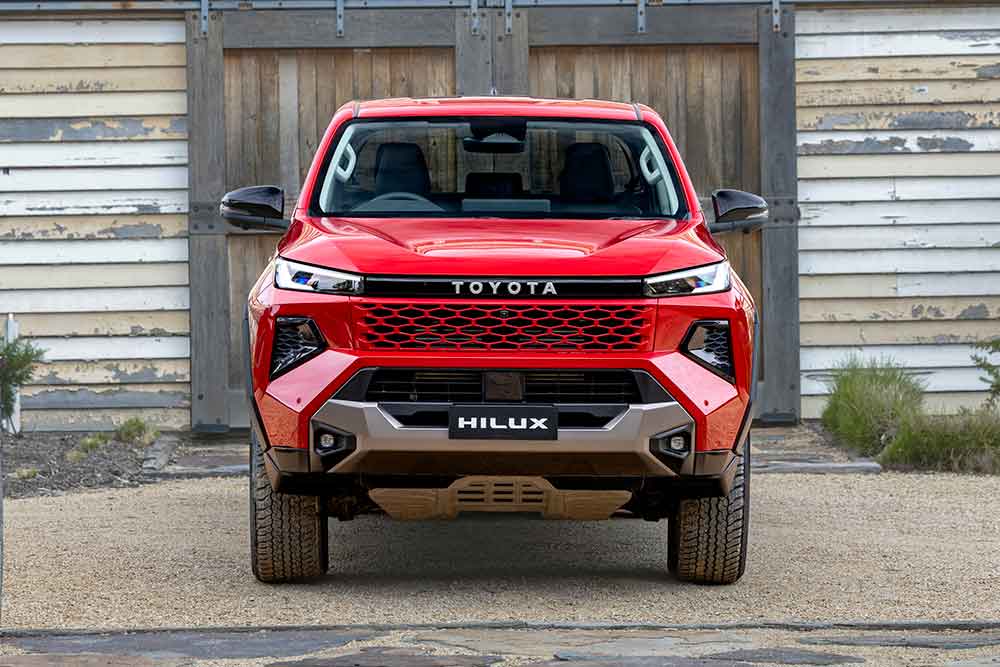
Toyota HiLux Rogue Dual Cab 4x4 exterior design
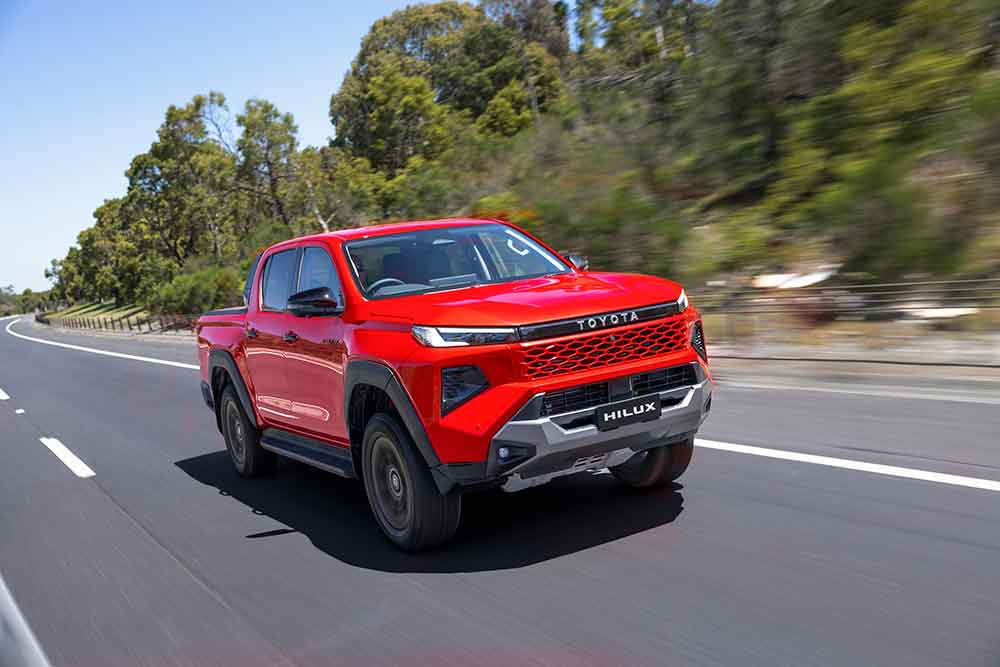
All HiLux variants feature the bold new exterior design spearheaded by Toyota Australia’s local design team, in collaboration with Toyota team members in Thailand and Japan.
Dubbed 'Cyber Sumo' the new design theme was overseen by Toyota Australia’s chief designer Nick Hogios and features striking slim-line headlights, sharp lines and redesigned front and rear fascia.
The new look is intended to evoke an image of strength and modern style, according to Toyota.
But the changes are largely confined to the front and rear ends of the vehicle and the wheelarches, with most major panels including doors and roof unchanged over the previous model. There are no changes to the established hard points of the previous model, meaning overall dimensions are identical.
Like the SR5 which sits one below it on the variant hierarchy, the Rogue adopts high-grade LED headlights with auto-levelling, LED tail-lights and LED rear fog light.
Rogue-specific design cues include 18-inch matte black alloy wheels, blacked-out TOYOTA tailgate badging, unique sports bar and front bumper, marine-grade carpet bedliner with an electric roller cover, deck rail with two sliding tie-down points, 12V tub socket, central locking tailgate, and a standard towing package including a tongue and ball, trailer wiring harness and electronic brake controller.
What is the Toyota HiLux Dual Cab 4x4 Rogue like inside?
The new look exterior design is complemented by an overhauled interior which brings an uplift in modernity, comfort, technology and ergonomics.
The dash, cluster and instrument design borrow heavily from its stablemate the 250 Series LandCruiser Prado, including items such as the tilt and telescopic-adjusting steering wheel, auto shift lever and switchgear.
The redesigned three-tiered dash sits flatter compared with the current model for improved forward visibility, with all grades adopting a new digital instrument cluster – 7.0-inch for WorkMate and SR grades and 12.3-inch on SR5 and above – along with a new 12.3-inch multimedia central touchscreen display.

The Rogue digital cluster can be configured in a range of layouts to suit driver preferences, with four design types including Casual, Smart, Tough and Sporty.
The new multimedia system is an improvement on the previous generation with an improved user interface, superior resolution, and enhanced voice recognition.
The system offers compatibility with wireless Apple CarPlay and Android Auto, embedded satellite navigation and voice command, and expanded Toyota Connected Services functionality.
Other interior changes include a redesigned steering wheel with an updated button layout, a wider centre console, and a taller centre console storage lid that now matches the height of the door armrest.
There’s decent oddment stowage with twin gloveboxes, handy lidded cup-holders at either end of the dash near the doors, plus another two cup holders in the centre console. There’s also a wireless phone charging pad, a lidded console bin, and large door pockets.
Like the SR5, the Rogue features dual-zone automatic climate control, a cooled glove box, heated front seats and steering wheel, the larger 12.3-inch digital instrument cluster, electro-chromatic rearview mirror, and an electric park brake.
The Rogue also includes in its price the SR5’s $2,500 optional Premium Interior package, which adds mineral coloured leather-accented upholstery, eight-way powered driver’s seat with lumbar support and a nine-speaker JBL premium audio system.
There are no changes to the physical dimensions of the cabin, however, and with several rivals now offering larger more spacious interiors the HiLux can feel a bit cramped.
Phone connectivity also proved unnecessarily problematic at times on the vehicles we drove and the graphics quality of the touchscreen is not as crisp as found in some rivals.
The Rogue also lacks a few features that might reasonably be expected for its circa $72,000 price point, with no illuminated vanity mirrors and manual-only adjustment for the front passenger seat.
The interior plastics and other materials are durable and utilitarian but hardly luxurious. If you’re looking for a more upmarket passenger-oriented ute interior with high-end trim and finishes then a Kia Tasman or BYD Shark will be a better choice.
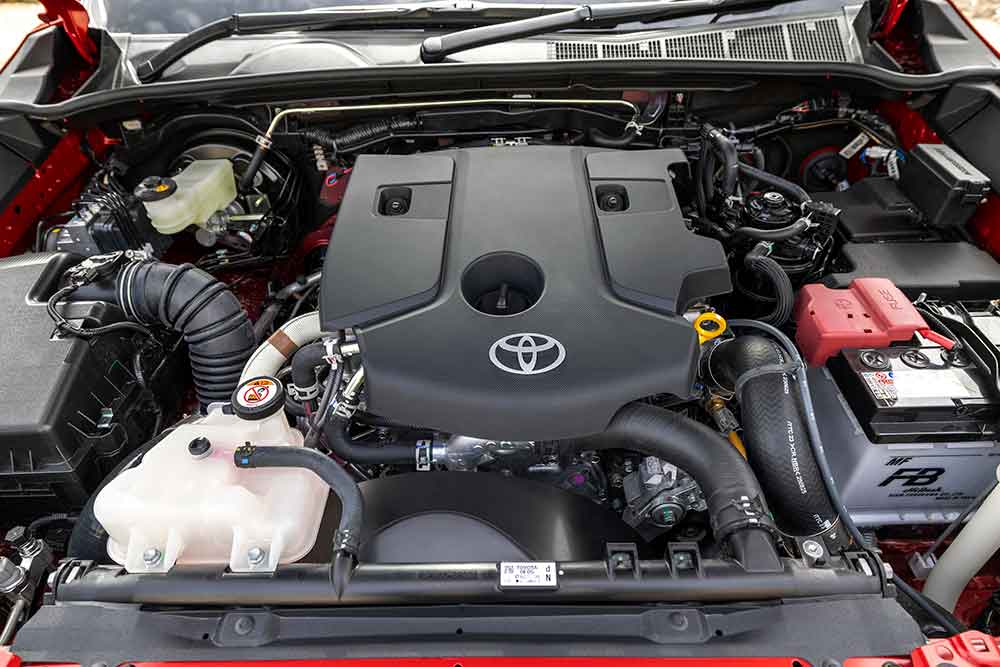
What powertrain does the Toyota HiLux Rogue Dual Cab 4x4 have?
While Toyota has flagged the introduction of a battery electric variant to the new HiLux range in 2026 and a hydrogen fuel cell (FCEV) variant in 2028, for now the only powertrain available is the brand’s well-proven and widely used 1GD-FTV 2.8-litre turbodiesel four-cylinder.
The HiLux was previously available with this engine plus a smaller 2.4-litre diesel and a 2.7-litre four-cylinder petrol on select variants, both of which have been discontinued.
Engine outputs are unchanged over the previous model, meaning maximum outputs of 150kW/500Nm when equipped with the six-speed automatic, or 150Nm/420Nm with the six-speed manual.
Double-cab SR grade variants and above with the automatic transmission, including Rogue, gain an additional but temporary 8.5kW/65Nm courtesy of Toyota’s 48-volt mild-hybrid or V-Active technology. This is designed to smooth stop-start functionality, contribute supplementary power and torque when needed, particularly at low speeds and under acceleration, and improve fuel economy.
Tell me about the Toyota HiLux Rogue Dual Cab 4x4’s suspension and chassis?
While the new HiLux shares a large part of its chassis with its predecessor, Toyota says there are extensive mods under the skin that transform its driving character.
These include extended and reinforced side rails, thicker front suspension, new front coil springs and thicker stabiliser bar, a new electric power steering system, and two different suspension tunes for different variants.
Chassis modifications to improve comfort and reduce noise and vibration include new hydraulic engine mounts, additional spot welds on the vehicle underfloor to improve structural rigidity, and additional sound deadening materials.
Other notable technical changes include the adoption of a new Electric Power Steering (EPS) system and the softer spring and damper package on lifestyle-oriented SR5 grades and above.
The basic suspension layout is unchanged, meaning independent front suspension with double wishbones and coil springs, and a live-axle rear end with leaf springs.
However, the work-oriented WorkMate and SR grades now come equipped with heavy-duty springs and dampers geared toward load carrying and towing, while all other variants including the Rogue adopt a suspension tune oriented more towards enhanced ride comfort for everyday use.
Importantly, the Gross Combination Mass (GCM) of all HiLux 4X4 grades is now 6300kg, an increase of around 450kg, which means HiLux owners can carry more payload when towing at the vehicle’s full 3500kg braked tow capacity.
What options are there for the Toyota HiLux Rogue Dual Cab 4x4?
In addition to seven exterior colour choices the Rogue can be optioned with Premium paint at an extra cost of $675. There’s also an extensive range of more than 25 Toyota Genuine Accessories available, including bull bars, side steps, sports bars, roller covers, trays, driving lights and more.
Is the Toyota HiLux Rogue Dual Cab 4x4 good to drive?
Toyota’s local vehicle evaluation division was directly involved in the tuning and calibration of the new suspension setups, with Rogue and other lifestyle grades benefiting from a suspension tune that’s oriented more towards enhanced ride comfort for everyday use.
The unladen ride of variants fitted with the softer suspension is certainly better than the stiffer load-oriented models, but it’s still not exactly plush, particularly when unladen, with a terse and jiggly ride on all but the smoothest surfaces.
The other major dynamic upgrade is the fitment of a new speed sensitive electric power steering system which replaces the old hydraulic system. The new system is intended to deliver light steering inputs at low speed while ensuring better high-speed stability and reducing unwanted feedback on rough roads.
The steering is undoubtedly a big improvement but could still do with a bit more high-speed heft for our tastes.
The standard fitment tyres are Dunlop Grand Trek A/T 265/60R18 do a good job of balancing on road grip, noise and ride quality while still delivering reasonable off-road capability.
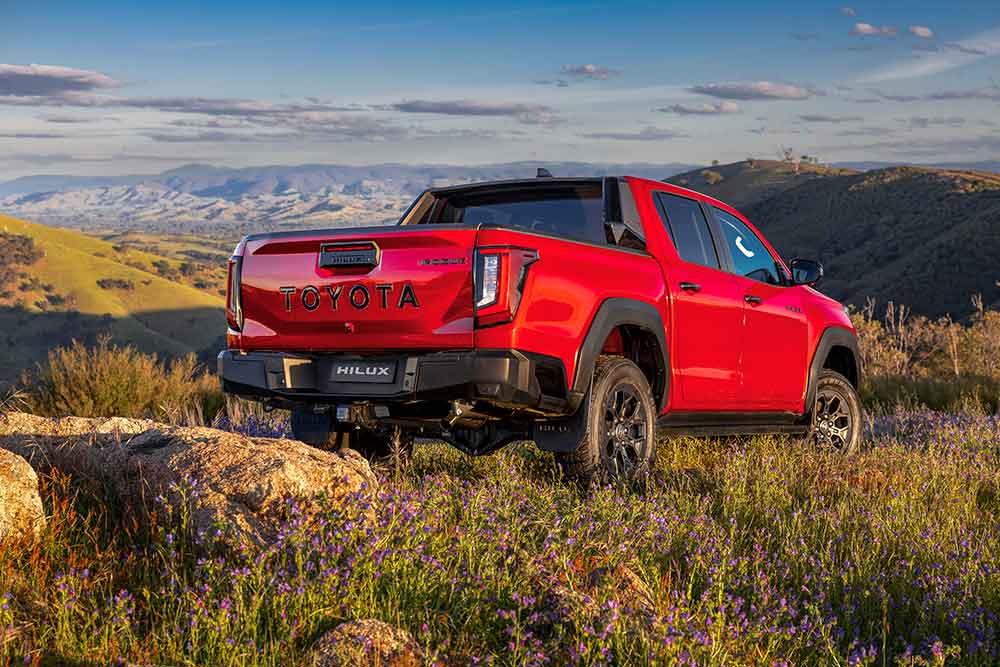
Rear wheel grip is decent, but it’s not too hard to break traction momentarily if you’re injudicious with the throttle on loose or slippery surfaces. Fortunately, the traction control system is well calibrated and steps in early before things get to out of shape.
Braking performance is good, with SR5 variants and above adopting larger 338mm front disc brakes and 335mm rear ventilated disc brakes, and these grades also adopting an electric park brake for the first time on HiLux.
In general, the Rogue feels confident and well planted out on the road, given the high ride-height, live axle rear suspension and stiff, load-oriented springs mean it’s never going to corner like a sportscar.
What about the HiLux Rogue Dual Cab 4x4’s powertrain?
While there are no changes to the powertrain over the previous model the 1GD-FTV 2.8-litre turbodiesel four-cylinder remains an impressively effective unit, with good throttle response and plenty of readily accessible low and mid-range torque.
The Rogue can be had with either a six-speed manual or six-speed automatic, although most buyers will opt for the auto which is easy to operate and features selectable Eco, Normal and Sport modes.
The gearbox feels particularly well matched to the engine’s torque characteristics, shifting confidently and quickly on gradient changes, or when required under acceleration, keeping the engine in its optimal torque band.
The combination delivers brisk off-the-mark acceleration and confident highway performance, with plenty in reserve for overtaking at the speed limit. But while reasonably subdued under a light throttle, the engine becomes vocal under load, with a fair degree of noise, vibration and harshness evident in the cabin, despite claimed improvements in this area.
What is the Toyota HiLux Rogue Dual Cab 4x4 like off-road?
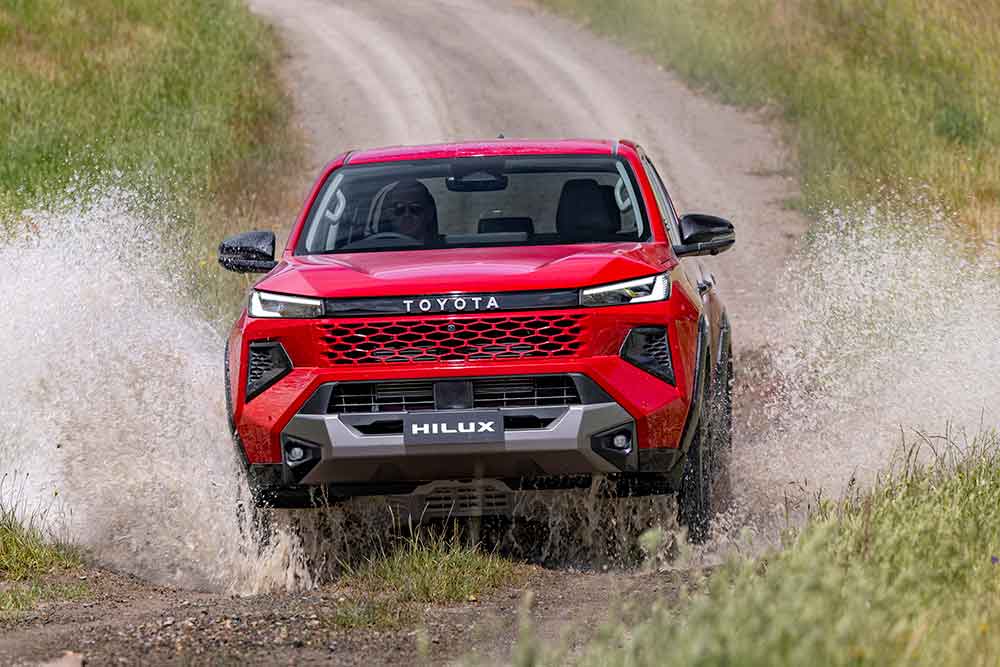
Off-road capability remains a key part of HiLux 4x4s appeal. Previous testing of HiLux against a range of rival Japanese utes has shown it to be one of the best performing utes in rough terrain, and there’s nothing about this update to suggest it has lost any of its edge.
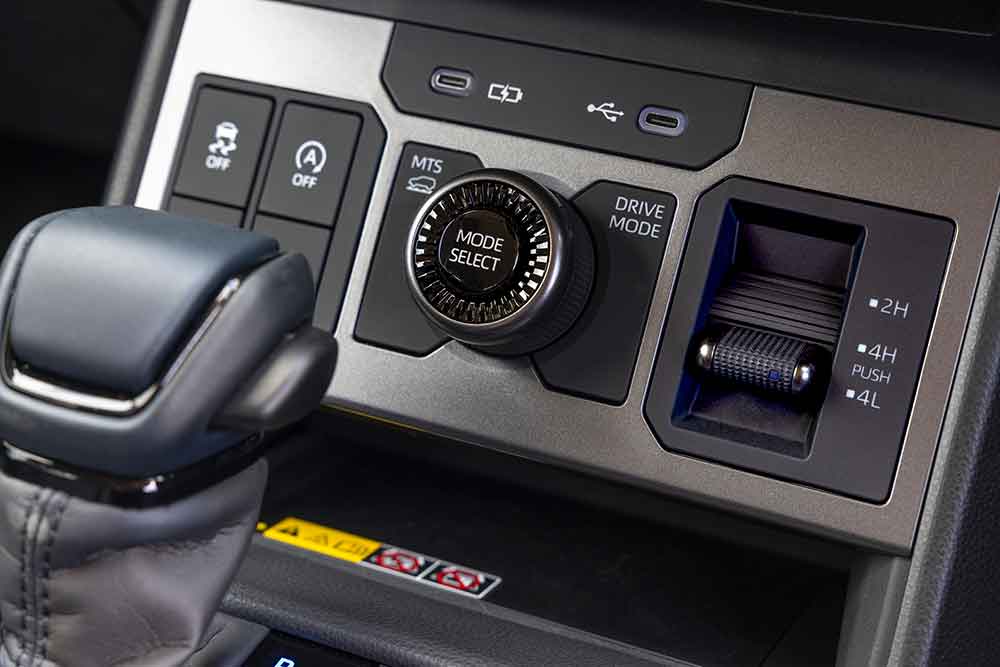
In fact, off-road performance has been enhanced on automatic SR 4x4 grades and above thanks to the addition of a standard fitment rear locking differential and Multi-Terrain Select (MTS) traction control system, in addition to the standard part-time system with high and low range ratios.
Automatic double-cab pickup SR5 grades and upwards, including Rogue also add a Multi-Terrain Monitor which uses cameras around the vehicle to offer a range of views of the vehicle’s surroundings and underbody.
The part-time four-wheel drive with dual-range transfer case is engaged via a toggle switch in place of the old model’s dial, with available 2H, 4H, 4Lo. There’s still no full-time 4x4 system available, however, which is something rivals models including several rivals including the Ranger, Triton and Shark 6 all offer.
The strong low rev torque and easily controllable throttle is appreciated off-road, where the Rogue effortlessly negotiated a series of different natural challenges on our test drive in the forested hills of NSW’s scenic Shoalhaven region.
Good clearances ensure minimal scraping over obstacles, even when clambering up eroded sandstone steps and Toyota’s traction control systems are particularly well tuned so that you don’t have to drive like a loon to make good headway in challenging conditions.
Nothing we encountered over the course of a solid half day on some reasonably challenging tracks and trails required the use of the lockable rear differential, but it’s always good to know you have that extra level of tractive ability if required.
What safety features does a Toyota HiLux Rogue Dual Cab 4x4 have?
The HiLux was awarded a five-star ANCAP rating and boasts a standard passive safety suite of eight SRS airbags, including driver front, side, centre and knee, front passenger front and side, and front/rear side curtain airbags.
The new front chassis rail extensions have also been redesigned to improve impact absorption in a frontal crash.
Elsewhere, safety has been upgraded over the previous model with enhancements to Toyota’s Safety Sense technology suite. This includes improved pre-collision safety which now offers pedestrian, cyclist and motorcycle detection, along with preceding and oncoming vehicle detection.
Additionally, intersection collision avoidance support is now capable of detecting vehicles crossing at an intersection, as well as oncoming vehicles when making a left or right turn.
There’s also a new acceleration suppression feature designed to detect unintentional strong throttle inputs when the car is driving at low speeds, and restrict throttle input to reduce the likelihood of a collision.
Also new is an emergency driving stop system (EDSS) designed to help bring the vehicle to a stop if the system detects the driver appears to be no longer operating the vehicle.
Other changes include the active cruise control system now being able to detect two vehicles ahead with earlier detection capability, and emergency steering assist which provides additional steering input to help avoid a roadside obstacle, while keeping the vehicle inside its own lane.
The adoption of electric power steering has also enabled improvements to the HiLux’s lane departure alert system, which now provides the driver with steering wheel vibrations if it detects that the vehicle is deviating from its lane.
Other safety kits include autonomous emergency braking, active cruise control, rear cross-traffic alert, lane departure alert, lane trace assist, blind spot monitor, road sign assist (speed signs only) and auto high beam.
Does the Toyota HiLux Rogue Dual Cab 4x4 have any notable technologies?
All HiLux grades get at least 12 months of complimentary access to Toyota Connected Services, which includes Toyota Essentials, Toyota Connect+ and Toyota Multimedia Connect.
Toyota Essentials is complimentary until the sunset of the 4G network, which should remain viable for at least another decade. It includes safety features like SOS Emergency Call and Automatic Collision Notification, plus remotely accessible vehicle insights when using the myToyota Connect app.
Toyota Connect+ is offered with a 12-month complimentary subscription and includes Stolen Vehicle Tracking, Status Connect which allows customers to receive notifications for vehicle alerts such as windows left open or doors unlocked, and Guest Driver Alerts including notifications for speed, distance travelled, and ignition on. The monthly subscription cost of Toyota Connect+ after the 12-month complimentary is $9.95 per month.
Users wanting to continue to use the Toyota Multimedia Connect system, which includes Connected Navigation, connected voice assistant and multimedia profiles for different vehicle users, will be on the hook for an additional $12.50 per month following the initial complimentary period.

How does the Hyundai Toyota HiLux Rogue Dual Cab 4x4 compare?
The list of rivals for the HiLux is long, with more than 20 models from 14 different brands all vying for consumer attention. Some of these, like the BYD Shark 6 and Ford Ranger PHEV are introducing new drivetrain technologies to the segment, while others like the Shark 6, MGU9 and GWM Cannon Alpha are physically larger vehicles than the HiLux with better-appointed cabins.
The impact of all this new competition has seen Toyota and other established players lose some market share in 2025, although with 21% segment share the HiLux remains comfortably ahead of all but the best-selling Ranger which commands almost 25% (as of November 2025).
Given the dominance of Ranger and HiLux it seems likely that many consumers will shop the HiLux Rogue against its Ford rival the Ranger Wildtrak.
Prior to this update the Ranger was generally considered to offer a more modern cabin, superior technology, and more refined on-road driving dynamics than the HiLux. Despite Toyota’s efforts to improve its ute’s tech and its ride and handling, the Ranger still holds an edge here.
The Ranger also offers the choice of a significantly more powerful 3.0-litre V6 turbodiesel engine, with outputs of 184kW/600Nm that the HiLux four-cylinder can’t match. Likewise, the Ranger’s larger tub with additional width between the wheelarches, allowing a standard Australian pallet to be loaded.
But in a case of horses for courses, many users will point to the Toyota’s superior reputation for reliability, its stronger resale value and its excellent off-road performance as out-pointing the Ford.
Improvements to the HiLux’s Gross Combined Mass (GCM) and Payload also help address an important area where the Ford was previously stronger.
Should I buy a Toyota HiLux Rogue Dual Cab 4x4?
At the time of writing (Nov ’25) the Toyota workhorse comfortably retains is position as Australia’s second best-selling dual-cab 4x4 ute behind arch-rival the Ford Ranger.
But there are new challenges emerging in the segment with new plug-in-hybrid electric powered versions of the Ranger and BYD Shark 6, along with Ford’s new load-oriented Ranger Super Duty.
There are also multiple new Chinese-made offerings from the likes of GWM, BYD, MG and JAC, some of which offer bigger, roomier and have better-appointed cabins than the HiLux. They’re also considerably less expensive.
But one thing none these rivals can touch the HiLux on is market longevity, with the first HiLux having launched here in 1968.
Over this time the Toyota workhorse has come to be relied upon by Australia’s mining and pastoral industries, as well as local government, tradies, small businesses, and of course, recreational users.
Toyota says its research shows that reliability, durability and aftersales support remain critical customer drivers in this segment, and these are all areas where Toyota excels, with Australia’s most extensive dealer network and genuine service and parts distribution centres.
The importance of this can’t be overstated for users who depend on their vehicle for their livelihood and it’s a key reason why Toyota 4x4s remain such a dominant presence in remote and regional Australia.
The HiLux also boasts outstanding residual value, which is a key consideration for the growing number of people purchasing their vehicle with finance or a lease arrangement.
The new HiLux is not the most comfortable, stylish, lowest priced, or best handling ute on the market, nor is it the most technologically advanced. But it’s competitive in all these areas and a well proven product that is now incrementally better than its predecessor.
For these reasons many buyers will continue to put their faith in Toyota and its at times conservative approach to model evolution.

Related topics
Things to note
The information in this article has been prepared for general information purposes only and is not intended as legal advice or specific advice to any particular person. Any advice contained in the document is general advice, not intended as legal advice or professional advice and does not take into account any person’s particular circumstances. Before acting on anything based on this advice you should consider its appropriateness to you, having regard to your objectives and needs.
Insurance Products (excluding Travel Insurance) are issued by RACQ Insurance Limited ABN 50 009 704 152 (RACQI) and arranged by RACQ Distribution Services Pty Ltd (RDS) ABN 35 116 361 650, AFSL 567130 and RDS' authorised representatives (including RACQ Operations Pty Ltd ABN 80 009 663 414, AR No. 234978 (RACQO)). Conditions, limits and exclusions apply.
Any advice provided by RDS and RACQO is general advice only and does not take into account your personal objectives, financial situation or needs and you will need to consider whether the advice is appropriate for you. Read the Product Disclosure Statement (PDS) before making a purchase decision on the product. You can also access our Target Market Determinations on this website.
RDS receives a commission from RACQI for the policies it arranges. RACQO receives fees paid for services it provides to RDS. Further details about remuneration are available on request prior to purchasing.
Banking and loan products issued by Members Banking Group Limited ABN 83 087 651 054 AFSL/Australian credit licence 241195 trading as RACQ Bank. Terms, conditions, fees, charges and lending policies apply. This is general advice only and may not be right for you. This information does not take your personal objectives, circumstances or needs into account. Read the disclosure documents for your selected product or service, including the Financial Services Guide and the Terms and Conditions, and consider if appropriate for you before deciding.
Except for RACQ Bank, any RACQ entity referred to on this page is not an authorised deposit-taking institution for the purposes of the Banking Act 1959 (Cth). That entity’s obligations do not represent deposits or other liabilities of RACQ Bank. RACQ Bank does not guarantee or otherwise provide assurance in respect of the obligations of that entity, unless noted otherwise.
RACQ Bank subscribes to the Customer Owned Banking Code of Practice which establishes higher standards than the law requires. The Code reflects modern consumer expectations and developments in approaches to issues such as consumer vulnerability, guarantors, and supporting customers through financial hardship. Please read our Customer Owned Banking Code of Practice page for more information.
RACQ Operations Pty Ltd (ABN 80 009 663 414, AR No. 234978) and Members Travel Group Pty Ltd (ABN 45 144 538 803, AR No.432492) (RACQ) are authorised representatives of the RACQ Travel Insurance insurer Tokio Marine & Nichido Fire Insurance Co., Ltd. (ABN 80 000 438 291 AFSL 246 548) (Tokio Marine). Tokio Marine Management (Australasia) Pty Ltd (ABN 69 001 488 455, AR No. 1313066) is an authorised representative of Tokio Marine, and administers RACQ Travel Insurance as the managing agent on behalf of Tokio Marine. Terms, conditions (including eligibility criteria), exclusions, limits and sub-limits apply. Any advice is general advice only, and does not take into account your specific objectives, financial situation or needs. Before you purchase, please consider the Combined Product Disclosure Statement (PDS) / Financial Services Guide (FSG) and Target Market Determinations (TMDs) available at racq.com or on request from RACQ.