

Ford Ranger Wildtrak PHEV review
.jpg?h=667&iar=0&w=1000&rev=0b79161a4f3f4654a8dc040b53768ac0&hash=60869A9DB66F616A33DF25724A75B723)
The New Vehicle Emissions Standard (NVES) has fundamentally changed the game for car makers in Australia.
Except for a few EV-only brands, the new standard has prompted most manufacturers to introduce, or plan for new zero- or low-emission models to offset high-emitting models in their range.
In the case of Ford Australia, whose biggest-selling model is the predominantly diesel-powered Ranger, it has led to the introduction of the brand’s first plug-in hybrid electric (PHEV) version.
The new Ranger PHEV is available in a four-variant 4x4 dual-cab lineup that mirrors the ICE-powered range with prices starting from $71,990 for the Ranger XLT PHEV, rising to $75,990 for the Ranger Sport PHEV, $79,990 for the Ranger Wildtrak PHEV, and $86,990 for the Ranger Stormtrak PHEV.
Visually, there’s little external differentiation between a Ranger PHEV and its ICE-powered equivalent, with changes limited to PHEV badges on the front wheel arches, a charging port above the left rear wheel arch, and unique-design 18-inch alloy wheel.
.jpg?rev=46939a34c0cb4a0994c99faaacc85f98&hash=D1ECCFF56FFEC7E581DD2AC0C0640B20)
But under the skin is a comprehensively reengineered version of what has been Australia’s best-selling vehicle for the past two years.
In place of the popular 2.0-litre biturbo diesel and the 3.0-litre turbo diesel V6 is a 2.3-litre turbocharged four-cylinder EcoBoost petrol engine mated to a 10-speed automatic, with a 75kW electric motor integrated between the engine and transmission and powered by an 11.8kWh battery packaged between reengineered chassis rails.
The petrol-electric drivetrain boasts combined outputs of 207kW/697Nm, which is more than the Ford’s 3.0-litre V6 diesel (184kW/600Nm).
More importantly, from an NVES perspective, the combination delivers a pure electric driving range of 49km (NEDC) and combined-cycle fuel-consumption of just 2.9L/100km.
The PHEV’s super-low fuel figure is achieved when driving with a fully charged battery, and once discharged the vehicle consumes more, with some tests indicating up to 8.1L/100km.
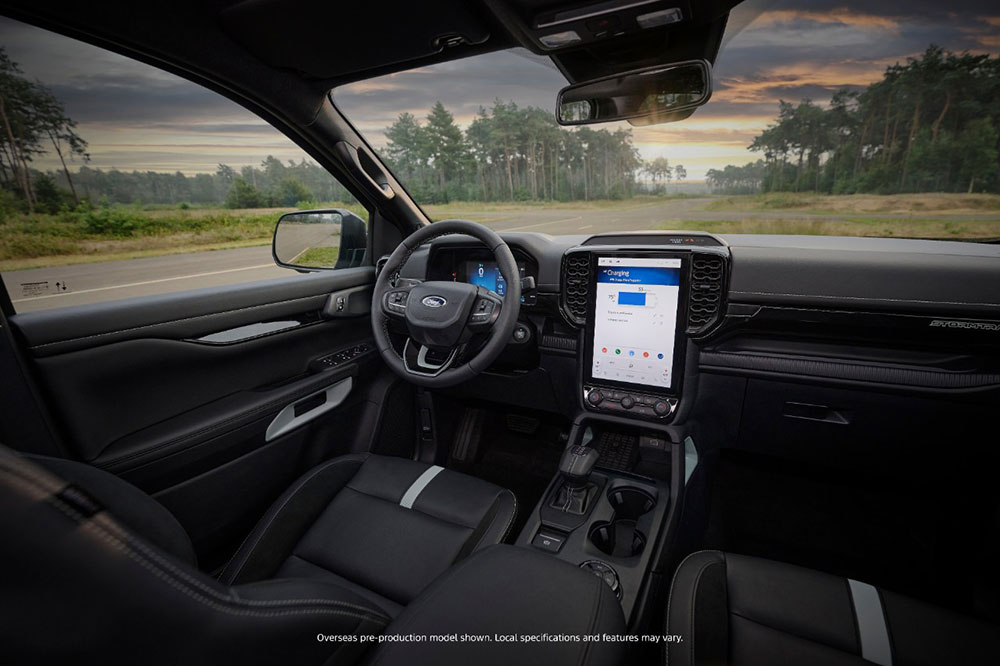
The PHEV’s lithium-ion battery can be charged to full overnight using a standard household plug.
The Ranger PHEV also has a feature called Pro Power Onboard, which allows the battery to be used for powering worksite equipment, campsites, or even a caravan, via twin 15-amp, 3.45kW power sockets in the tray, and a single 10-amp, 2.3kW socket in the cabin.
Ford Australia’s development brief for the Ranger PHEV was that it had to deliver the same 4x4 off-road ability and 3,500kg braked towing capacity as its ICE-powered stablemates. As a result, the new model gets the same full-time 4WD system with electronically controlled two-speed transfer case as the V6-powered Ranger, with the choice of 2H, 4A, 4H, or 4L driving modes.
A locking rear differential provides additional rough terrain capability, and the PHEV’s electrics and air intake are designed to handle the same 800mm wading depth as ICE-powered models.
Out on the road the Ranger PHEV is smooth and quiet, with the drivetrain switching easily between electric and combustion power. Performance is strong, but the combination doesn’t feel quite as potent as the powertrain output figures suggest.
.jpg?rev=f1321c336bd5485bb21be1506cd3561e&hash=5F9BC84EB8A2B58654B3A7A2B73FA293)
Specifications
PRICE: $79,990 (MRLP)
WARRANTY: Five years/unlimited kilometres (vehicle), eight years/160,000km high-voltage battery and electrical drivetrain components
POWERTRAIN: 2.3-litre turbocharged four-cylinder petrol engine, 10-speed automatic, 75kW electric motor, 11.8kWh battery, AWD or 2WD, (207kW/697Nm combined)
ANCAP CRASH RATING: Not rated
FUEL CONSUMPTION (CO₂): 2.9L/100km (67.28g/km CO₂).
Pros and cons
FOR: Refined and well-integrated drivetrain; no reduction in towing or off-road performance; useful electric-only range and Pro Power Onboard technology.
AGAINST: More expensive than ICE variants; more expensive and less electric driving range than key rivals (BYD Shark and GWM Cannon Alpha); no ANCAP rating; higher real-world fuel consumption likely.
Read more on the Ford Ranger PHEV
Next story →

Related topics
Things to note
The information in this article has been prepared for general information purposes only and is not intended as legal advice or specific advice to any particular person. Any advice contained in the document is general advice, not intended as legal advice or professional advice and does not take into account any person’s particular circumstances. Before acting on anything based on this advice you should consider its appropriateness to you, having regard to your objectives and needs.
Insurance Products (excluding Travel Insurance) are issued by RACQ Insurance Limited ABN 50 009 704 152 (RACQI) and arranged by RACQ Distribution Services Pty Ltd (RDS) ABN 35 116 361 650, AFSL 567130 and RDS' authorised representatives (including RACQ Operations Pty Ltd ABN 80 009 663 414, AR No. 234978 (RACQO)). Conditions, limits and exclusions apply.
Any advice provided by RDS and RACQO is general advice only and does not take into account your personal objectives, financial situation or needs and you will need to consider whether the advice is appropriate for you. Read the Product Disclosure Statement (PDS) before making a purchase decision on the product. You can also access our Target Market Determinations on this website.
RDS receives a commission from RACQI for the policies it arranges. RACQO receives fees paid for services it provides to RDS. Further details about remuneration are available on request prior to purchasing.
Banking and loan products issued by Members Banking Group Limited ABN 83 087 651 054 AFSL/Australian credit licence 241195 trading as RACQ Bank. Terms, conditions, fees, charges and lending policies apply. This is general advice only and may not be right for you. This information does not take your personal objectives, circumstances or needs into account. Read the disclosure documents for your selected product or service, including the Financial Services Guide and the Terms and Conditions, and consider if appropriate for you before deciding.
Except for RACQ Bank, any RACQ entity referred to on this page is not an authorised deposit-taking institution for the purposes of the Banking Act 1959 (Cth). That entity’s obligations do not represent deposits or other liabilities of RACQ Bank. RACQ Bank does not guarantee or otherwise provide assurance in respect of the obligations of that entity, unless noted otherwise.
RACQ Bank subscribes to the Customer Owned Banking Code of Practice which establishes higher standards than the law requires. The Code reflects modern consumer expectations and developments in approaches to issues such as consumer vulnerability, guarantors, and supporting customers through financial hardship. Please read our Customer Owned Banking Code of Practice page for more information.
RACQ Operations Pty Ltd (ABN 80 009 663 414, AR No. 234978) and Members Travel Group Pty Ltd (ABN 45 144 538 803, AR No.432492) (RACQ) are authorised representatives of the RACQ Travel Insurance insurer Tokio Marine & Nichido Fire Insurance Co., Ltd. (ABN 80 000 438 291 AFSL 246 548) (Tokio Marine). Tokio Marine Management (Australasia) Pty Ltd (ABN 69 001 488 455, AR No. 1313066) is an authorised representative of Tokio Marine, and administers RACQ Travel Insurance as the managing agent on behalf of Tokio Marine. Terms, conditions (including eligibility criteria), exclusions, limits and sub-limits apply. Any advice is general advice only, and does not take into account your specific objectives, financial situation or needs. Before you purchase, please consider the Combined Product Disclosure Statement (PDS) / Financial Services Guide (FSG) and Target Market Determinations (TMDs) available at racq.com or on request from RACQ.