
Honda CR-V e:HEV RS MY26 review
Key points
- Honda CR-V competes at the premium end of the mid-size SUV market.
- Upgraded six-variant range comprises four trim grades, front-wheel drive, all-wheel drive, and five- and seven-seat accommodation.
- Pricing starts at $44,900 driveaway for the VTiX, rising to $64,400 driveaway for the top-spec e:HEV RS.
- Hybrid is now available from a $10,000 lower price point in the $49,900 driveaway CR-V e:HEV X grade.
- All CR-Vs are sold via Honda’s fixed-price sales model, meaning driveaway pricing that’s the same Australia-wide and no negotiation on price.
- Efficient dual electric motor hybrid powertrain uses 5.5L/100km and offers close to 1000km range
Honda CR-V e:HEV RS, a polished rival for popular Toyota RAV4
This is the latest version of the Honda CR-V, a model that has become a common sight on Aussie roads in the almost three decades since the first-generation launched here in 1997.
The CR-V was one of the first compact SUVs, its initials standing for Comfortable Runabout Vehicle, which probably made sense back in the late ’90s but sounds cheesy today.
The Honda has long been one of the best family SUVs on the market which helps explain why there’s a quarter of a million of them running around on Aussie roads, and over 15 million sold globally.
Back in 2018 the CR-V was flying with 16,107 vehicles sold that year, but less than a decade later the CR-V has lost much of its sales mojo with sales as at August 2026 of 3,737 vehicles, indicating full-year sales of less than half its 2018 figure.
Some of this is due to Honda’s own decisions, including moving to a fixed-price sales model, and others to do with the broader market dynamics which include a flood of new and cheaper Chinese models entering the medium-SUV segment.
But it mostly has to do with the stunning success of its primary rival the Toyota RAV4, which has a similar lineage and origins to the Honda but which in recent years has run rings around its sales.
Last year, the RAV4 outsold the CR-V at a ratio of almost 10 to one, something that would surely be inexplicable to anyone who drives both vehicles back-to-back.
Even more so, the fact that at various times in recent years thousands of RAV4 customers have routinely waited up to six months for delivery of their new car, while Honda’s highly-competitive alternative sits hiding in plain sight.
A key component of the RAV4’s success has been Toyota’s consistent promotion of its hybrid technology.
Few people would know it today, but Honda launched its first hybrid Insight in 1999, just two years after Toyota launched the first-generation Prius. However, where Toyota has relentlessly promoted the technology and expanded it into more and more models, Honda has taken a more piecemeal approach.
Honda CR-V e:HEV RS price and running costs
Earlier this year Honda updated its CR-V range with the big news being the hybrid drivetrain is now available at an almost $10,000 lower price point on the $49,900 e: HEV X.
Prices now range from $44,900 driveaway for the entry-level VTiX petrol 2WD, to $64,400 driveaway for the top-spec e:HEV RS which we’re looking at here.
There’s plenty of choice in between, with six variants in total comprising two petrol 2WD variants in five or seven-seat configuration, two 2WD hybrids and two AWD hybrids, with the hybrids being five-seaters only.
The lineup kicks off with the 2WD VTi X in five and seven-seat configurations, priced respectively at $44,900 and $54,900 driveaway; followed by the five-seat-only 2WD e:HEV X and e:HEV L priced respectively at $49,900 and $53,900 driveaway; and tops out with the all-wheel drive, e:HEV LX and e: HEV RS, which are also five seaters, priced at $58,900 and $64,400 driveaway.
Honda CR-V e:HEV RS exterior design
This update is what’s known in the car industry as a mid-life or mid-cycle update, which means this isn’t an all-new car, but an improved and updated version.
There’s not a lot of changes, design or otherwise to be honest, with most of what is different focused around reshuffling the range to make the hybrid tech more widely available and affordable.
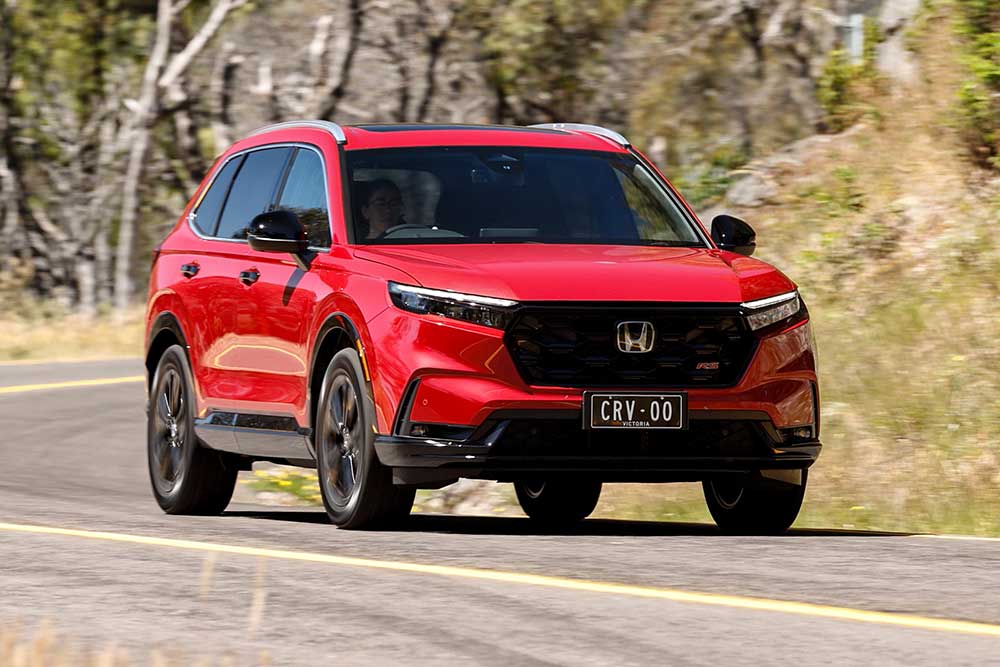
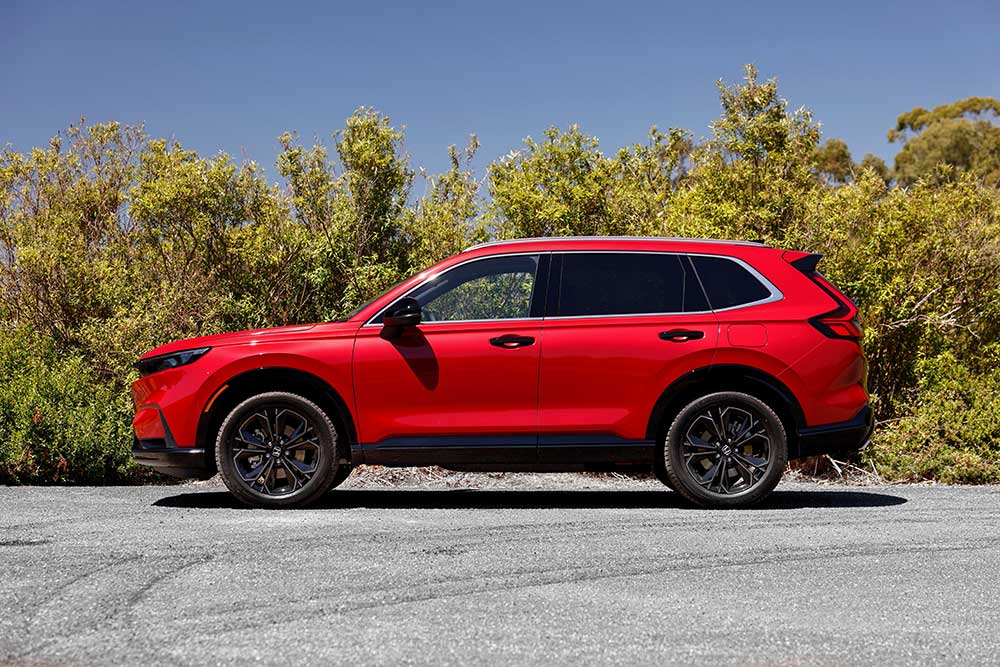
That’s okay, as the updated CR-V has given us a reason to revisit this once market-leading family SUV which still looks the part three years into its life-cycle, with nicely balanced proportions and a design that strikes a happy balance between sporty and functional.
Dimensionally, the CR-V is slightly longer, wider and taller than the benchmark Toyota RAV4, with the Honda measuring 4,704mm long, 1,866mm wide, 1,681mm high, and riding on a 2,701mm wheelbase.
This results in something of a ‘Goldilocks-sized’ vehicle, a roomy five-seater with the ability to accommodate seven in the VTi L 7 variant, but without the excess real estate of a full-sized seven-seater.
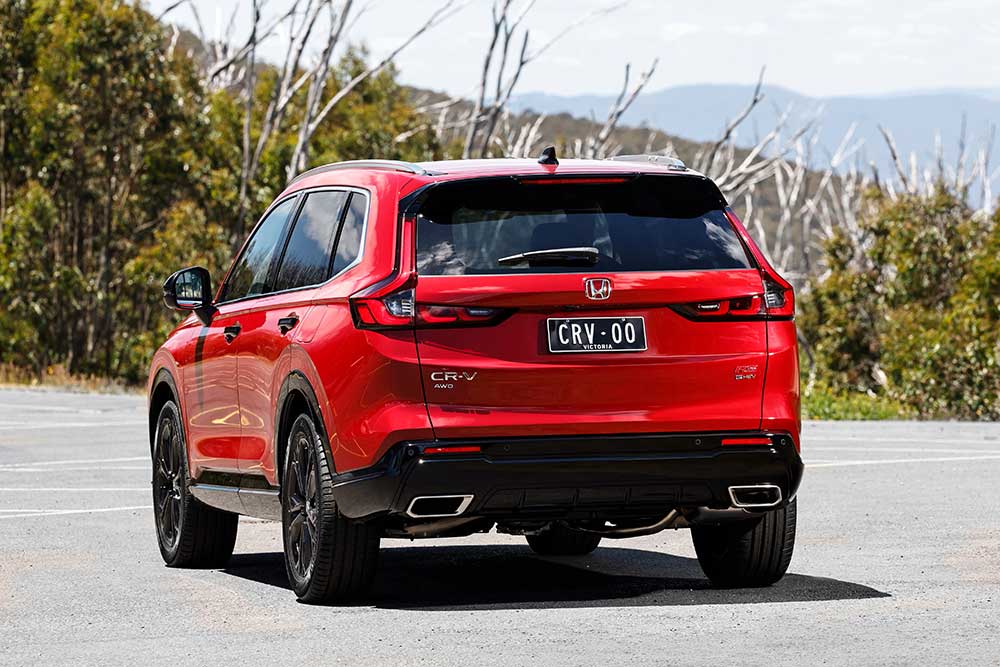
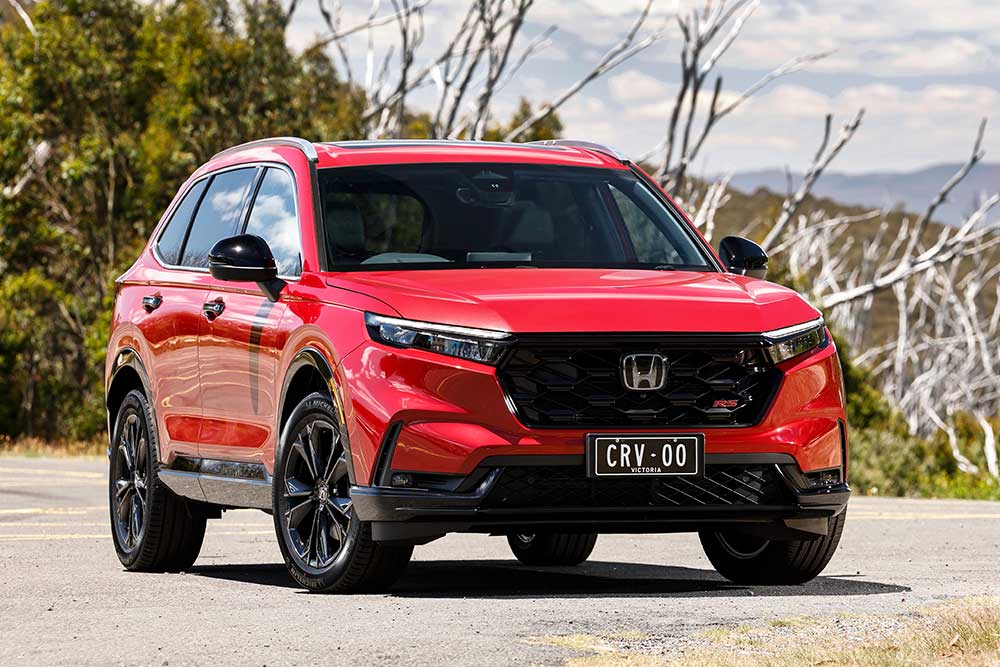
Like most of the rest of the range the e:HEV RS is a five-seater only, with an exterior design differentiated from its stablemates via a piano black diamond-pattern grille, gloss black accents on the wheelarches, lower sills, door handles and rear bumper, and unique 19-inch alloy wheels.
Honda CR-V e:HEV RS interior design, features and technology
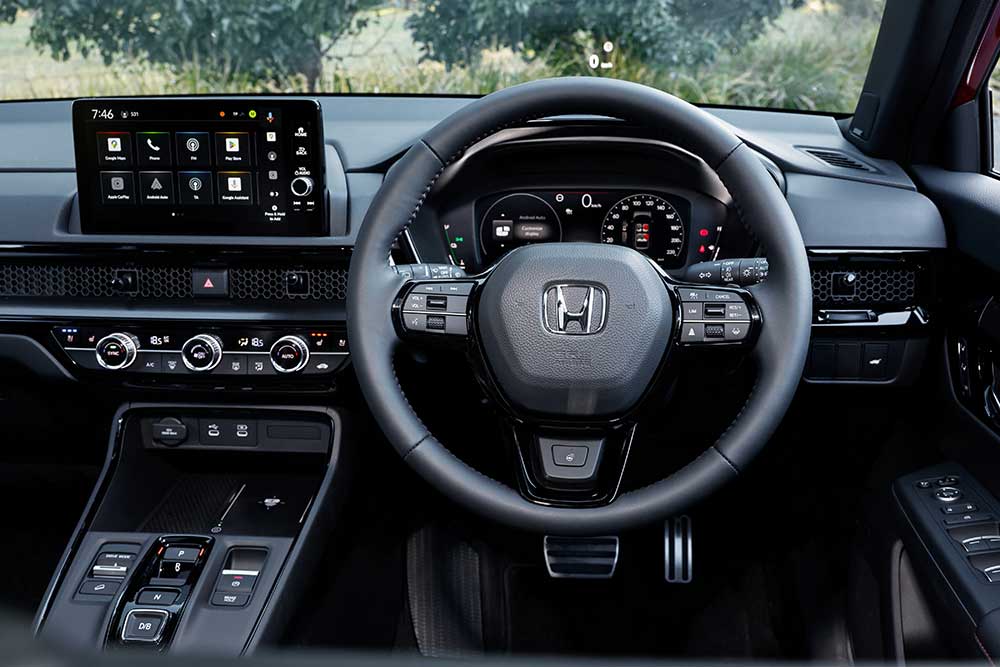
The CR-V interior is a pleasant place to be, with an attractive and sophisticated design that’s intuitively laid out and pleasingly functional.
The design incorporates an attractive mix of textures and materials including stitched leather trim, piano black, textured inserts, and a honeycomb vent design that runs the width of dash.
Honda’s decision to stick with physical switches and controls, including a trio of rotary dials for the HVAC controls, will be appreciated by drivers averse to the distraction of touchscreen-embedded alternatives.
The dash design is nonetheless clean and uncluttered, with a centrally mounted 9.0-inch touchscreen infotainment system and 10.2-inch digital driver display.
The infotainment screen supports wireless Apple CarPlay and Android Auto connectivity but also includes Google Built-In which means you can link the vehicle to your Google account and use features like Google Maps, Google Play Store, and Google Assistant without having a phone connected.
Also, standard is Honda Connect, which enables intelligent remote features such as using your smartphone to lock, unlock and start the vehicle without a physical key, and to immobilise it if required.
The system also supports an emergency call feature and automatic collision detection support.
A button-operated drive-by-wire gear selector on the console may not be to everyone’s tastes, but it’s easy enough to get used to, with the exception of when coordinating a quick shift from D to R and back to D, such as when executing a three-point turn.
Nearby is a toggle switch for selecting the Normal, Sport and Individual drive modes, and there are paddle shifts behind the steering wheel for pseudo-manual control of the CVT gearbox.
The front seats are electrically operated, with heating and cooling and are clad in an attractive perforated leather with sporty red cross-stitching and subtle black RS embossing on the seat back.
The nicely proportioned steering wheel is heated and also leather-trimmed with matching red stitch detailing.
Comfort and convenience features include a sunglass case in overhead console with integrated convex ‘parents mirror’ for keeping an eye on kids in the rear, illuminated vanity mirrors under both sun visors, USB-A and USB-C ports, a good-sized centre console bin, twin cup holders, and large door pockets with bottle holders.
Other standard features of this well-equipped model include:
- Head Up Display
- 360-degree camera system
- Dual-zone climate control
- Panoramic sunroof
- Privacy rear glass
- Red cross-stitching on the console and door armrests, and piano black finishes on the dash.
Access to the rear seats is easy thanks to doors that swing open at a wide 90 degrees.
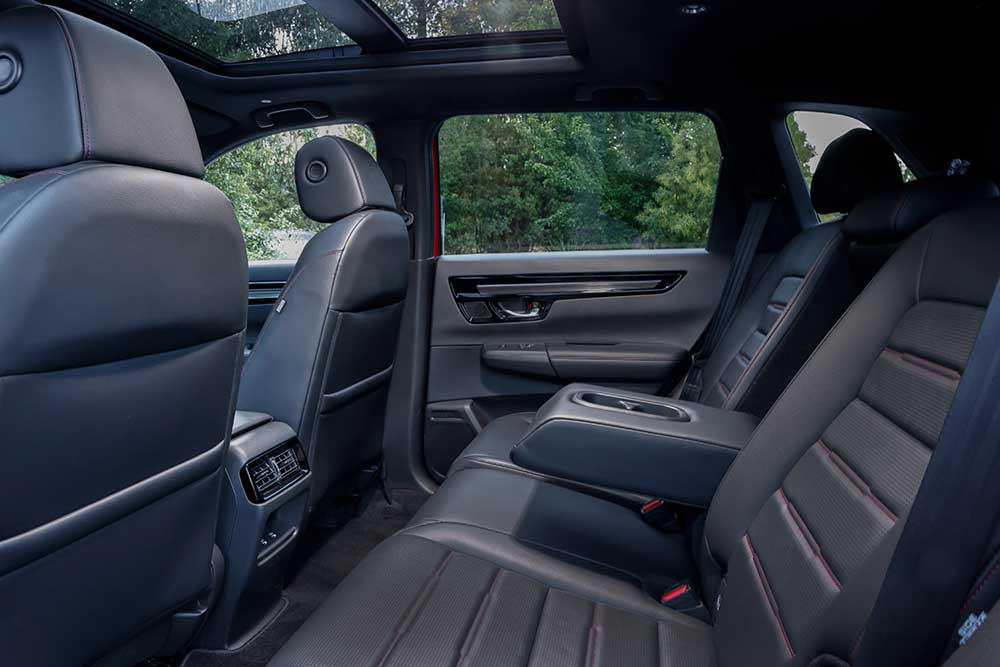
The seats are nicely shaped and comfortable with heating for the outer positions, slide and recline adjustment, a centre armrest with twin cupholders, and good headroom, legroom and foot room.
Rear-seat amenities include privacy glass, touch sensitive map lights, overhead grab handles, seatback map pockets, air vents at the rear of the console (but no temperature or fan controls), and two USB-C ports.
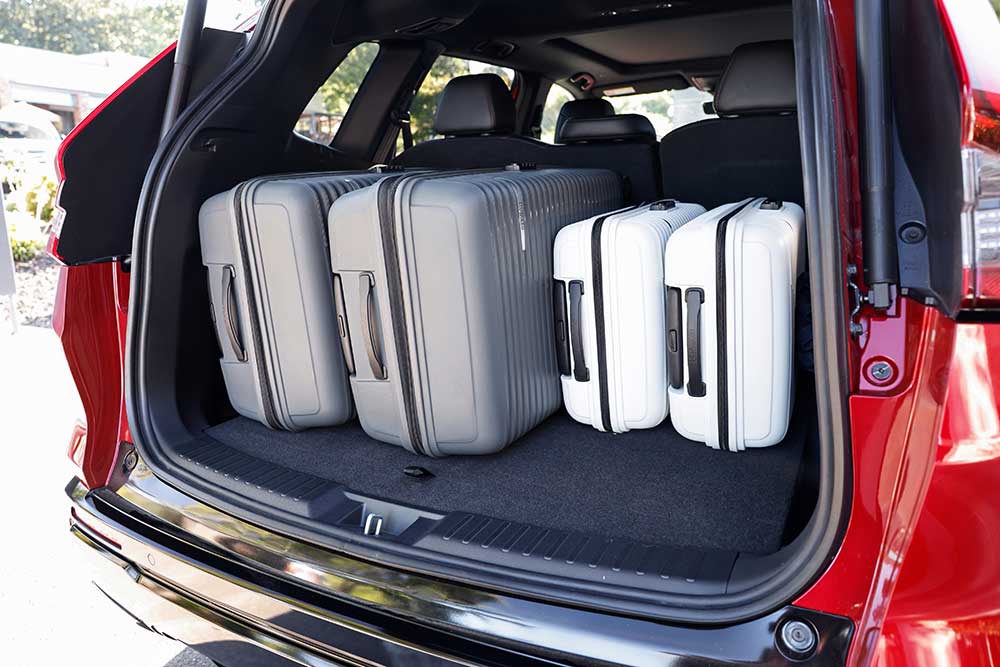
Moving further rearward you find a powered tailgate which gives access to a good-sized 581-litre boot space, expanding to 1,636 litres with seats folded, and a flat load area with extras including a 12V accessory outlet, curry hooks, tie-down points, and a cassette-style luggage blind.
Unfortunately, for a vehicle that pitches itself as being suited for buyers seeking an adventurous lifestyle there’s no spare wheel – not even a space saver – just an emergency tyre repair kit or ‘can of goo’.
The upside, if you can call it that, is that there’s a little extra underfloor storage where the spare would usually go.
The Honda CR-V’s e:HEV RS performance, engine and drivetrain
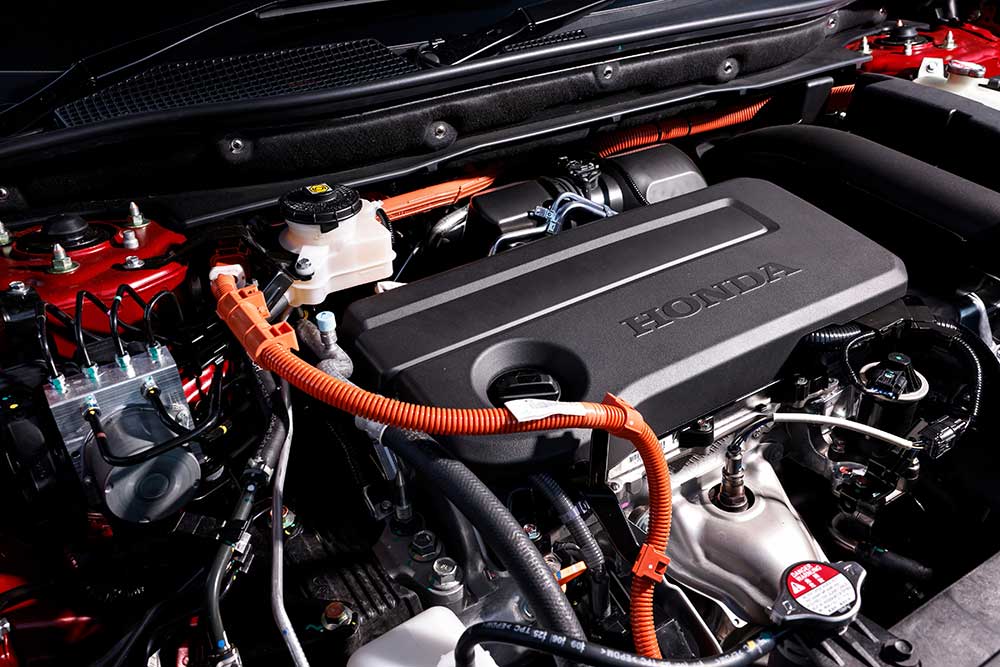
The CR-V’s performance is strong enough thanks to Honda’s e:HEV hybrid system which includes a 2.0-litre direct-injection four-cylinder petrol engine paired with two electric motors, delivering combined outputs of 135kW/335Nm.
That doesn’t sound like a lot in these days of outrageously powerful electric vehicles, but it is effective and shifts the 1828kg SUV purposefully while delivering impressively low 5.7L/100km fuel consumption, which equates to around 1,000km between fills.
We averaged a higher 8.5L/100km during a full-day test drive that covered a good mix of urban and rural driving, including an enthusiastic pedal up Victoria’s 1,433m Lake Mountain and back.
Unlike more common parallel and series hybrid systems, where the engine blends power with the electric motor to drive the wheels directly, Honda’s two-motor system uses an electric motor to drive the wheels most of the time, with the petrol engine acting primarily as a generator.
The system incorporates a traction motor and a generator motor, with the traction motor directly connected to the driveshaft and the generator motor dedicated to charging the battery pack.
This setup allows the CR-V to drive in three distinct drive modes, Electric, Hybrid and Engine, with the vehicle selecting the correct mode for the conditions; driving in electric mode at speeds up to 40km/h, and engaging the combustion engine to drive at higher speeds.
The CR-V is not primarily designed as a towing vehicle so it’s braked tow rating is limited to 750kg, which is enough to tow a small to medium trailer or a jet ski.
Honda CR-V e:HEV RS safety performance
This sixth-generation CR-V was launched in Australia in September 2023 at which time all-variants were awarded a four-star ANCAP safety rating in 2024.
ANCAP introduced new safety rating protocols in January of this year which are stricter than the previous protocols, but the CR-V hasn’t been tested to these standards so the old rating stands.
Based on the 2024 testing protocols, ANCAP scored the CR-V at 88% for Adult Occupant Protection, 88% for Child Occupant Protection, 76% for Vulnerable Road User Protection and 68% for its safety assist systems.
The safety body noted at the time that CR-Vs sold in Australia have a different safety specification to their European equivalents, including a less-sophisticated suite of active collision avoidance (ADAS) features, being fitted as they are with the Honda Sensing safety system rather than the more sophisticated Honda Sensing 360 system.
ANCAP also noted there are no top-tether anchorages for child restraints fitted to the third row in seven-seat vehicles, declaring the CR-V unsuitable for transporting young children in the third row.
That’s academic in the case of this five-seat variant but worth noting if you’re considering the seven-seat VTi X.
Standard CR-V safety equipment includes dual frontal, side chest-protecting and side head-protecting airbags, as well as driver and passenger knee airbags.
There’s also a centre airbag which provides added protection to front seat occupants in side impact crashes.
The standard driver assistance systems fitted to the CR-V are well calibrated so as to be fairly unobtrusive and include:
- Autonomous Emergency Braking (Car-to-Car, Vulnerable Road User, and Junction Assist)
- Lane support system with Lane Keep Assist (LKA)
- Lane Departure Warning (LDW)
- Emergency Lane Keeping (ELK)
- Advanced Speed Assistance Aystem (SAS).
The Honda CR-V e:HEV RS driving experience
The CR-V offers above-average driving dynamics and is an unusually engaging drive for a family SUV.
It’s well-balanced and feels secure and competent on the road.
The ride is pleasingly compliant and the steering nicely weighted and accurate, with enough feel to instil a satisfying degree of confidence when cornering.
The calibration of major controls such as steering weight and accuracy, brake pedal feel and the quality of ADAS integration are all top notch, and demonstrably better than many Chinese rivals.
And, while it may not be the first vehicle you’d necessarily think about as being sporty, the good chassis balance and strong all-wheel drive grip mean the CR-V can be pedalled enthusiastically without losing its composure.
The result is that, unlike may contemporaries, the CR-V has the band width to rise above its primary role as safe, comfortable and economical family transport to deliver traces of the sporty DNA Honda is known for.
The hybrid drivetrain combines impressively well with the CVT transmission to ensure there’s always good torque available underfoot, the 2.0-litre engine even delivering a vaguely sporty note while doing so.
Quality 235/55R19 Michelin Latitude Sport 3 tyres provide good cornering grip and low noise levels, helping the CR-V to shine as a quiet and comfortable highway cruiser with pleasingly complaint ride quality and excellent NVH.
How does the Honda CR-V e:HEV RS compare?
There’s no shortage of rivals for the Honda CR-V which sells in the highly competitive medium SUV segment against no fewer than 36 different offerings.
The hybrid-electric Toyota RAV4 is the clear segment leader with year-to-date sales as at July 2026 of 21,115 units, placing it comfortably ahead of the battery-electric BYD Sealion 7’s 15,064 sales, and the Hyundai Kona which is offered in ICE, hybrid and fully electric guise and has sold 15,228 units.
The CR-V, meanwhile has managed a less impressive 3,737 sales for the same period, but that is at least a four percent improvement on its 2025 sales.
The current Toyota RAV4 was released earlier this year so is fresher than the updated CR-V, with the new sixth-generation model lineup being Toyota’s largest and most diverse yet.
There’s a total of 11 RAV4 variants across six model grades, including a choice of hybrid and PHEV powertrains, in front- and all-wheel drive.
Prices start at $45,990 (MRLP) for the entry-level GX 2WD Hybrid and go all the way up to the flagship GR Sport AWD plug-in hybrid (PHEV) at $66,340.
Honda doesn’t offer a comparable PHEV variant, meaning the closest model to the Honda CR-V e:HEV RS is arguably the RAV4 Cruiser Hybrid, priced at $60,340 (MRLP) in AWD trim.
The BYD Sealion 7, meanwhile, is also riding a wave of popularity and is available in Premium (RWD) guise, with a single electric motor and priced from $54,990 plus on-road costs, and in dual-motor Performance (AWD) from priced from $63,990 (MRLP).
Other notable segment rivals include the Hyundai Tucson Hybrid ($42,850 to $59,850 MRLP), Kia Sportage Hybrid ($44,450 to $60,370 MRLP), Mazda CX-5 ($39,990 to $54,990 MRLP), Nissan X-Trail e-Power (from $45,990 up to $58,380 MRLP), and Subaru Forester Hybrid ($43,490 to $55,990 MRLP).
When compared with its main rival the Toyota RAV4 the CR-V feels a bit more polished, with a slightly better-quality cabin and a sportier feel to its handling and performance (with the exception of Toyota’s new GR Sport variant).
However, the Toyota offers a superior ANCAP safety rating and better fuel consumption.
Is the Honda CR-V e:HEV RS right for you?
Despite Honda’s reputation for building quality vehicles with innovative engineering at their core, the CR-V has in recent years failed to capture the public’s imagination (and purse strings) in anywhere the volume of its best-selling rival the Toyota RAV4.
Having now spent some quality time at the wheel of this updated model in a wide variety of conditions, we’re convinced that it deserves to do better.
Like many Hondas, the CR-V offers above-average driving dynamics and is an unusually engaging drive for a family SUV, with well-judged ride, steering and handling that adds to the driving experience.
The exterior design blends sporty and functional elements, while the roomy interior is attractively designed, well equipped and nicely finished.
In summary, the CR-V combines attractive design with impressive build quality, and quality calibration of key controls. It’s a sensible, pragmatic car that feels a step above the quality of many rivals in the $45-$65k medium-SUV segment.
FAQs about the 2026 Honda CR-V e:HEV RS
Are Honda CR-Vs reliable?
Honda has been selling cars in Australia for almost 60 years and has developed a reputation as a manufacturer of quality vehicles. The CR-V is a well proven model that’s now in its sixth-generation. Honda has a well-established parts distribution and national servicing network via its 87 Honda Centres.
Where are Honda CR-Vs made?
The CR-V is manufactured at Honda’s Prachinburi Plant in Thailand.
How big is a 2026 Honda CR-V?
Dimensionally, the CR-V is slightly longer, wider and taller than the benchmark Toyota RAV4, with the Honda measuring 4,704mm long, 1,866mm wide, 1,681mm high, and riding on a 2,701mm wheelbase.
Is the 2026 Honda CR-V suitable for towing?
The CR-V is not primarily designed as a towing vehicle so it’s braked tow rating is limited to 750kg, which is enough to tow a loaded small to medium trailer or a jet ski.
What engine does the 2026 Honda CR-V have?
The e:HEV RS variant is powered Honda’s clever e:HEV hybrid system which includes a 2.0-litre direct-injection four-cylinder petrol engine paired with two electric motors, delivering combined outputs of 135kW/335Nm.
Honda CR-V e:HEV RS specifications
- PRICE: $64,400 (driveaway)
- POWERTRAIN: 2.0-litre direct injection Atkinson cycle four-cylinder petrol engine, e-CVT transmission, all-wheel drive, twin electric motors (generator and propulsion), combined outputs (135kW/335Nm).
- FUEL CONSUMPTION: 5.7L/100km (132g/km CO2)
- ANCAP SAFETY RATING: Four stars (2024)
- WARRANTY: Five years/unlimited kilometres (or eight years/unlimited kilometres with Honda Extend, if serviced with Honda)
- FOR: Attractive exterior design; functional and roomy interior; quality finishes; above-average driving dynamics; hybrid technology now available at a lower price point; good fuel efficiency.
- AGAINST: More expensive than most rivals; fixed-price sales model may deter some buyers; four-star ANCAP safety rating; no spare wheel (inflation kit).


More articles
Related topics
Things to note
The information in this article has been prepared for general information purposes only and is not intended as legal advice or specific advice to any particular person. Any advice contained in the document is general advice, not intended as legal advice or professional advice and does not take into account any person’s particular circumstances. Before acting on anything based on this advice you should consider its appropriateness to you, having regard to your objectives and needs.
Insurance Products (excluding Travel Insurance) are issued by RACQ Insurance Limited ABN 50 009 704 152 (RACQI) and arranged by RACQ Distribution Services Pty Ltd (RDS) ABN 35 116 361 650, AFSL 567130 and RDS' authorised representatives (including RACQ Operations Pty Ltd ABN 80 009 663 414, AR No. 234978 (RACQO)). Conditions, limits and exclusions apply.
Any advice provided by RDS and RACQO is general advice only and does not take into account your personal objectives, financial situation or needs and you will need to consider whether the advice is appropriate for you. Read the Product Disclosure Statement (PDS) before making a purchase decision on the product. You can also access our Target Market Determinations on this website.
RDS receives a commission from RACQI for the policies it arranges. RACQO receives fees paid for services it provides to RDS. Further details about remuneration are available on request prior to purchasing.
Banking and loan products issued by Members Banking Group Limited ABN 83 087 651 054 AFSL/Australian credit licence 241195 trading as RACQ Bank. Terms, conditions, fees, charges and lending policies apply. This is general advice only and may not be right for you. This information does not take your personal objectives, circumstances or needs into account. Read the disclosure documents for your selected product or service, including the Financial Services Guide and the Terms and Conditions, and consider if appropriate for you before deciding.
Except for RACQ Bank, any RACQ entity referred to on this page is not an authorised deposit-taking institution for the purposes of the Banking Act 1959 (Cth). That entity’s obligations do not represent deposits or other liabilities of RACQ Bank. RACQ Bank does not guarantee or otherwise provide assurance in respect of the obligations of that entity, unless noted otherwise.
RACQ Bank subscribes to the Customer Owned Banking Code of Practice which establishes higher standards than the law requires. The Code reflects modern consumer expectations and developments in approaches to issues such as consumer vulnerability, guarantors, and supporting customers through financial hardship. Please read our Customer Owned Banking Code of Practice page for more information.
RACQ Operations Pty Ltd (ABN 80 009 663 414, AR No. 234978) and Members Travel Group Pty Ltd (ABN 45 144 538 803, AR No.432492) (RACQ) are authorised representatives of the RACQ Travel Insurance insurer Tokio Marine & Nichido Fire Insurance Co., Ltd. (ABN 80 000 438 291 AFSL 246 548) (Tokio Marine). Tokio Marine Management (Australasia) Pty Ltd (ABN 69 001 488 455, AR No. 1313066) is an authorised representative of Tokio Marine, and administers RACQ Travel Insurance as the managing agent on behalf of Tokio Marine. Terms, conditions (including eligibility criteria), exclusions, limits and sub-limits apply. Any advice is general advice only, and does not take into account your specific objectives, financial situation or needs. Before you purchase, please consider the Combined Product Disclosure Statement (PDS) / Financial Services Guide (FSG) and Target Market Determinations (TMDs) available at racq.com or on request from RACQ.